
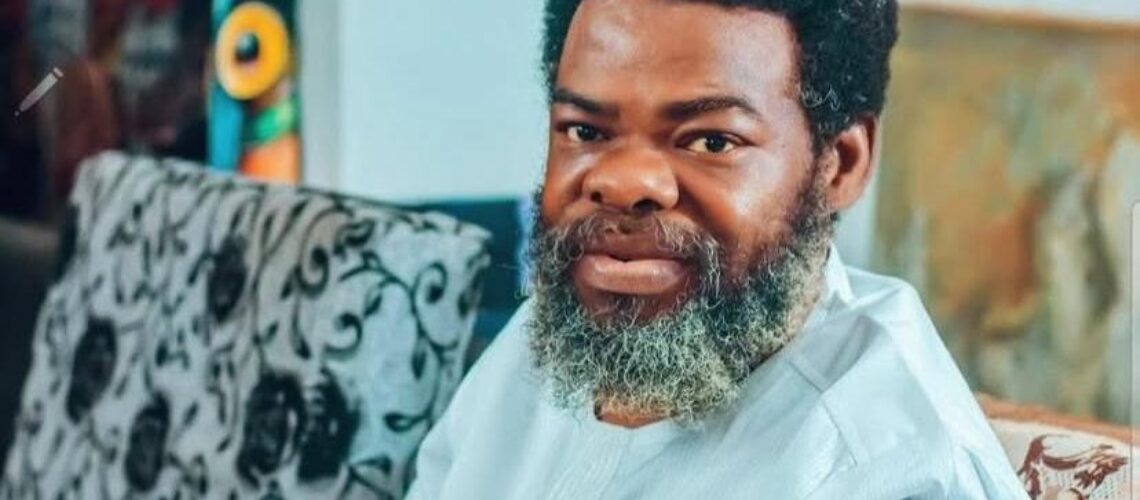
You may have heard many beliefs or Eurocentric perspectives about Yoruba wood carvings, but Yinka Fabayo’s work tells a different story. His carvings were artistic expressions meant for environmental and home beautification, and in contemporary times, as investments for the future. To him, art was a means of appreciating Yoruba culture and preserving its traditions. Though we lost him to death on July 15, 2025, at age 59, his works continue to speak to the world, testifying to Yoruba artistic intelligence and his mastery of wood carving and painting. Many of these masterpieces remain accessible to us at his Genesis Art Gallery in Osogbo, Osun State, Nigeria.
Through Yinka Fabayo, we learn that art is a life of its own and a viable career that deserves our encouragement and support so that those who pursue it can thrive and achieve greatness.
The Accidental Artist
Born on February 14, 1966, in Ila-Orangun, Osun State, Adeyinka Fabayo’s journey to becoming one of Yoruba’s most celebrated wood carvers began not with grand ambition, but with a chance encounter during a rainstorm. The second child in his family, young Yinka had dreams far removed from the artistic path that would eventually define his life. He wanted to become an estate agent, had passed his JAMB examination for Environmental Design at the University of Ife, but fate, and a disappointing WAEC result, had other plans.
The turning point came on an ordinary day that would prove extraordinary. Caught in the rain, Fabayo sought shelter in a friend’s house. What began as casual banter about eyeglasses and wipers evolved into a friendship that would awaken dormant talents within him. When his friend showed him artwork during a subsequent visit, something stirred in Fabayo’s soul, a reminder of abilities he had long neglected. From that moment, he began painting again, working quietly from home, unaware that this was the beginning of a legacy that would span continents and generations.
Family Opposition Forged an Artist
What followed was perhaps the most defining period of Fabayo’s life, a test of conviction that would have broken lesser spirits. His parents, devastated by his shift from university aspirations to artistic pursuits, took drastic measures. They destroyed his paintings, enlisted a teacher-uncle to discourage him, and even packed his clothes out of the house. Yet in the face of this crushing opposition, Fabayo displayed remarkable resilience.
Reflecting on this period, he recalled:
“Despite all the discouragement, I continued drawing and painting with determination.”
Rather than eating at home, he requested money for food, saving it instead to buy pencils, paper, and art materials. This was the burning fire of desire of a man who had discovered his calling and refused to let it be extinguished.
His vindication came at the Osun State College of Education in Ila-Orangun, where he studied Fine Arts Education from 1987 to 1990. Despite being advised to study Music Education, he insisted on Fine Arts and earned an A3 grade in the subject, something he hadn’t achieved even in secondary school. This academic success was more than a grade; it was confirmation that he had chosen the right path. At the college, he learned sculpture from Dr. Akintonde and graphics from Baba Areo, building the technical foundation that would support his future masterpieces.
Education and the Birth of Genesis
Fabayo’s artistic education didn’t end at the College of Education. His encounter with Ogoyemi Awani, who taught him painting techniques, marked the beginning of greater things. He would later sharpen his skills at South Essex College of Arts and Technology in the United Kingdom, specializing in contemporary oil painting. This international exposure enriched his perspective, allowing him to blend contemporary techniques with traditional Yoruba aesthetics.
In 1990, the same year he graduated, Fabayo founded Genesis Arts Gallery in Ila-Orangun. By 2000, he had relocated it to Osogbo, where it would become a three-story monument to African art and culture. The gallery wasn’t just a business venture, it was a statement of belief, a physical manifestation of his commitment to art as a store of value and cultural preservation.
Speaking about his motivation, Fabayo once said:
“My passion to call attention to the import and importance of art works in Nigeria and particularly in Osogbo”
drove everything he did. The gallery became more than walls and exhibitions; it became a household name in Nigerian contemporary art, eventually recognized as one of Osogbo’s major tourist attractions and commissioned by former Governor Rauf Aregbesola.
Demystifying Art and Embracing Culture
Fabayo’s artistic philosophy was revolutionary in its simplicity and clarity. In a society where wood carvings and sculptures were often viewed with suspicion—associated with spiritualism or fetishism—he stood as a counter-narrative. As a devout Christian, he addressed these misconceptions directly:
“I am a Christian, and there is nothing spiritual or fetish about my carvings—they are purely artistic expressions… The carvings I make are not tied to any rituals, as some believe; they are works meant for home and environmental beautification, preservation, and future auctioning to generate value.”
This demystification of art was perhaps one of his greatest contributions to Nigerian society. By clearly articulating that his work was about expression, cultural preservation, and aesthetic value rather than spiritual manipulation, he opened doors for others to appreciate Yoruba art without fear or misunderstanding.
His work was a deliberate blend of contemporary techniques and the Osogbo School of Art, characterized by Africanized forms and what he called the “waste to wealth” mantra, the belief that no material is wasted but rather transformed into beautiful art. His sculptures told stories: a father nurturing children from childhood to adulthood, a Yoruba king (Oba) demonstrating responsibility to his people, a responsible husband whose wife prays for his safe return. Each piece was laden with meaning, teaching values and showcasing Yoruba traditions that were slipping into extinction.
Preserving What Was Being Lost
As wood carving became an increasingly rare occupation in Yorubaland, Fabayo emerged as both practitioner and advocate. He understood that in an era where young people saw no career prospects in art, someone needed to demonstrate not just that art was viable, but that it was vital. His work reflected Yoruba culture and lifestyle, particularly traditions facing extinction, serving as visual archives for future generations.
He described himself as
“an unrepentant activist of artistic, cultural and social activism in Nigeria.”
This wasn’t hollow rhetoric, it was lived reality. Through workshops and community engagement programs, he bridged generational knowledge gaps, becoming a passionate educator deeply committed to nurturing young talents. His art graced exhibitions across Africa, Asia, and Europe, with collectors in the United States, France, Germany, Poland, and Equatorial Guinea. Yet he often kept many pieces for personal reflection, understanding that art’s value wasn’t always monetary.
His membership in organizations including the Nigeria Association of Visual Artists, Confederation of Osun State Professional Artists, Africa Creative Minds, Nigeria Museum Society, Creative Clusters (UK), and the American Society for Arts demonstrated his commitment to professional development and collective advancement of Nigerian visual arts.
The Man Behind the Masterpieces
Those who knew Fabayo intimately speak not just of his artistic prowess but of his character. Dr. Mudiare Onobrakpeya, son of iconic artist Professor Bruce Onobrakpeya, captured this beautifully:
“Adeyinka was a man of integrity and purpose. He lived for his craft and the community, and year after year, he would travel from Osogbo to Lagos to attend the Art Expo Nigeria… He never came for applause or fame, but because he believed deeply in standing with his fellow artists and advancing the cause of Nigerian visual art.”
Professor Bruce Onobrakpeya himself remembered Fabayo as a son:
“As a carver, he had gifted hands, because his pieces always carried a spirit that spoke beyond the surface. But more than his talent, it was his dedication and loyalty that I will always remember.”
Colleagues from the Art Galleries Association of Nigeria (AGAN) praised his
“quiet strength and steadfast dedication,” while Dotun Popoola recalled his signature welcome—”a heavy punch to my shoulder, a squeeze deep handshake, followed by a warm smile and an unforgettable hug.”
This warmth, humility, and discipline defined Fabayo’s interactions. He was soft-spoken but strong, reserved but radiant with purpose. He never needed to announce himself—his work and way of being did that for him.
The Cost of Commitment: Sacrifice and Vindication
Fabayo’s total commitment to art came at personal cost. He turned down job offers abroad, causing friction with his wife who struggled to understand his unwavering dedication. Yet he remained resolute, believing that the career required
“patience and endurance, but once you stay true to it, you will never regret it.”
The vindication was sweet. The same uncle who had once destroyed his artworks later visited Genesis Gallery and, seeing all Fabayo had created, was amazed and thanked God that he hadn’t succeeded in destroying his nephew’s destiny. His late mother was always proud, and his father defended him against relatives who claimed artists were lazy, asserting that it took intelligence, hard work, and creativity to produce such paintings and carvings.
To young people contemplating artistic careers, Fabayo’s message was unequivocal:
“If you go into art, you can never go wrong. Art is expressive and liberating; it helps you release your emotions and reduces stress… I have devoted over thirty years of my life to art, and by the grace of God, I have no regrets.”
Legacy Carved in Wood and Wisdom
When Adeyinka Fabayo passed away on July 15, 2025, at age 59, he left behind more than sculptures and paintings. He left a roadmap for cultural preservation, proof that art is investment and expression rather than superstition, and inspiration for a generation of artists who watched him journey from Osogbo to Lagos year after year, not for fame but for fellowship and collective advancement.
His Genesis Art Gallery stands in Osogbo as his gift to Yoruba people and art lovers everywhere, a three-story testament to what one person with vision, determination, and humility can build. The gallery’s collection, ranging from pencil sketches to batiks, metal sculptures to wood carvings, represents not just artistic diversity but the fullness of a life lived in service to culture and community.
As Femi Coker noted in tribute:
“His creativity knew no bounds and his presence radiated warmth and friendship. A true friend and visionary, he inspired many through his art and life.”
In an era when Nigerian art is experiencing global revival, Fabayo was at the forefront, Africanising his work and reflecting unique Yoruba culture through every carved piece. His belief in unity, peace, and development through art wasn’t abstract philosophy—it was his daily practice. “Unity in diversity, peace in Africa, peace in the world,” he preached through his work, understanding that where there is conflict and war, there can be no development.
Adeyinka Fabayo proved that sometimes the greatest legacies begin with rejection, are forged in opposition, and are ultimately defined not by applause but by the quiet commitment to stand with others and advance a cause greater than oneself. He carved not just wood but history, and in doing so, ensured that Yoruba culture and traditions would continue speaking to generations yet unborn.