
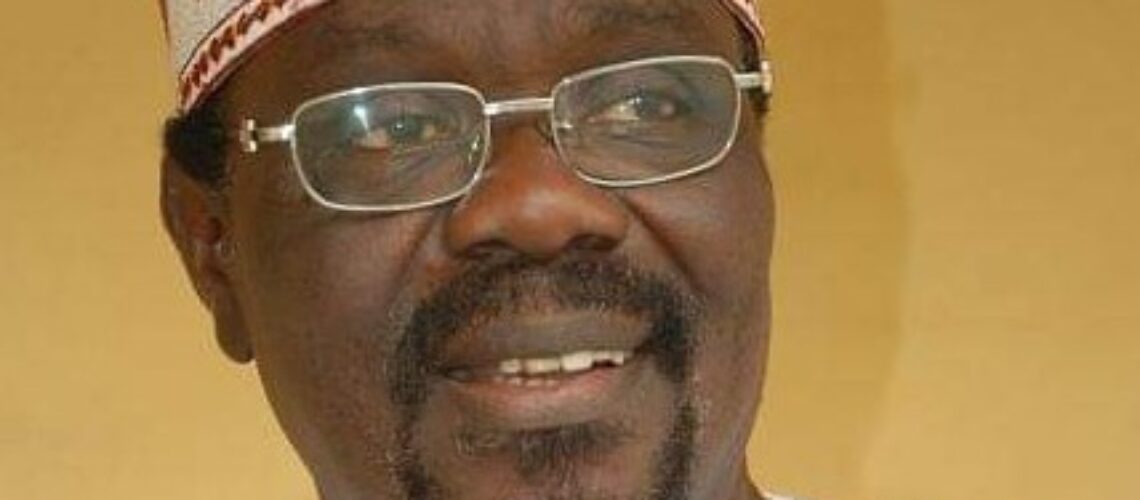
Tola Adeniyi was born May 29 1945 into a devout Muslim family in Ago-Iwoye, Ogun state. His early exposure to Quranic education laid the foundation for his lifelong passion for mass communication, influencing his career path and sparking his interest in oral poetry.
As he entered primary school, Tola Adeniyi’s talent for communication took center stage when he became an actor, participating in plays showcased at the Western Region Festival of Arts. This early involvement in theater was instrumental in shaping his communication skills and creativity.
The year 1959 marked a significant turning point as he enrolled in Ijebu Muslim College for secondary education. Driven by a compelling impulse, he established the “Young Journalists Club,” a precursor to his formal journalistic pursuits. This club served as the launching pad for his future career, earning him the esteemed title of “School Reporter.” He embraced the role, delivering highly anticipated “Week in Review” sessions in the school hall every weekend.
As he continued to ascend, Chief Tola Adeniyi took on the role of Editor of the school’s magazine, “The Spartan,” and eventually assumed the prestigious position of Editor-in-Chief during his Form V years. These responsibilities deepened his editorial skills and commitment to effective communication.
His journey extended to Yoruba poetry on Radio Nigeria, where his recited poems played a pivotal role in the creation of the first Yoruba Poetry book, “Aye Ode Oni.” The influence of his Quranic education and early experiences in oral poetry was evident in his work.
Entering the realm of higher education brought new opportunities for intellectual growth and communication. In 1966, Tola Adeniyi established the University of Ibadan Writers Club, setting the stage for like-minded colleagues to join him on his journey. This period also saw him assume the role of “Information and Cultural Officer” at the Ministry of Information in Ibadan, accompanied by contributions to renowned publications such as Sam Amuka’s Sunday Times, Oseni’s Sunday Sketch, and Uche Chukwumerije’s Afriscope.
His dedication and commitment bore fruit when he graduated with a B.A. Hons in English in 1969, marking a significant milestone in his educational journey. He continued to pursue knowledge, acquiring degrees, certificates, and diplomas from institutions such as the TESOL Institute Calgary (2001), United Newspapers UK (1975/76), and Lancaster University UK (TESOL, 1977/78), among others.
Chief Tola Adeniyi’s ventures extended beyond traditional journalism into music and play reviews, fostering connections with iconic figures like Fela Anikulapo Kuti. The pinnacle of this phase arrived with the launch of his book of poetry, “Soul Fire,” in January 1974, solidifying his status as a distinguished author and communicator.
Embarking on his professional career, Tola Adeniyi held notable positions at Times Journalism Institute and the Sketch, where he served as Deputy Managing Director. However, his editorial prowess truly shone during his tenure as Editor-in-Chief of the Nigerian Tribune from 1978 to 1980. His leadership extended to the helm of the Daily Times of Nigeria Plc, where he held the position of Chairman and CEO in 1992-1993.
Chief Tola Adeniyi’s commitment to community development was evident through his involvement in various organizations and committees. He became a member of the Nigerian Institute of Management in 1976 and the Association of Retired Federal Permanent Secretaries in 2005. His affiliations also included membership in the Nigerian Union of Journalists since 1973, the International Press Institute since 1991, and a Fellowship with the Association of Commonwealth Journalists since 1992.
Cultivating and celebrating Nigerian culture remained a cornerstone of Adeniyi’s contributions. He served on the Research Committee of the National Arts Council from 1970 to 1975, founded the National Cultural Revolution Movement in 1971, and led the Black Nationalists Movement in the same year. His influence extended to the Oyo State Governing Council for Arts and Culture from 1980 to 1983, as well as his role as Chairman of the Board of Governors at Ago-Iwoye Secondary School from 1977 to 1979.
A significant turning point in Tola Adeniyi’s journey emerged when he joined the Daily Times. Remarkably, within just four months, he rose to the position of Regional Editor, overseeing the newspaper’s operations throughout Western Nigeria. This role provided opportunities to engage with influential figures and further honed his communication skills. Simultaneously, he began writing articles for the Sunday Times, expanding his influence and profile.
During a period of military rule, Tola Adeniyi’s journalistic exploits retained a degree of autonomy and integrity. Unlike the challenges faced in contemporary civilian rule, he remained largely unswayed by politicians. This resilience was partly attributed to the absence of widespread bribery and influence-peddling that characterizes modern civilian administrations. While politicians sought favor and publicity, military governors were less concerned with such pursuits, allowing journalists like Adeniyi to uphold professionalism and dedication to their craft.
Tola Adeniyi’s commitment to responsible journalism and advocacy became evident as he criticized the inhumane maladministration of the Abacha regime. His unwavering determination to expose the truth led to a dramatic turn of events when he was whisked out of the country by concerned friends who could not bear to see him endure the oppressive regime who had declared him wanted. Throughout his career, he championed causes. For instance, his advocacy through his column in newspaper championed the cause for the construction of the Ikorudu overhead bridge in Lagos and exposing irregularities in contracts by politicians in government.
Notably, Tola Adeniyi experiences working under the leadership of Chief Obafemi Awolowo at the Tribune was highly recognised. While he lauded Awolowo for his hands-off approach to editorial policy, which allowed journalists to boldly cover stories, even those involving the ruling party, Adeniyi fondly remembered an occasion when Awolowo hosted a dinner in his honor, highlighting the value placed on his contributions to journalism. In addition, his dedication to the principles of good governance and democracy were recognized by past President Muhammadu Buhari when he congratulated Adeniyi on his 75th birthday, acknowledging him as a pillar of advocacy for democracy and good governance.
Beyond his remarkable career in journalism, Tola Adeniyi’s entrepreneurial spirit led him to become the Chairman and CEO of Gemini (W.A.) Ltd. He continued his foray into the world of commerce, serving as Chairman of the Canada-Nigeria Chamber of Commerce since 1996 and founding the Canada Africa Chamber of Commerce in the same year. His commitment to nurturing talent and promoting cultural exchange remained unwavering, evident through his membership in The Writers Union of Canada since 1996 and his affiliation with the Association of Nigerian Authors since 1985.
Tola Adeniyi’s literary talents were widely recognized, and he authored several impactful works, including “Teenagers Must Repent” (1964), “Aye Ode Oni” (1964), “Soul Fire” (1974), “The Lunatic” (1976), “Nigerian Professionals” (1985), “The Jewel” (a biography of Chief Mrs. HID Awolowo), “Theatre On Wheels” (1997), “Deaths in the Thighs” (2001), and “IN THE BELLY OF VULTURES” (2018). These works showcased his ability to address critical societal issues through literature.
In addition to his literary contributions, Tola Adeniyi’s thought-provoking papers and speeches delved into pressing societal matters. He tackled topics such as indiscipline, corruption, women’s potential, the role of writers, the politics of language, and social challenges. His writings and speeches reflected a deep commitment to exploring complex issues and sparking meaningful dialogue.
In conclusion, Tola Adeniyi’s remarkable journey through life and communication is a testament to his unwavering dedication, creativity, and leadership. From his early years in Quranic education to his illustrious career in journalism, literature, and commerce, he has left an indelible mark on Nigerian society. His legacy continues to inspire generations, highlighting the transformative power of effective communication, responsible journalism, and advocacy for good governance and democracy. His pen wields greater power than the sword and he remain the general of the fourth estate.
Reference
I was the first to adapt Things Fall Apart into TV, stage play —Chief Tola Adeniyi
Chief Tola Adeniyi’s book, “In The Belly of Vultures,” launches March 1st