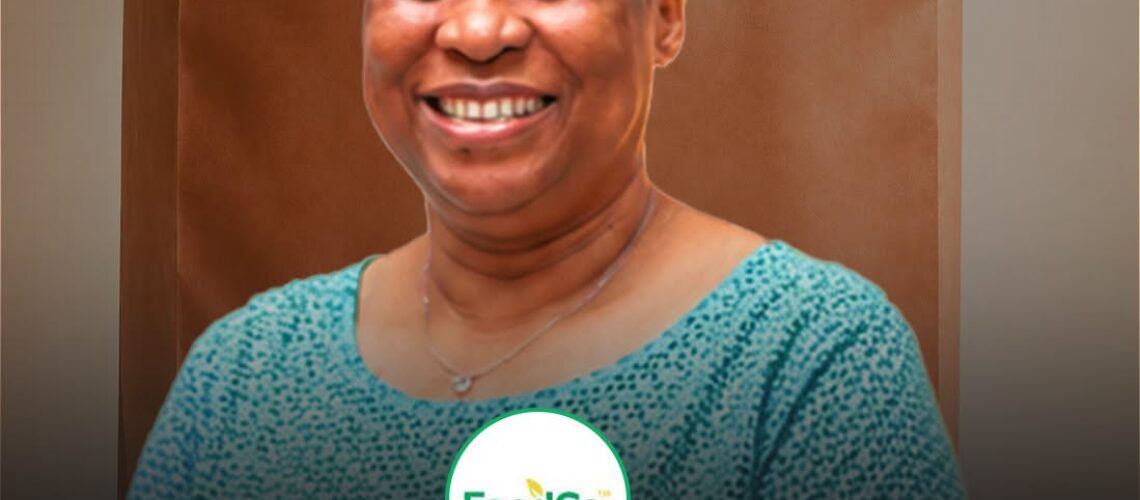
- Sola Sun-Basorun built FoodCo three times. The first attempt closed in under two years. The second grew to five outlets, then shrank to one. The third began in 2006 with a single shop in Bodija, Ibadan, and today runs more than twenty stores across Oyo, Ogun and Lagos States.
That arc is why Akinkanju turns to her this week. She is a biologist and librarian by training, a mother of two sons, a children’s minister of more than three decades, and the founder and chairman of one of the largest indigenous retail chains in southwest Nigeria. She is also a living lesson in the Omoluabi virtues of discipline, daring, and perseverance. Her own summary of the lesson is plain:
“You are not a failure until you declare yourself a failure. Every time you fail is an opportunity to learn what not to do.”
1970s: A Large Family, an Early Faith, a Stubborn Dream
She was born in 1954 in Ilesa, in present-day Osun State, into a very large family, with a father who still checked each morning that every child had brushed their teeth. She gave her life to Christ at about 12, and she credits that early faith with giving her an intimate sense of a father she could relate to, in a house where intimacy was stretched thin.
She moved to Ibadan for secondary school at Queen’s School, in the capital of the booming Western Region. Her first exposure to a supermarket came on a trip to Ile-Ife, and Ibadan itself had several international retail names, among them Leventis, UAC and Kingsway stores. Her father also took her on a trip to the United Kingdom, where she visited stores such as Tesco, Sainsbury’s, and Asda. He hoped she would become a medical doctor. What she had developed, from the shops she saw and the city around her, was an interest in business.
Her ambition arrived just as early. When it came time to choose subjects in secondary school, she took all the sciences and all the arts. Her principal asked what she was planning. She answered that she wanted to run a supermarket, and the principal threatened to report her to her father. She remembers knowing from early on what she wanted to do: “I was saying it in my heart that I want to do it.” Given a single arts subject to keep, she held on to the sciences she loved.
She earned a bachelor’s degree in Biology Education at the University of Ife, now Obafemi Awolowo University, added an elective in library studies because she loved reading, and went on to a Master of Library Studies at the University of Ibadan. There she was recruited as a librarian, and she took the post for a deliberate reason: to learn how organisations run and how people are led. In her book she writes:
“Working as a librarian in UI provided a solid foundation and gave me some experience as well as skills that would serve me well when I started my business.”
The dream and the apprenticeship were separate tracks, and she ran both.
“I did not have rivers. I depended on rain from God.”
1981–1983: Seven Years at the Library, One Maternity Leave
She spent seven years at the University of Ibadan, and she started FoodCo while still employed there, on maternity leave with her first baby, at about 25. The account read at a recent event dates the start to 1981: wedding gifts worth ₦12,500 went into freezers and a bus, and she began selling fresh vegetables and meat. She herself dates FoodCo to 1982.
The idea came from watching people. She hated the muddy, dirty markets. A neighbour, an American married to a Nigerian, went to a local meat market and was too sickened to eat for a week. Civil servants wanted quarter-cows when a whole cow cost about ₦14,000. So the first store, called Fresh Food, sold vegetables, blended and packed pepper, and cuts of slaughtered cow by the kilo.
Then it faltered. Complications at delivery kept her away from the store for weeks. When she returned, the girl she had hired was opening late and locking up early, timing her routine. Sales had collapsed, and within one or two years the first FoodCo closed. She keeps the lesson from that episode:
“Business starts from ideas… open your eyes, look at what’s going on around you. What do people need?”
1984–2010: The Second Generation, the Fall and the Rebuild
After a year’s break she saw a vacant space in a new building on Bodija’s market road, and the second FoodCo opened around 1984 as a full supermarket. By the time the shelves were fitted and the rent paid, the couple had no money left. Her husband, a medical doctor, went with her to Union Bank, where the manager asked for collateral. She had never heard the word. Her salary was her only security, so the bank lent ₦5,000. They joked that it was a bread supermarket, because her sister’s bakery supplied most of what they sold, and she carried loaves in before work and again at break time.
The name came from a trip to the United States. She saw a company with “co” in its name, liked it, and decided that since they were selling food, theirs would be Food and Co. She adds, with a smile, that other FoodCos now exist on several continents but hers is the oldest.
By the late 1990s there were five outlets. Then the income stopped covering the bills. A loan of ₦2 million ended up costing ₦10 million to repay. From 2001 to 2006 she closed every branch except Bodija. In her words, some mornings she did not want to get out of bed, and her youngest son, then about 13, would sit by her and repeat a verse until she did.
She stopped blaming witchcraft and went looking for structure. Her eldest son had started university in 2000 and pointed her to a book on why people work hard but their businesses do not. She read it, then read more. The business had no structure, so she built organograms and written standard operating procedures for every process, from the recipe for a pot of rice to the way a customer is greeted. In 2006 she began again with one outlet. A second opened in Jericho in 2010. She calls what stands today the third generation of FoodCo.
“In 2006, we started from ground zero again with one outlet and then we started building slowly one more time.”
2017–2020: A Son Comes Home
Both her sons grew up in the business, even though they had studied electrical engineering before going on to bag MBAs. The elder, Ade, had four job offers on graduation and took the lowest-paying because it came with a mentorship programme, at General Electric. For years he asked to join FoodCo. She told him to stay out and learn how other businesses work, so that he would add more value when he finally came.
In 2017, Ade called out of the blue and asked, “Mommy, is Daddy there?” She knew from the question that he had something to say. He asked them to put him on speaker and then told them he had already resigned and was coming to join FoodCo. His father, who chaired the board, was angry. For years the couple had told their son to stay away and learn elsewhere, and now he had quit the good job without asking.
He flew into Nigeria and landed in Lagos. The next day his father died. Ade had not yet reached Ibadan, so it was his mother who had to call him with the news:
“You have to come. Your dad has just died.”
Her son, Ade, who had arrived expecting to learn a family business, now found a household in mourning and a company that had lost its chairman. She stepped into her husband’s chair as chairman of the board while still serving as managing director, and she was in no state to lead.
“I was just useless,” she says. “I couldn’t even think straight… I couldn’t hold a thought for 2 minutes. My brain just went to sleep.”
The role he had joined to take, executive director, became in practice the job of keeping the company running. In her words:
“He was the one that took over and steered us through that year.”
That year of loss bound mother and son together, but it did not make them agree on how to run the business. The two clashed, as a mother and a son with different instincts will.
In July 2020, after a six-month transition, she handed him the role of managing director and became chairman of the board. He asks for advice when he wants it. She keeps her opinion to herself otherwise: “It’s your show. Run it.” Her view of his generation is generous: they went to business school, worked in global firms, and know more about running a business than she does, while she knows the Nigerian retail terrain.
The numbers since the handover tell the rest. The chain grew from 11 stores in 2020 to 22 by September 2025, with a 23rd due. It opened its first outlet outside Ibadan, in Lekki, Lagos, and followed with a Lagos mainland store and three stores in Abeokuta. It added a games arcade and restaurants under one roof, online shopping, and its own Sunfresh bread and ice cream. Ade describes the pitch for the new market in four words: “Lagos Life, Ibadan Price.”
“We are a patient company… We are thinking about long-term increment. We are not in a hurry.” — Ade Sun-Basorun
October: A Book Written by the Team
The latest milestone is a book, The FoodCo Story, which was due out in October. Her name is on the cover as author, but she is careful to say who really wrote it. Staff who worked in the business each wrote their own chapter on what they did and how they experienced FoodCo. The choice follows from a value she has preached for decades: teamwork, because “there is no island there.”
“My name is the author but if you look in the book, it’s everybody wrote their own story of what they did, how they experienced the business.”
Recognition has come to the company as well as to her. The profile read when she was introduced to a church audience lists several national honours, among them retail company of the year and multigenerational company of the year. Her son’s interview with How We Made It in Africa adds a ranking by the Financial Times among Africa’s fastest-growing companies. She was also praised for handing over the managing director’s role in 2020, noting that many founders hold on to the post for life.
Today: The Chain That Outlasted the Giants
FoodCo has now operated for more than 40 years, and its chief executive notes that in that time “we’ve witnessed numerous local and foreign players enter and exit the market.” FoodCo outlasted them and is now expanding from Ibadan into Lagos and Ogun with a plan to reach underserved communities across the southwest.
Her own account of why it lasted is not about capital. It is about the failures. The first closure taught her to watch the shop and the people in it. The second taught her that a business needs structure, written standards, controls against theft and wastage, and the discipline to borrow only what it can repay. FoodCo has no outside investors today and grows on retained profit and carefully sized debt. She still draws a salary, not a share of the till, because “food money was not our money.” Her son adds the other half: keep costs tight, keep managing risk, and
“keep listening to our ultimate boss, the consumer.”
The customer-as-boss idea has been there since the second FoodCo, when a poster of a lion hung in the store above the words “the customer is boss.” Every FoodCo meeting still ends with a chant that finishes on the same line.
She is no longer in the business day-to-day. Passing a store, she says, she stays in the car and sends the driver in, so that she does not interfere. Outside it she runs Olive Tenders, a non-profit ministry whose Salt and Light camp for teenagers has run for 31 years. Her own description of her life’s work is short:
“I’m Sola Sun-Basorun and I’m a legacy builder.”
References
-
Sun-Basorun, S. The FoodCo Story. Ibadan: FoodCo Nigeria Limited.
- Sun-Basorun, S. Talk and question-and-answer session at a church gathering, including the introductory profile read before it (video transcript, “How do you get the name FoodCo”). Supplied by the author.
- Sun-Basorun, S. “Legacy builder” interview (video transcript). Supplied by the author.
- Adewakun, A. “Why it took us 37 years to come to Lagos – CEO, FoodCo, Sun-Basorun.” Tribune Online. tribuneonlineng.com
- Yusuf, I. A. “Ade Sun-Basorun: I treat my staff as equals.” The Nation. thenationonlineng.net
- “Inside the growth story of Nigerian retail chain FoodCo.” How We Made It in Africa, 15 September 2025.