
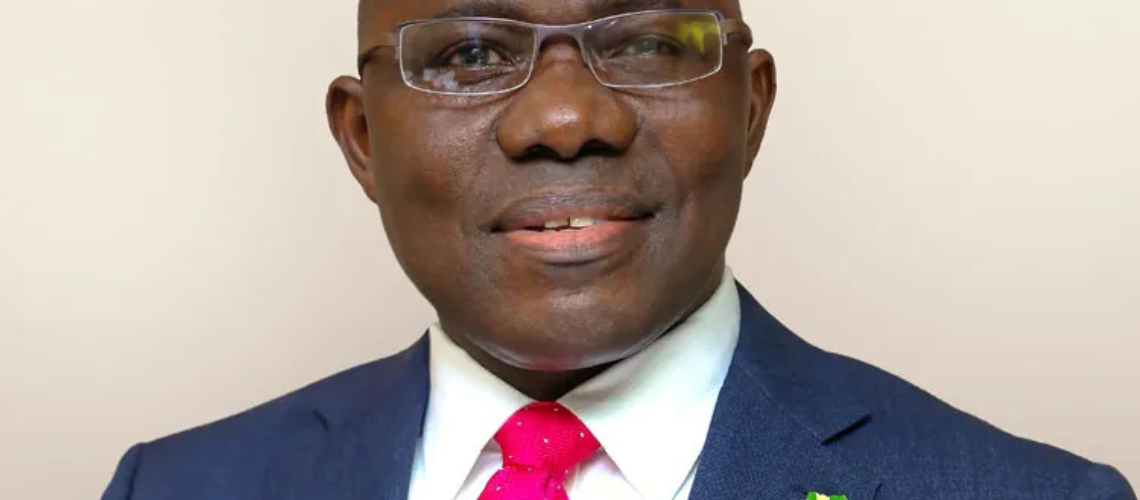
In the Southwest, we have a proverb that says “Ìwà rere lẹ̀ṣọ́ ènìyàn” — good character is a person’s jewel; it is what truly adorns a man. We say it so often it has become almost decorative. But every generation or so, a man comes along and actually wears it — out loud, at cost, without apology. Remi Babalola was born in this same Southwest soil many of us call home. He walked the same kind of streets, sat in the same kind of classrooms, and carried the same kind of ambition.
Then he became a minister — and resigned when they silenced him. As our people say, “Moja mosa la fi n mo akinkanju loju ogun” — true bravery is known by the wisdom in knowing when to retreat from the war front and when to intensify the battle. He became chairman of First Bank — and resigned when corruption blocked him. He built a hospital for the poor and quietly tried to remove his own name from it.
What he did with the life this soil gave him is why his story is not just inspiring, but a masterclass in something Nigeria desperately needs more of: a man who wore his jewel and refused to trade it for anything.
Early Roots in the Heart of Yorubaland
On September 8, 1964, in Ibadan, Aderemi Waheed Babalola was born into the Babalola family—a child who would one day stand before Nigeria’s most powerful institutions and refuse to bend. Raised in a Muslim home, Aderemi Babalola grew up within a regional tradition where education was not a privilege but a cultural inheritance, and where the enduring legacy of Obafemi Awolowo’s free education policy continued to shape the ambitions of families. It was this environment, demanding, disciplined, and proud, that gave Remi his first understanding of what public service ought to mean. The Southwest did not just produce him; it formed him.
An Education Built for Excellence
Remi began his formal schooling at Prospect High School, Ibadan, completing his West African School Certificate with Division 1 in 1980. He proceeded to the Oyo State College of Arts and Science (OSCAS), where he earned both his Higher School Certificate and Cambridge A-Level with three principal passes. He then studied Agricultural Economics at the University of Ibadan (1982–1986), earning a bachelor’s degree with honours — a discipline that trained him to think in systems, in resources, in long-term cycles. He later earned a Master’s degree in Banking and Finance from the University of Lagos, completed the Advanced Management Programme at Lagos Business School, and attended some of the world’s most prestigious institutions: INSEAD in France, Stanford Graduate School of Business, Wharton, Harvard Business School, and London Business School. His education was not ornamental. It was a deliberately assembled toolkit for a man who intended to matter.
Rising Through Banking’s Most Demanding Ranks
Remi entered professional life through the doors of Price Waterhouse, where he spent eighteen months, and Arthur Andersen, where he sharpened his auditing and consulting skills over four years in the Banking and Finance Group. He then joined Zenith Bank, where over a decade he climbed from Deputy Manager to General Manager, serving as Financial Controller and Chief Strategist — a role in which he pioneered the bank’s profit centre concept and shaped its treasury and strategic planning functions. His excellence was noticed. First Bank headhunted him, and he became Deputy General Manager and Divisional Head of Corporate Planning before rising to Executive Director, overseeing Lagos and West business, Consumer Banking, and Electronic Payments. His mission there was singular: to transform First Bank into what internal documents called the “Clear Leader” of the Nigerian Financial Landscape.
“People can actually feel and touch the passion of the entrepreneur — especially the person that has the idea, the person that is the soul of the organisation.”
That passion was never merely rhetorical for Remi. It was structural, visible in the systems he built, the standards he set, and the trajectory he maintained.
From the Boardroom to the Cabinet
On July 26, 2007, President Umaru Musa Yar’Adua appointed Remi Babalola as Minister of State for Finance — a targeted appointment that recognised the depth of his private sector expertise. Before accepting, in a move that revealed his character early, Remi asked to see the list of other ministers. He needed to know whether he would be working with a team of professionals, not politicians. When told that was not how things worked, he insisted, eventually securing a conversation with the President himself. He was not going to fight a war without understanding the battalion.
“I accepted the appointment as a national call to service, an opportunity to deploy my endowments to illuminate humanity.”
As minister, Remi’s tenure was marked by a rare commitment to transparency in a system where opacity was the norm. He was among the very first ministers in the Yar’Adua administration to publicly declare his assets. He institutionalised accountability in the Federation Account Allocation Committee (FAAC), eliminating the time lag between revenue distribution and actual payment — a reform that meant workers received salaries by the 25th of each month instead of the following one. He championed e-payments across government ministries, developed a medium-term fiscal policy framework, resolved a prolonged crisis in the insurance industry, and recovered over ₦46 billion during his brief tenure as Supervising Minister of the FCT. Then came the moment that defined him. When Remi publicly stated that the Nigerian National Petroleum Corporation (NNPC) was broke — a truth the system was not prepared to hear — he was swiftly moved out of the Finance Ministry to the Special Duties portfolio. He did not negotiate. He did not appeal. He resigned immediately. In a country where ministers often cling to office regardless of dignity, Remi Babalola chose his principles over his position.
The Yoruba say, “Moja mosa la fi n mo akinkanju loju ogun” — a true warlord is known not just by how fiercely he fights, but by his wisdom in knowing when to retreat from the war front and when to intensify the battle. Remi had retreated from one war front. But the war was far from over.
First Bank: A Second Battle, Another Resignation
In April 2021, the Central Bank of Nigeria appointed Remi as Non-Executive Director and Chairman of FBN Holdings — again, a national call. He came in determined, and within months achieved a meaningful corporate governance overhaul: reinstating confidence in the brand, halting value erosion, transferring registrars for transparency, and pushing for improved performance. But the rot was deep.
“With the rot, stench and corruption in the system, it has been well-nigh impossible for me to break; and upon deep reflection and partial to my personal values, I write to formally resign.”
On December 17, 2021, less than eight months after his appointment, he resigned. He walked away clean, as he always had. The Central Bank, in a letter inviting him to a meeting, described his resignation as a “surprise.” For those who had followed Remi Babalola’s life closely, it was anything but.
Three Pillars: The Life Coaches Behind the Man
Remi has been deliberate about the architecture of his personal advisory structure, maintaining two distinct circles. The first is a group of contemporaries — men of comparable stature and achievement, such as Fola Adeola, the visionary founder of Guaranty Trust Bank, and Dr. Sulaimon — with whom he sits down once a quarter, talking freely about ideas, directions, and the general currents of life and business. These conversations keep him sharp and connected.
The second circle is more sacred. His life coaches — the late Professor Akin Mabogunje, the distinguished geographer and planning scholar; the late Justice Ayoola Esho, one of Nigeria’s most respected jurists; and Chief Afe Babalola (SAN), the legal colossus and founder of Afe Babalola University — are the men he turns to only when a life-changing decision must be made. Significantly, it was these same three titans who identified him and put his name forward for the ministerial appointment under President Yar’Adua. They did not just advise his career — they helped shape its most consequential chapter.
Yet when the moment came to resign as minister, Remi deliberately did not consult them. He knew why. These were men he revered deeply, men whose counsel carried the full weight of age, wisdom, and authority in this part of the world. If they said stay, he would have found it almost impossible to leave. So he protected his decision by keeping it between only three people — the one who sponsored his appointment, his wife, and his mother. It was not a betrayal of his coaches. It was the act of a man who knew himself well enough to know when his own conscience had to speak last and loudest.
“The only time I actually ran away from my mentors was when I wanted to resign — because I didn’t want people that I respect so much to say no, and then I take a different decision.”
A Philosophy of Constant Growth and Integrity
Remi’s guiding philosophy is captured in two lines he has lived by: “Come, let’s live our dreams; let’s give it all we got,” and CANI — Constant And Never-ending Improvement, a principle popularised by Tony Robbins. For Remi, CANI was not a motivational slogan; it was an operating system. Combined with an unshakeable commitment to integrity — rooted in his faith and a clear-eyed accountability to a higher being — these values formed the invisible architecture of his career. He has said simply: “Just be true to yourself.” In a country where compromise is often the price of progress, that simplicity was, in fact, radical.
A Philanthropist Who Builds What Others Neglect
In 2009, Remi raised one million US dollars to build the Remi Babalola Red Cross Medical Centre in Gbagi, Ibadan — a state-of-the-art facility serving low-income Nigerians, road accident victims, and market women who had never had access to quality healthcare. The centre, operated in partnership with the University College Hospital (UCH), serves over 80 patients daily, charges no consultation fees, and sells drugs at subsidised prices. UCH described it as a landmark in public-private partnership. When a group of market women swarmed around him one day in Ibadan and began praying for him, Remi reflected:
“It made me realise that the best and most beautiful things in the world are things that touch the heart. Money can’t buy this.”
Through his NGO, the Remi Babalola Initiative (RBI), he continues his quiet work in education, health, and poverty reduction — not for recognition, but because service, as he has said, is the highest mark of whatever a person can accomplish in this world.
Three Lessons for Southwest Youth
First: Build your competence before you seek the platform. Remi’s appointment as minister was not an accident — it was the culmination of decades of deep preparation across auditing, banking, strategy, and global education. Excellence creates doors that connections alone cannot.
Second: Integrity is not a sacrifice; it is a strategy. Every time Remi resigned, he preserved something more valuable than the office he left — his reputation, his clarity, and his freedom to operate again. The Nigerian system expected him to compromise. His refusal to do so is precisely why his name still commands respect.
Third: Build structures — in your career, your mentorship, and your giving. Remi did not stumble into success. He maintained quarterly advisory sessions, curated life coaches for critical decisions, and established philanthropic vehicles that outlast his personal involvement. Young people from the Southwest must learn to build systems, not merely chase opportunities.
Remi Babalola is not simply a success story. He is a blueprint — proof that a son of Ibadan can rise to the highest levels of finance and governance, fight for what is right, and walk away when the system will not yield, without losing a single piece of himself in the process.