
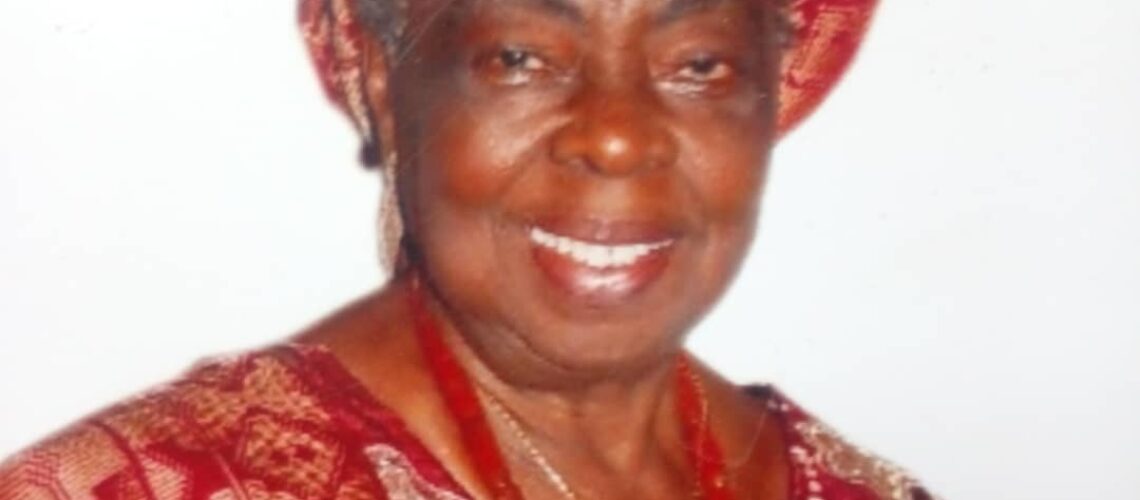
In a nation where women’s education was once considered optional, Professor Felicia Adetowun Ogunsheye carved a path that would inspire generations. Born on December 5, 1926, in Benin City to James Herbert Odukoya and Sabina Banjo of Ijebu-Ode, she emerged as Nigeria’s first female professor, shattering glass ceilings across multiple domains. Now at 99, her mental acuity remains sharp, her passion for education undiminished, and her legacy as a pioneer in library science and women’s advocacy firmly established.
A Family of the Enlightened
Professor Ogunsheye’s journey began in a household that defied convention. Her father, a missionary teacher who later became a civil servant, understood the transformative power of education. As she recalls, her birth date was preserved in official records because
“My father was a missionary teacher, first in Benin, and it was at the same time he became a civil servant. I have a baptismal certificate signed by the mission.”
This attention to documentation, unusual for the era, foreshadowed her own meticulous approach to scholarship and record-keeping.
Growing up in British Cameroon where her father served as chief clerk, young Adetowun’s early education took place at the Cameroons British Tutorial School before she returned to Nigeria to sit for the entrance examination to Queen’s College, Lagos. Her family’s commitment to education was extraordinary for 1926 Nigeria, where female education remained a contentious issue. The Odukoya-Banjo household was one where intellectual achievement knew no gender boundaries, a rarity that would prove instrumental in shaping her pioneering trajectory.
Breaking Barriers
Adetowun’s educational journey reads like a catalog of firsts. After completing her studies at the prestigious Queen’s College, Lagos, from 1939 to 1945, she set her sights on Yaba Higher College, an all-male institution that had never admitted a female student. When the principal of Queen’s College told her father that the institution wouldn’t accept her because it was all-male, her father’s response demonstrated the family’s principled stance on equality. She recounted that her father
“…disagreed with him, arguing that there was nothing in the instrument setting up that school that forbade women from attending it.”
This bold assertion opened doors not just for Adetowun but for generations of Nigerian women. She passed the entrance examination and became one of the two female students in her cohort at Yaba Higher College in 1946, earning her Teaching Diploma. When the college merged with the newly established University College, Ibadan in 1948, she moved with her classmates, becoming a pioneering student of Nigeria’s premier university.
Her academic excellence caught the attention of her teachers, one of whom recommended her for Cambridge University. However, a significant obstacle emerged, she had not studied Latin in secondary school, a requirement for Cambridge admission. Demonstrating the determination that would characterize her career, she taught herself Latin within a year, earned a credit, and secured a government scholarship to study Geography at Cambridge University in 1949, becoming the first African female to attend that prestigious institution.
Academic Excellence and Career Trajectory
After obtaining her BSc in Geography from Cambridge in 1952, Professor Ogunsheye returned to Nigeria, defying the trend of talented Nigerians remaining abroad. Her explanation was simple yet profound:
“Because I was a government scholar, I felt like working for the government.”
This sense of duty to her nation would define her entire career.
She began as the founding principal of Anglican Girls’ Secondary School in Ilesha (now St. Margaret’s School), before transferring to St. Anne’s School, Ibadan, where she taught from 1953 to 1956. Her transition from geography teacher to librarian came in 1958 when John Harris, the University Librarian at the University of Ibadan, invited her to join the library staff as Assistant Librarian in charge of map collection. Her geography background and expertise in cartography made her uniquely qualified for this role, and she soon developed a new classification scheme for organizing African map collections, publishing her findings in the Journal of the Geographical Association of Nigeria.
Recognizing the need for professional grounding in her new field, she pursued a master’s degree in Library Science at Simmons College, Boston, Massachusetts in 1962. Upon her return in 1963, she was appointed lecturer in the newly established Institute of Librarianship at the University of Ibadan.
The Path to Professorship
In 1973, Professor Ogunsheye achieved what no Nigerian woman had accomplished before, she was appointed to the rank of professor, becoming the first Nigerian woman to attain that position not only at the University of Ibadan but within the entire Nigerian university system. As she proudly stated,
“There is no doubt about it because I made the first professorship and I sat on the Senate for the appointment of subsequent professors.”
As Head of the Department of Library Studies from 1970 to 1977, she introduced groundbreaking programs including the Postgraduate Diploma in Librarianship, followed by Master’s and Doctoral programs. Her department created a record by becoming the first Library School in Nigeria to offer a doctoral program in Librarianship, establishing the University of Ibadan as the foremost center for library science education in West Africa. During her tenure, she supervised eleven PhD candidates and numerous master’s degree students, building a generation of library professionals who would spread across Nigeria and beyond.
Champion of Women’s Advancement
Professor Ogunsheye’s commitment to women’s development extended far beyond her personal achievements. She served as president of the Women Improvement Society from 1959 to 1961, an organization of educated women in Ibadan that provided daycare for children and literacy programs for market women. This group later transformed into the National Council of Women Societies, where she became the first secretary.
Her leadership roles in women’s organizations were numerous and impactful: pioneering secretary of the West African Council of Women Societies (1960-1961), Vice-President of Zonta International Ibadan (1971-1973), and president of the National Association of University Women (1971-1975). These positions allowed her to advocate tirelessly for equal opportunities, challenging the patriarchal structures that limited women’s potential.
Administrative Leadership and Institutional Building
Beyond her academic contributions, Professor Ogunsheye served the University of Ibadan in various administrative capacities. She worked as Assistant Hall Warden, Hall Warden, and Hall Mistress from 1963 to 1976 of Queen Elizabeth Hall, providing guidance and mentorship to countless students. In 1977, she was elected Dean of the Faculty of Education, becoming the first woman to hold this position at the university. She also served as a member of the University Senate from 1968 to 1987, participating in crucial decisions that shaped the institution’s development.
Abadina Media Resources Centre: A Legacy for Children
In 1974, Professor Ogunsheye founded the Abadina Media Resources Centre at the University of Ibadan, a project that reflected her deep concern for children’s literacy and development. The Centre was established with a clear mission: to encourage children, especially those from less privileged homes, to develop the habit of reading. The Centre has since served as a vital training ground for librarians specializing in children’s literature and has become a reference point for school library programs across Nigeria, currently offering diploma and postgraduate courses for school library and media personnel.
A Lifetime of Writing: Africa’s Oldest Publishing Author
Professor Ogunsheye’s intellectual productivity has never waned. With more than 50 publications to her name spanning academic papers, books, and children’s literature, she has remained a prolific writer well into her tenth decade. Her literary contributions include “A Break in Silence,” which chronicled her brother Victor Banjo’s tragic fate during the Nigerian Civil War, documenting his sympathy for Nigeria’s Igbo victims of the late-1960s pogrom.
At 95, she published “Aso Oke (1950-2020s)” in August 2022, a beautifully documented coffee table book celebrating the history and cultural significance of the Yoruba textile. The book showcases the evolution of Aso Oke styles, colours, and materials over seven decades, demonstrating her continued engagement with Yoruba cultural heritage and her ability to produce sophisticated scholarly work at an age when most would have long retired from intellectual pursuits. This achievement makes her Africa’s oldest publishing author, a distinction that adds yet another “first” to her remarkable list of accomplishments.
International Recognition and Service
Professor Ogunsheye’s expertise was sought by international organizations worldwide. She served as consultant, expert, or resource person to the International Federation of Library Associations and Institutions (IFLA), UNESCO, the International Association of School Librarianship (IASL), the International Federation of Documentalists (FID), the British Council, and the World Bank. Her contributions earned her numerous honors including: Ford International Fellow (1961), Honorary Doctor of Library Science from Simmons College (1969), Simmons College International Alumnus Award (1979), Fulbright Fellowship for Senior African Scholars (1980), Fellow of the Nigerian Library Association (1982) and Nigerian Academy of Education (1985), Honorary Doctor of Letters from University of Maiduguri (1990), and induction into the International Education Hall of Fame (2000).
The Price of Principle
Professor Ogunsheye’s life was not without profound sorrow. Her family of “firsts” included her younger brother, Victor Banjo, who became the first graduate in the Nigerian military. During the Nigerian Civil War, Victor Banjo, a friend of Biafran leader Odumegwu Ojukwu, sympathized with Nigeria’s Igbo victims of the late-1960s pogrom. His stance cost him his life, a tragedy that Professor Ogunsheye chronicled in her book “A Break in Silence.” This loss, along with that of another brother, demonstrated the terrible price some Nigerians paid during that dark period of the nation’s history.
Personal Life and Enduring Love
Professor Ogunsheye’s marriage to the late Professor Ayo Ogunsheye was a union of intellectual equals. They met through one of her former teachers who introduced her to “the most famous bachelor in town.” Recalling their first encounter, she noted,
“The day we met, it was like I met an old friend. It was fantastic. We started talking as if we had always known each other.”
Their shared love of classical music and intellectual discourse created a bond that endured until his sudden death about forty years ago. She never remarried, instead channeling her energy into raising their son and four other children her husband had entrusted to her care.
An Unfinished National Debt
At 99, Professor Adetowun Ogunsheye remains intellectually vibrant, managing the Ogunsheye Foundation, a research library for students, and continuing to write for children and youth. Yet, the Nigerian government has not accorded her her space in history, most especially by honouring her with a national award. This oversight represents a failure to recognize not just an individual’s achievements but the transformative impact one person can have on a nation’s educational and social landscape.
Professor Ogunsheye’s life embodies the power of education, the importance of breaking barriers, and the necessity of service to community. She opened doors for countless Nigerian women, established institutions that continue to serve the nation, and demonstrated that excellence knows no gender. As Nigeria grapples with educational challenges and gender inequality, her example offers both inspiration and a roadmap for progress. Her legacy demands recognition, celebration, and emulation. It is time for Nigeria to honour this remarkable daughter who gave her nation so much and asked for so little in return.