
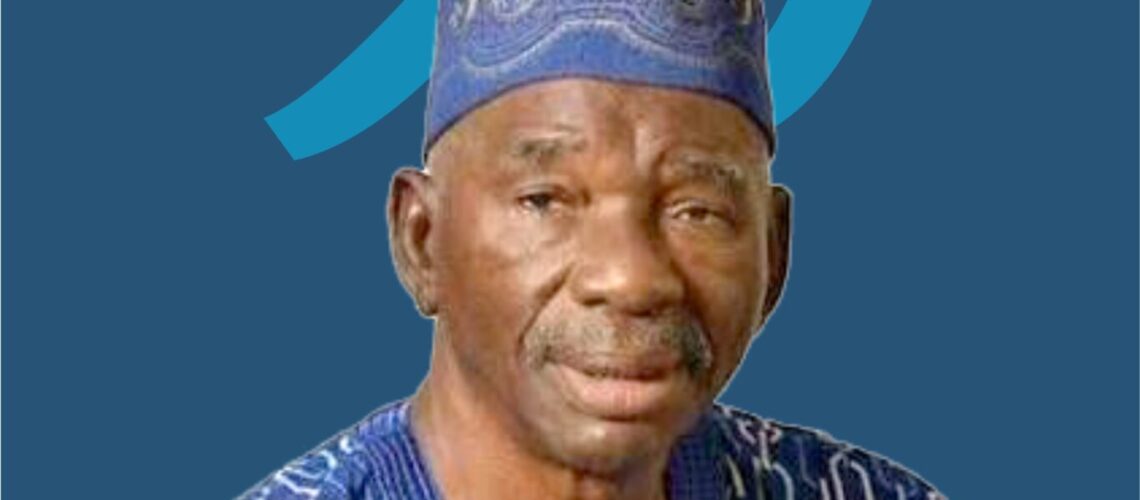
Prince Tajudeen Oluyole Olusi marked his ninetieth birthday on the 13th of October, 2026. Born on Lagos Island on 13 October 1936 to Oba Sanusi Olusi, the first Muslim Oba of Lagos, and Princess Kabitu Asake Olusi, Tajudeen is now known by many names: Baba, the Prince of Peace, Atobatele of Ado-Ekiti, Baba Adini of Yorubaland, and, to the DAWN Commission, an Akinkanju.
His journey, which began in a palace of stories, is what he defines as
“…in the service of humanity.”
Roots: A Palace of Stories (1936–1952)
Tajudeen Olusi was raised in the Olusi Palace in Oke Arin, built for his father. From the age of four or five, he would sit at his father’s feet as an “akobata,” listening raptly as palace chiefs and elders debated through history and storytelling.
Recalling those palace years, he says:
“People could be fighting over property, chieftaincy title, how somebody mounted the throne, and things like that. I grew up in the midst of people telling stories.”
As early as 13, he was responsible for taking attendance at the Area Council party meetings held in the palace.
He began his primary education at Ansar-Ud-Deen School, Alakoro, right in front of the royal palace. However, seeing his cousins dressed smartly in white uniforms for Araromi Baptist School, he insisted on joining them. His father, Oba Sanusi Olusi, agreed, allowing him to transition from an Islamic school to a Christian one despite being a Muslim king himself, an early lesson in religious tolerance. Towards the end of the Second World War, tragedy struck the Olusi throne when his father passed away on 18 January 1945, after which his brother became his guardian.
Tamale to Isolo: A Scholar in the Making (1952–1958)
In 1952 he followed his mother, a trader, to the Gold Coast, travelling from Accra, where her brother worked in the colonial printing department, through Kumasi to Tamale, capital of the Northern Territories. While helping her mother’s trade, Tajudeen finished the Presbyterian-run United Middle School (1952–1954) as the best student in his set. To continue his secondary education, he came to Lagos in 1954 to collect his fees, but his guardian persuaded him to stay. Admissions had closed, so he waited at home until 1955, when he entered Ansar-Ud-Deen College, Isolo, on scholarship.
At Ansar-Ud-Deen College, Tajudeen’s palace educational background gave him an edge following an essay he wrote on Iga Iduganran, the Oba’s palace. His essay was adjudged the best by the principal, Mr J. O. Abbey, and posted for every student to read. Recollecting this experience:
“One morning the principal just came in and said,
“Who is Tajudeen Olusi?’’ When I stood up, he said, “Your essay was adjudged the best.’’
I vividly described the palace and narrated its history. Maybe that’s why it was judged the best.
Following his rise to prominence, he became an honorary registrar, secretary of both the Yoruba Society and his local party’s youth section, and later, chairman of the Alakoro Boys’ Club. As part of the school press, he wrote editorials championing justice and passionately participated in mock parliament debates.
Driven by his love for studying law, he frequently watched British lawyers from the Parliament Building gallery during federal inquiries. This passion, combined with his love for history and his experiences in Latin class, where his teacher, Mr. Salami, constantly challenged him to discuss current affairs, culminated one morning when Mr. Salami walked into class and declared:
“Olusi, you are going to be a politician.”
The educational structures and systems he experienced, both at the palace and in school, molded him for his future career. Before long, a series of events led Tajudeen Olusi to enter politics at an early age.
Clerk to Councillor: (1959–1966)
Advancing his studies, Olusi completed his education at the Lagos Centre for Higher Studies and Yaba College of Technology in Lagos between 1959 and 1960. During this period, he served as a clerk in the Lagos Town Council (1959–1962). A pivotal opportunity arose when the sitting councillor, Odeku, was regularly absent from council meetings. Guided by the constitution’s stance against persistent absenteeism, Tajudeen petitioned the party over the councillor’s absences. This prompted elders such as Chief Wahab Balogun and Mr. Ogunbiyi to intervene, leading to a public apology from Odeku. Rather than running immediately, Tajudeen initially decided to support Alhaji Rauf Williams (popularly known as ‘Raw Raw’), who successfully defeated the incumbent councillor by an eight-to-four vote split in the electoral college.
Driven by the Oke Arin ward’s assertion for its first-time representation, Tajudeen subsequently sought the councillorship for his area. Supported strongly by Baba Raji Gbajumo and receiving Chief Aminu Kosoko’s full backing, the ward meeting endorsed his candidacy. Despite intense family opposition from his brother and elders who harbored reservations about his early political entry, Tajudeen stood firm. In October 1962, at just 26 years old, he won a seat on Chief Obafemi Awolowo’s Action Group platform.
He opened his father’s compound for AG meetings when rivals banned them, earning Awolowo’s applause from prison, and with Ganiyu Dawodu ran errands for the jailed Lateef Jakande, supplying documents for “The Case for a Lagos State.” He also worked at ESSO (1964–1968) until the 1966 coup ended his councillorship. “This was how he not only got into politics but also became one of the foundational disciples of Obafemi Awolowo, a connection reflected in his beliefs and the principles that guide his political journey to this date
Recalling the petition, he says:
“We were young and fearless. And we wanted justice; we wanted things to be done right.”
Parliament at 43 (1966–1983)
Tajudeen Olusi returned to business, and when the opportunity to serve on the council’s caretaker committee (1972–1975) opened during the military regime, he served. In the election leading to the Second Republic in 1976, he won the in-house contest for chairman by 17 votes to 13, but the military annulled it over his closeness to Awolowo. By 1979, he became a founding member of the Awolowo-led Unity Party of Nigeria (UPN), its first Lagos Division Secretary, and, at 43, a member of the House of Representatives for Lagos South, leading the delegation to the 1982 Commonwealth Games in Brisbane until the coup of 31 December 1983 ended his second term.
Of his generation, he says:
“My generation went into politics with the simple conviction of improving the welfare of the people and fighting for the rights of the common man.”
At every turn of Awolowo’s political journey, as a true disciple, Tajudeen Olusi stayed true, sacrificed, and embraced the challenges of the political struggle in Nigerian history.
Party Builder and Peacemaker: Shaping Lagos Politics (1990–2007)
When democratic activities resumed in 1990, Prince Tajudeen Olusi aligned with the Social Democratic Party (SDP), taking up the post of Vice-Chairman for the Lagos State chapter before ascending to state chairmanship in 1993. Following the political disruption caused by the annulment of the June 12 presidential poll, he pivoted toward administrative leadership within Lagos State, accepting an appointment as Commissioner for Commerce and Industry under Military Administrator Olagunsoye Oyinlola. During this tenure, Secretary to the State Government Fidelis Adeyemi recognized Prince Olusi as the guiding force within a cabinet that featured prominent figures such as Engr. Funsho Williams, Prof. Ekundayo Simpson, Abel Yusuph, and Prince Ogunleye.
With the return to civilian rule in 1998, Prince Olusi joined fellow progressive strategists to construct the Alliance for Democracy (AD), which secured a sweeping victory across Southwestern Nigeria in 1999 and facilitated Bola Ahmed Tinubu’s ascension as Governor of Lagos State. As the political coalition evolved into the Action Congress (AC) and later the Action Congress of Nigeria (ACN) under Tinubu’s stewardship, Prince Olusi remained a constant pillar, serving as National Vice Chairman (Southwest) for the AC. His long-standing influence proved decisive early on, playing a key role in introducing Lateef Jakande to public life and mentoring Tinubu’s political journey.
Assessing his political trajectory, the late Prof. Siyan Oyeweso observes:
“To a very large extent, Prince Tajudeen Olusi has no doubt carved a niche for himself in the Lagos socio-political system. He is a bigwig in the party. He is a strategist and has always been careful about his association in political parties which explains some of his political ideologies. A look at his political profile shows that he has always been on the winning side, from the Awolowo era till the Asiwaju Bola Tinubu’s period in the Action Congress of Nigeria (ACN). Many have referred to this group as the party of the progressives because of its history in promoting growth and development in the society”
Currently at 90, Prince Tajudeen Olusi serves as the Chairman of the Lagos State Governor’s Advisory Council (GAC), having assumed leadership following the passing of the previous chairman, Oba Olatunji Hamzat, in May 2019. In this role, he continues to guide the GAC as the apex political advisory and decision-making organ of the ruling All Progressives Congress (APC) in Lagos State.
Corporate Governance, Business, and Community Service
Beyond the political arena, Prince Olusi has established a strong legacy in corporate governance and civic organization. He currently serves on the board of Eko Hotels Ltd as a Director and leads Asake (Nig) Ltd as Chairman, emphasizing institutional stability over individual ambition. His lifelong commitment to civic development is reflected in his involvement with the Boy Scouts Movement in Nigeria, his leadership as the first National Vice-President of the Zumratul-Ul-Islammiyah Society, and his prior tenure heading the Lagos State Pilgrims Board.
Keeper of Lagos’s Memory
Given his deep roots in Lagos society, Prince Olusi is widely regarded as a premier authority and living encyclopedia of Lagos history, heritage, and traditional systems. Prince Olusi’s efforts in documenting Lagos’s traditional institutions had helped clarify the historical rivalries and succession patterns that have shaped Lagos royalty over the centuries.
For instance, in A Short History of Obaship in Lagos, Prince Olusi unpacks the complex dynastic histories, early settlement patterns, and regional connections among the Awori and Bini descendants. His 2019 volume, Essays and Evidences Relating to Lagos Obaship and Chieftaincies, compiles archival documentation alongside commentary on traditional titles and cultural festivals like Eyo. Furthermore, his biographical works, complemented by studies like Prof. Oyeweso’s The Colonial Manipulations of the Obaship Institution and the Olusi Dynasty in Lagos, 1865–1945 and his autobiography Do Not Be A Low Mean Man: The Story of a Prince of Peace, all provide a detailed look into his family’s royal legacy and his own decades of public service. On the subject of historical documentation, Prince Olusi stresses:
“We must work hard to preserve history by ensuring that whatever we want to put into writing is well verified and remains verifiable.”
To cap it all, at 90, Prince Olusi continued to document the history of Lagos and the Yoruba people at a critical moment when debates over Lagos history were prominent. He marked his 90th birthday in October 2026 by presenting and launching his landmark book titled The Kingdom of Lagos, which documents the rich history, chieftaincies, traditional institutions, and cultural heritage of Lagos. Additionally, a commemorative tribute book highlighting his life and legacy, titled Nine Decades of Noble Service, was featured during the week-long birthday celebrations.
Legacy: The Prince of Peace Endures
Nine decades on, his legacy lives on in the leaders he steadied, the books that keep Lagos’s story verifiable, and the Prince Tajudeen Olusi Educational Fund. Beyond his political leadership, his lifelong service has been recognised through esteemed chieftaincy and royal titles, including Atobatele of Ado-Ekiti, Baba Oba of Apa Kingdom, and Prince of Lagos.
In recognition of his distinguished contributions to the nation, he was conferred with the national honours of Member of the Order of the Niger (MON) and Officer of the Order of the Niger (OON), as well as an honorary Doctor of Literature (Honoris Causa) degree from Lagos State University in 2024.
President Bola Ahmed Tinubu calls him “a custodian of our progressive heritage,” “not just a politician” but “an institution,” who “bridges our progressive movement of yesterday and today’s Renewed Hope,” and a father figure “whose wisdom has been a compass for generations of leaders.” Of what he wants most, he says:
“I love a peaceful environment. I just want people to be happy.”
The DAWN Commission celebrates you, Sir. You are an Akinkanju.