
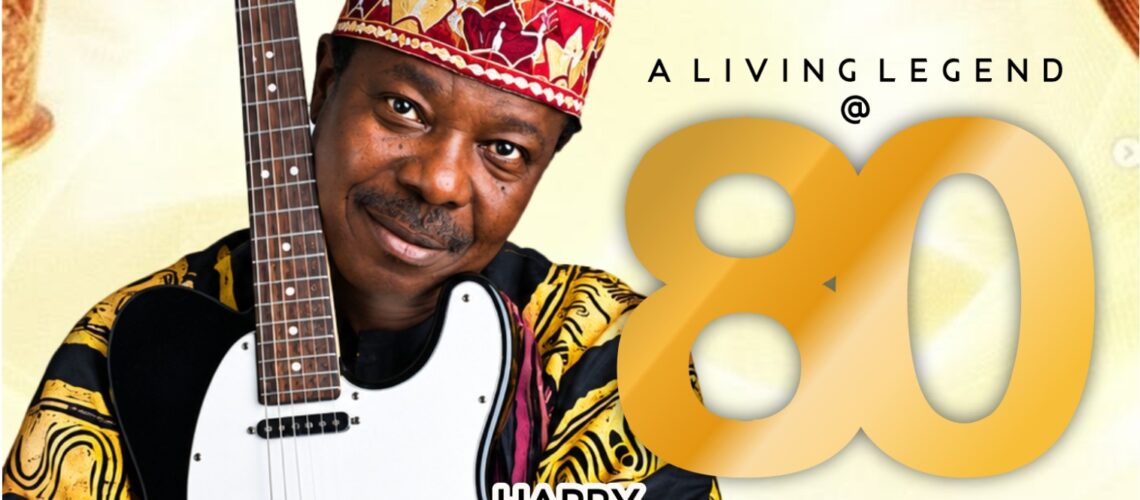
King Sunny Ade turns eighty this day, the 22nd of September, 2026, active, agile, and still rocking the music world, with fans everywhere dancing to the rhythmic strings of his guitar and singing along to his melodious, intelligent, and enduringly popular music. What many contemporary Afrobeat artists still aspire to, King Sunny Ade has already achieved. But the journey of this global musical icon started from humbler beginnings: a boy following his mother to church, fascinated by the men playing percussion.
Born Sunday Adeniyi Ishola Adegeye, MFR, in Osogbo on 22nd September 1946 to royal parents, his father from Ondo City, his mother from Akure, both of Ondo State, he has grown to be known by many names across his eight decades on earth: King Sunny Ade (KSA), the King of Juju, the Minister of Enjoyment, the first Nigerian ever nominated for a Grammy, and, to the DAWN Commission, an Akinkanju.
Reflecting on the traditionalist discipline that has shaped both his life and his music, he says:
“I’m a traditionalist, by profession!”
That discipline has carried him through eight decades in music. His life has been built in layers: a royal childhood that resisted the very vocation that would come to define him, a musical apprenticeship spent moving between genres and mentors, a band that grew into an institution, and a business empire that now employs hundreds. On his eightieth birthday, it is worth tracing that road from its beginning, in his own words as much as in the record.
Roots: The Soil That Shaped a King
King Sunny Ade’s early life carried the weight of expectation from two directions at once. Both of his parents came from royal families. His father, Samuel Adeniyi Adegeye, was a church organist in the Methodist Church; his mother, Maria Adegeye, was a trader and a member of the Adesida dynasty of Akure, whose relatives included Oba Adesida I, who ruled the ancient city for sixty years. Music was never absent from the household, but it was not intended to be his vocation.
Brought up in Osogbo, he was raised in a family that believed a prince belonged in a courtroom or a classroom, not on a bandstand, then regarded as a common trade. His parents flatly rejected his musical aspirations and maintained their disapproval for decades. Yet the boy followed his instincts. At the age of seven, he would follow his mother to the Cherubim and Seraphim church, where percussion was played alongside traditional worship, and he liked nothing more than standing among the percussionists. He later traced his love of music to those services:
“In that church, Cherubim and Seraphim … you have so many enticing music there, music that would really entice you to dance — so that’s where my love started.”
At home, his father’s gramophone nurtured his musical passion through records, both foreign and local, though parents of that era generally viewed music as an unserious pursuit, one likely to pull a child out of school. In Sunny Ade’s case, it eventually did. Knowing his mother disapproved, his friends kept watch whenever he played percussion so she would not catch him:
“I always liked to be in between those people playing percussion. So what I did was make sure some people covered me, so when my mother looked back, I could dodge her.”
He attended primary and secondary schools in Osogbo, including African School, Methodist School, and St. Charles Grammar School, before leaving school around 1963 for Abeokuta and from there to Lagos in the mid-1960s, an escape, in effect, into music.
A Dropout Finds His Voice in the City of Lagos
In Lagos, Sunny Ade joined a highlife band, though he was too young by the group’s reckoning: barely seventeen, he added a couple of years to his age and claimed to be nineteen to be allowed in. He worked his way up from percussion to a self-taught command of the guitar and eventually from band member to bandleader.
His influences in those years were wide-ranging: the Nigerian musician I.K. Dairo and American artists such as James Brown, Brook Benton, and Jim Reeves. He passed through the mentorship of figures like Sanni Ariyo and Idowu Owoeye and later joined Moses Olaiya’s Federal Rhythm Dandies, a highlife outfit fronted by the man later known as the comedian Baba Sala.
As his interest in his own Yoruba culture deepened, he moved from highlife toward Juju music, drawn by the pioneering Tunde Nightingale, and borrowed stylistic elements from Nightingale’s “So wa mbe” style. It was on the advice of Bobby Benson, who encouraged him to perform standing rather than seated, as was then customary, that King Sunny Ade began to reshape Juju, pairing the change with the stylistic dancing that would become his signature, to the delight of audiences everywhere.
Green Spots to African Beats: Birth of a King (1966–1976)
By 1966, Ade had formed his own band, the Green Spots, a name chosen in echo of I.K. Dairo’s own Blue Spots. Its timing proved fortunate: when civil war broke out in Nigeria in the 1960s, many highlife bandleaders, a number of them from Eastern Nigeria, returned home to join their Igbo compatriots, leaving stages across the country empty. Juju rose to fill that space, and Sunny Ade rose with it. His first single, “Challenge Cup,” released in 1967 in honour of the local soccer team, the Stationery Stores Football Club, sold over half a million copies, more than any Juju record had done before it, and became a national hit.
Two to three best-selling albums followed every year afterward. After eight years and twelve LPs on the Nigerian Africa Song label, contract disputes in 1974 led Ade to form his own record company and rename the band African Beats, a name that would, over the years, also carry the label Golden Mercury for further business reasons. The hits continued, and by 1976, the press and his fans alike had crowned him King of Juju, a title he has held ever since.
Reflecting on how those years forced him to carve out an identity distinct from the musicians who trained him, King Sunny Ade recalled:
“I had to find my own name in different music.”
A Sound of His Own: The African Beats’ Signature
King Sunny Ade and the African Beats have toured with a line-up of twenty to thirty members, playing a spacey, jamming style of Juju built on tight vocal harmonies and intricate guitar work, backed by traditional talking drums and percussion, and, unusually for the genre, pedal steel guitar, synthesiser, vibraphone, and accordion, the last introduced to the band by his sisters. In other words, he transformed live Juju into a kinetic visual marvel. His sweeping stage presence, complex choreographed dance routines, and interactive guitar duels turned his concerts into universal spectacles that required no knowledge of the Yoruba language to enjoy.
He has always insisted the additions were practical rather than experimental, the product of deliberate research into which instruments could stand in for older sounds. The pedal steel, for instance, was adopted as a stand-in for the African violin once he heard how closely it matched the sound in Jim Reeves’ country records; the bass guitar replaced the old thumb piano. It is a working method he has followed for decades, and one he says no other musician quite replicates:
“Before I put in anything or add anything, I will go back and do research. I make sure all kinds of music are in there. Any kind of music in the world, you can find in my music. It’s just that I sat down to create, and when you hear it, no matter what kind of music you can think about, you will still have the feelings within that band. Really, the aim is to send this particular music to the whole world and let everybody have that feeling. So that if you’re a fanatic fan of jazz, it’s within this music. If you’re a fanatic fan of rock and roll or R&B, you’ll find that in my music.”
The New York Times attested to this rich innovation in 1984:
“What Mr. Ade has achieved is the revitalization of juju through a series of daring musical innovations. He has added synthesizers, a Hawaiian steel guitar and phalanxes of electric guitars and conga drums to the traditional juju ensemble.”
Taking Juju to the World: Island Records and Two Grammy Nominees
After the death of Bob Marley, Island Records went looking for another artist to carry its world-music ambitions, and producer Martin Meissonnier introduced King Sunny Ade to label founder Chris Blackwell. The result, Juju Music (1982), propelled Ade, his band, and Juju music into the international limelight. He was soon billed as “the African Bob Marley,” and the New York Times called him “one of the world’s great band leaders.” The album spent twenty-nine weeks on the US Billboard 200, a run that stood as the longest-charting Billboard 200 album by a Nigerian artist for roughly four decades, until it was broken in 2023.
His next album, Synchro System (1983), was equally successful and earned him the first Grammy Award nomination of any Nigerian artist in the ethnic/traditional folk recording category. He parted ways with Island after 1984’s Aura, but the momentum did not stop: in 1987, Rykodisc released a recording of a live concert he had given in Seattle, and a new deal with the Mesa label produced 1988’s Odu, a collection of traditional Yoruba songs that brought him a second Grammy nomination, making him the first African artist ever nominated twice. He kept travelling to American studios to record through those years, convinced the equipment and engineering on offer there gave his records an edge.
The Chairman: An Empire Beyond Music
To many Nigerians, King Sunny Ade is known simply as the Chairman, a title earned through his leadership across a wide spread of businesses. He has invested the revenues of a music superstar into an oil firm, a mining company, a nightclub, a film and video production house, record labels for African artists, and several other enterprises besides. About 70% of his business remains rooted in music, and by his own estimate over 700 people work for him in one capacity or another, with 200 of them directly employed in music.
He chaired the board of the Musical Copyright Society of Nigeria through the turbulent years when it fought to be licensed as a collecting society, leading delegations to government and defending musicians’ rights through a series of legal battles; he was later appointed the Society’s honorary president in recognition of that leadership. He remains an outspoken advocate for government protection of musicians’ intellectual property against piracy:
“If somebody develops a business, spends their time, money and energy, and then somebody comes from around the corner and takes it without their consent, it is not good. The government should protect such people.”
Honours on the World Stage
Beyond the two Grammy nominations and the Billboard record, King Sunny Ade’s music found its way into Hollywood in the 1980s, featured in Breathless (1983) starring Richard Gere and in One More Saturday Night (1986), with an acting appearance in Robert Altman’s O.C. and Stiggs (1987). In 2008 he received an award for outstanding contribution to world music at the International Reggae and World Music Awards in Harlem; the following year he was inducted into the Afropop Hall of Fame at the Brooklyn African Festival, an honour he dedicated to Michael Jackson, and was appointed a visiting professor of music at Obafemi Awolowo University, Ile-Ife.
The recognitions have kept coming into his later years: the AFRIMA award and induction into the Hard Rock Cafe Hall of Fame, both in 2016, and induction into the Headies Hall of Fame in 2021. In that latter year, a vintage Fender guitar he had owned, designed by artist Victor Ehikamenor, was auctioned in Lagos for ₦52.1 million, one of the highest sums ever paid for a Nigerian musical instrument.
On what the Hard Rock Cafe honour meant to him, King Sunny Ade said:
“I feel on top of the world, because it’s part of my dream. Anything that can make me number one in the music world, I love it.”
During one of his historic tours in the United States, the City of Atlanta officially presented King Sunny Ade with the key to the city; local officials proclaimed a specific date “King Sunny Ade Day” in celebration of his global impact on world music and African culture, with the proclamation signed by the legendary civil rights leader and former Atlanta mayor, Andrew Young. Beyond Atlanta, Miami and Providence are among the prominent US cities that have also presented him with a key to the city.
Giving Back: The King Sunny Ade Foundation
In his continuing effort to support African music, Sunny Ade established the King Sunny Ade Foundation with Nigerian civic and business leaders, on land donated by the Lagos State Government. It includes a performing arts centre, a fully equipped recording studio, a school of music, and a school of drama, alongside housing for young performers and musicians and financial assistance for the children of musicians who have died and for elderly musicians who can no longer perform.
Describing his hopes for the Foundation’s reach, King Sunny Ade said:
“I believe that I can hook the whole world together with this foundation, helping underprivileged people and helping them get work.”
Legacy: The Reign Continues
King Sunny Ade’s story reads as a regional one as much as a national or international one, a prince of Ondo and Akure whose reign, built on Yoruba rhythm and Yoruba enterprise, has carried the Yoruba culture to the world stage.
Eighty years on from a boyhood spent among the percussionists at church, King Sunny Ade’s reign continues: in the records that still sell, in the hundreds who draw a living from the empire he built, in the young performers housed and trained under his Foundation, and in the title his fans gave him half a century ago and never took back. He remains, in every sense that matters, the King of Juju.
In September 2026, in the week of his eightieth birthday, the US Mission in Nigeria marked its #ThisWeekInUSNigeriaHistory series by revisiting his 1982 Billboard 200 feat, calling attention to the enduring relationship between Nigerian music and American audiences. That same week, he was pictured bowing before the Ooni of Ife, Oba Adeyeye Ogunwusi, at an event in Osun State, a gesture Nigerians online read as a display of the cultural values around age, achievement, and traditional authority that have run through his entire life.
The DAWN Commission celebrates you, Sir. You are an Akinkanju.
References
DAWN Commission, “King Sunny Ade – Nigeria’s Music Legend” (published 7 March 2019), archival profile and updated roughsheet supplied for this essay-story.
Wikipedia, “King Sunny Adé.”
Britannica, “King Sunny Ade” and “juju” (Virginia Gorlinski); “African popular music” (Charlie Gillett).
Jason Gross, interview with King Sunny Ade, Perfect Sound Forever, June 1998.
Ghaniyah Olowoyo, “Remembering Sunny Ade’s feats as he clocks 74,” Premium Times, 23 September 2020.
Accelerate TV, video interview transcripts with King Sunny Ade.
US Mission Nigeria, #ThisWeekinUSNigeriaHistory series, X/social media post, September 2026.
Leadership.ng, “King Sunny Ade’s Billboard Record That Stood For Four Decades.”
The Nation Online Nigeria, “King Sunny Ade bows to greet Ooni of Ife at Osun event,” and related reporting.