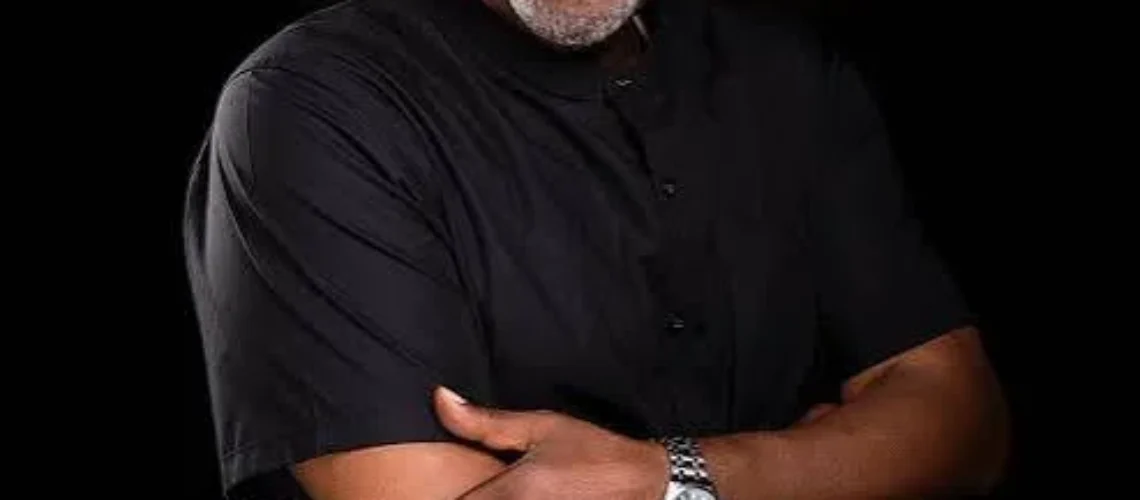
Oludotun Baiyewu Jacobs, MFR, the actor and film executive the world came to know as Olu Jacobs, died on September 16, 2026, at the age of 84, bringing to a close a career that had spanned more than five decades and two continents. The Development Agenda for Western Nigeria (DAWN) Commission joins his family, the entertainment industry, and well-wishers across the globe in mourning the passage of a man widely regarded as one of the greatest and most respected African actors of his generation, a figure so central to the growth of Nigeria’s film industry that he was often described as one of the “godfathers of Nollywood.”
For over forty years, Jacobs stood as a bridge between two worlds; the old and the new, the British stage and the Nigerian screen, and the traditional and the modern breeds of actors, and in each, he left work that endures. He acted in more than 120 Nigerian films, portraying fathers, elders, kings, and statesmen with a gravity that made him, in the words of many who watched him work, one of Nollywood’s finest interpreters of character.
Roots: The Soil That Shaped Him
Olu Jacobs was born on July 11, 1942, in Abeokuta, to parents from Egba Alake in present-day Ogun State. He spent his early childhood in Kano, in Northern Nigeria, where his parents had settled, and attended Holy Trinity School, taking an early interest in the debating and drama societies there. His family later sent him and his siblings south for secondary school, a decision shaped as much by the uncertain politics of the period as by their hopes for the children’s education.
It was in Kano, at one of Chief Hubert Ogunde’s annual concert parties at the Colonial Hotel, that Jacobs’s passion for acting was first ignited. He would later recall seeing a travelling stage performer as a boy of about nine and deciding, in that instant, what he wanted his life to be. That passion, by his own account, never dimmed.
Education: From Kano to the Royal Academy
Determined to pursue acting despite his father’s disapproval, his father was said to have torn up his application form in protest, Jacobs secretly processed his visa with the help of his brothers, left home, and travelled to England. He wrote to his father from London but never saw him again; the elder Jacobs died before his son’s eventual return to Nigeria. In England, Jacobs trained at the Royal Academy of Dramatic Art (RADA) in London, an institution he remembered as a place with no room for half-measures. Recalling the discipline it demanded, he said:
“It is not a place for hanging about. You don’t toy with it. Anybody who is not good will be shown the way out.”
— Olu Jacobs, on his training at the Royal Academy of Dramatic Art
A Career Built Between Two Worlds
Jacobs’s earliest stage role came in 1972, playing the Boy in A Taste of Honey at the newly opened Crucible Theatre in Sheffield. Through the 1970s, he became a familiar face on British television, appearing in The Goodies, Till Death Us Do Part, Barlow at Large, The Venturers, Angels, 1990, The Tomorrow People, and The Professionals. In 1978, he took on the role of President Mageeba in Michael Codron’s production of Tom Stoppard’s Night and Day at the Phoenix Theatre in London’s West End, a run of eighteen months, eight performances a week, in which he never once missed a show. Reflecting on the resolve that run demanded of him, he explained:
“I prayed for success. If success means having to play this thing eight times a week, I will play it.”
— Olu Jacobs, on his eighteen-month run in Night and Day
In the 1980s, Jacobs’s career widened further into international film, with roles in John Irvin’s The Dogs of War, Roman Polanski’s Pirates, and the family adventure film Baby: Secret of the Lost Legend, alongside a continuing presence on British television, including a cast role in TVS’s The Witches and the Grinnygog. Working in an industry where, as he later reflected, very few parts were written for Black actors, Jacobs was part of a generation of actors who pressed the profession, through the actors’ union Equity, to reflect the society it claimed to represent.
Return Home: Nollywood’s Godfather
In 1990, Jacobs returned to Nigeria and starred in the Nigerian Television Authority’s detective series The Third Eye, a lead role he held until 1993. It marked the beginning of a second, equally distinguished chapter of his career — one that would see him become one of the pioneers of Nigeria’s home-grown film industry. Over the following decades, he appeared in more than 120 Nollywood productions, notably Oloibiri (2015) and The Royal Hibiscus Hotel (2017), bringing to each role a weight and authority that helped define what a Nollywood elder statesman could look like on screen. In Nollywood, Jacobs distinguished himself as a godfather to many up-and-coming actors and actresses, helping usher in the industry’s new generation even as he embodied its old guard. Speaking on what Nollywood had made possible for Nigerians telling their own stories, he said:
“Our people see it and they are happy. They are proud, and we are very, very proud of them.”
— Olu Jacobs, on Nollywood’s power to tell Nigeria’s own stories
Recognition Well Earned
Jacobs’s contributions to film were recognised repeatedly across his career. He won the Africa Movie Academy Award (AMAA) for Best Actor in a Leading Role in 2007, and received the Industry Merit Award for outstanding achievement in acting at the 2013 Africa Magic Viewers’ Choice Awards. AMAA conferred its Lifetime Achievement Award on him in 2016, and he was similarly honoured with a lifetime achievement award at the Africa International Film Festival (AFRIFF) in November 2021. In 2011, President Goodluck Jonathan bestowed on him Nigeria’s national honour of Member of the Order of the Federal Republic (MFR), formal recognition of decades of service to the country’s cultural life. In August 2022, he and his wife were jointly presented an icon award and membership certificates by the Audio-Visual Rights Society of Nigeria (AVRS).
Family Life
Olu Jacobs was married to fellow actor Joke Silva from 1989 until his death, and the couple had two children. Together, they founded and ran the Lufodo Group, a media company that grew from its beginnings as a stage and film production outfit into a fuller media and entertainment services company, housing the Lufodo Academy of Performing Arts (LAPA) and Lufodo Consult among its divisions. Jacobs was often asked why his wife continued to work under her maiden name, and his answer became one of the more quoted reflections of his marriage. On the question, he was characteristically direct:
“She is her own individual. When I met her, she was an actress known as Joke Silva; so why should marrying me now deny her and her audience her name. She is Miss Joke Silva who is also Mrs. Joke Jacobs. It is as simple as that.”
— Olu Jacobs, on his wife keeping her professional name
The Final Years
In 2021, rumours spread that Jacobs had died; he laid them to rest by appearing at AFRIFF that November to accept a Lifetime Achievement Award, though observers noted he looked frail. His wife later revealed, in an interview with Chude Jideonwo, that he had been battling Lewy body dementia. On July 10, 2022, he marked his 80th birthday with a celebration at Lagos’s Glover Memorial Hall, attended by dignitaries and colleagues from across the entertainment industry, where filmmaker Femi Odugbemi screened a documentary offering a behind-the-scenes look at his life. It was, in many ways, a fitting gathering, a chance for the industry he had helped build to give him his flowers while he could still receive them.
Olu Jacobs died on September 16, 2026, at the age of 84, with the announcement made by his son in the early hours of that day.
The Lasting Echo of the Lion of Lufodo
Following the passing of veteran actor Oludotun Baiyewu Jacobs (Olu Jacobs), colleagues, national leaders, and fans from across Africa and beyond poured out tributes honouring his monumental impact on film, theater, and culture.
President Bola Tinubu described him as a giant of the Nigerian creative industry, stating that his passing is a massive loss to Nigeria, African cinema, and the global performing arts community.
Renowned filmmaker Tunde Kelani (TK) alos shared a deeply personal reflection recalling their history together, stretching all the way back to their days in London:
“I first crossed paths with Oludotun Baiyewu Jacobs—fondly known to many of us as Uncle Olu Jacobs—in 1978… accolades alone cannot capture the magnitude of his legacy: Oludotun Baiyewu Jacobs stands unequivocally as a founding patriarch of modern Nigerian screen performance.”
Other popular actors, including Richard Mofe-Damijo (RMD), reflected on his impacts, writing
“Uncle Jay, you have taken your final bow… your return home, his commitment to the craft and the standard he set reminded us that there was a place for excellence, discipline and integrity.”
To Funke Akindele, he was a true legend and a gracious mentor.
“A kind and gracious man who was always willing to support, encourage, and uplift young talents.”
Mercy Johnson-Okojie and Mo Abudu, the media mogul praised him as one of the true giants of African cinema and television.
Conclusion
Olu Jacobs’s story is, in many ways, Nollywood’s own story, a journey from a boy captivated by a travelling concert party in Kano, through the West End stages of London, to the screens of a Nigerian film industry he helped raise from its infancy into a global cultural force. He remains, in the industry he leaves behind, a standard against which craft, discipline, and dignity on screen continue to be measured. The DAWN Commission celebrates this great legend of the entertainment industry and extends its deepest condolences to his wife, Joke Silva, his children, and the entire Lufodo family, as Nigeria bids farewell to one of its most distinguished sons.
References
- Bolarinwa, David (16 September 2026). “BREAKING: Olu Jacobs Dies at 84”. Trending News. Retrieved 16 September 2026.
- “July: Of Exuberance and Melancholy”. This Day. 31 July 2021. Archived from the original on 21 August 2021. Retrieved 21 August 2021.
- Oladejo, Peace (16 September 2026). “A Life Well Spent: Celebrating Olu Jacobs’ Artistry”. New Telegraph. Retrieved 17 September 2026.
- “Filmography of Olu Jacobs”. London, UK: The British Film Institute. Archived from the original on 22 May 2009. Retrieved 12 August 2010.
- Njoku, Benjamin (4 March 2019). “Pete Edochie, Olu Jacobs: The living ‘godfathers’ of Nollywood”. Vanguard. Lagos, Nigeria. Archived from the original on 13 October 2020. Retrieved 10 July 2020.
- “Olu Jacobs: Patriarch of the movie world”. Vanguard. Lagos, Nigeria. 11 January 2022. Archived from the original on 11 January 2022. Retrieved 11 January 2022.
- “I disobeyed my dad to become an actor – Olu Jacobs”. Vanguard. Lagos, Nigeria. 20 November 2009. Archived from the original on 5 July 2022. Retrieved 17 July 2022.
- Ogbu, Rachel. “A Race for Stars Only”. Newswatch. Lagos, Nigeria. Archived from the original on 13 October 2020. Retrieved 9 August 2010.
- “Nominees & Winners of AMAA 2007 @ a glance”. The Africa Movie Academy Awards. Archived from the original on 10 December 2007. Retrieved 11 September 2010.
- Coker, Onikepo (4 May 2007). “Africa Celebrates Film Industry at AMAA 2007”. Mshale Newspaper. Minneapolis, USA: Mshale Communications. Archived from the original on 3 March 2012. Retrieved 5 September 2010.
- “AMAA Nominees and Winners 2007”. Africa Movie Academy Awards. Archived from the original on 12 October 2010. Retrieved 17 October 2010.
- “Outpouring of love for Olu Jacobs at 80”. This Day. Retrieved 2 February 2026.
- Otagbo, Olasumbo (18 October 2014). “How Hubert Ogunde inspired me to become an actor -Olu Jacobs”. The Nation. Lagos. Archived from the original on 13 October 2020. Retrieved 27 June 2016.
- “My Happiest Moment In Acting – Olu Jacobs”[link removed], Naijarules.com.
- Ugochukwu, Françoise (20 January 2022). “Olu Jacobs: Nollywood’s elder statesman has always acted for his country”. The Conversation. Retrieved 8 July 2024.
- Njoku, Benjamin. “I disobeyed my dad to become an actor – Olu Jacobs”. Vanguard. Lagos, Nigeria. Archived from the original on 25 February 2010. Retrieved 9 August 2010.
- A BBC-2 series that traces the history of acting. (14 July 1983). The Stage and Television Today (Archive: 1959–1994), 15
- “Olu Jacobs Fighting Challenges”. Archived from the original on 4 February 2024. Retrieved 4 February 2024.
- “I Bought My Dad His Best Tobacco”. The Punch. Archived from the original on 4 February 2024. Retrieved 4 February 2024.
- “How I met Joke Sylva – Olu Jacobs”. The Sun. Lagos, Nigeria. Archived from the original on 2 December 2010. Retrieved 9 August 2010.
- “Why My Wife Still Bears Her Maiden Name – Actor Olu Jacobs – MJ Celebrity Magazine”. MJ Celebrity Magazine. 9 December 2013. Archived from the original on 20 December 2016. Retrieved 8 December 2016.
- Obey, Yinka (17 November 2021). “Pale-looking Olu Jacobs attends Afriff, wins lifetime achievement award”. Legit.ng. Archived from the original on 18 November 2021. Retrieved 18 November 2021.