
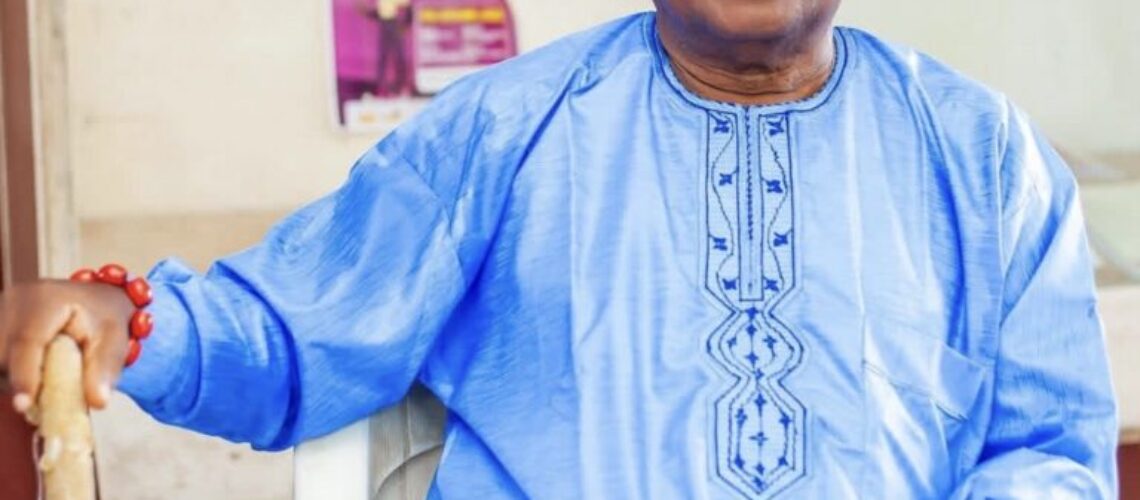
On June 12, 2026, Nigeria bid farewell to Professor Gabriel Adeola Oyewo, popularly known as Kola Oyewo, whose passing at the age of 80 marked the end of an extraordinary six-decade journey in theatre, scholarship and cultural preservation. Actor, academic, lecturer and community leader, Oyewo was among the foremost custodians of Yoruba culture, carrying its language, traditions and values from the travelling theatre stage to television screens, film productions and university classrooms. A devoted student of professors such as Wole Soyinka, Ola Rotimi, and Femi Osofisan, he embodied lifelong learning and artistic excellence. Through his performances, teaching and cultural advocacy, he left an enduring legacy that continues to inspire generations
Born of Royalty, Raised by Masquerade
Kola Oyewo was born on March 27, 1946, in Otan Ayegbaju in present-day Osun State, into a farming family that was, by an accident of lineage, also a royal one; he spent part of his childhood in the palace where his uncle once reigned as king. His father, Mr Bamgbola Oyewo, was an Egungun dancer — a masquerader — and it was from this ancestral vocation, steeped in the spiritual choreography of the Yoruba egungun cult, that young Kola absorbed his first lessons in performance, discipline and the unhurried virtue his father modelled for him.
My father, Mr Bamgbola Oyewo, was an Egungun dancer (masquerader) from whom I learnt patience.— Kola Oyewo’s personal recollections
The Boy Who Wanted to Speak English on Stage
His formal theatrical instincts were sharpened at home, in the Otan Ayegbaju Dramatic Society founded by a schoolteacher uncle, where village children performed drama sketches during long school holidays. After secondary modern school, an advertisement calling for trainee actors and actresses changed the course of his life: he auditioned for the legendary Duro Ladipo Theatre Company in Osogbo in January 1964, proving his versatility in singing, drumming, dancing and acting — the three pillars without which, in that era, no one could be employed.
To even be considered for employment, you had to prove talent in three distinct areas — drumming, dancing, singing. If you lacked these three innate talents, you simply could not be employed.— Professor Kola Oyewo, recounting the 1964 Duro Ladipo auditions
Nine years with Duro Ladipo took him through stage opera, live unrecorded television on WNTV/WNBS, and the photo-play magazine Atoka. But it was a chance encounter with the University of Ife Theatre, performing an Ola Rotimi play at Ede Town Hall, that lit a new ambition in him.
Ah, I want to act like this. I want to speak English on stage and perform like them.— Kola Oyewo, recalling his first sight of the University of Ife Theatre
Ife, and the Company of Giants
On July 9, 1973, out of a crowded field of applicants, only two candidates were admitted into the Ori Olokun Players at the University of Ife: Jimi Solanke and Kola Oyewo. There, under Professor Ola Rotimi, he abandoned a lifetime of improvisation for memorised, scripted dialogue, famously learning his role of Odewale in The Gods Are Not to Blame in four days flat, a tape recorder by his side even in the bathroom. As the troupe evolved into the University Theatre Company, Oyewo came of age under three towering directors in succession — Ola Rotimi, Wole Soyinka and Femi Osofisan — each demanding a different register of craft.
Ola Rotimi’s dialogue was grounded and natural. Wole Soyinka’s plays were highly poetic and deeply metaphorical. Femi Osofisan’s theatre brought a rich return of music and song.— Kola Oyewo, describing his three mentors at the University of Ife
“Then Go to School!”
Triumph soon collided with crisis. When Rotimi and Soyinka left the university, remaining management threatened to disband the troupe, dismissing its members as a “pack of illiterates.” A determined delegation, fresh from a convocation performance, marched to the lodge of Vice-Chancellor Professor Ojetunji Aboyade and won a reprieve. But the danger of a future administration was real, and it was Professor Femi Osofisan, then on sabbatical at Ife, who issued the challenge that would redirect the rest of Oyewo’s life.
Then go to school! — At what age?— An exchange between Professor Femi Osofisan and Kola Oyewo
His late wife bought him a GCE form the very next day. He passed five O-Level papers, added a distinction in Yoruba Oral Literature, and gained direct entry into the 200-level Dramatic Arts programme at the University of Ife in 1995 — in the very class where his own son, Yemi, was already enrolled. Classmates teased the father and son mercilessly, and Oyewo turned the awkwardness into one of his most loved stories.
Why didn’t you ask me before we left the house? Didn’t we sleep in the same house?— Kola Oyewo, recalling classroom banter with his son Yemi
From Father-Student to Professor
Encouraged further by his head of department, Dr Ropo Sekoni, to pursue postgraduate study, Oyewo enrolled at the University of Ibadan, where he was reunited with Professor Femi Osofisan — now his head of department and, soon, his supervisor for both a Master’s degree and a PhD in Drama, which he completed in 2005 in his late fifties.
Ah, Oyewo! What are you doing here? — Sir, you were the one who told me to go to school, so I am still going to school. I am now one of your postgraduate students!— Exchange between Professor Femi Osofisan and Kola Oyewo at the University of Ibadan
He joined the academic staff of Obafemi Awolowo University in 1996, rising to senior lecturer until his retirement in September 2011. Retirement did not end his classroom service: he went on to head the Department of Dramatic Arts at Redeemer’s University and later lectured in performing arts at Elizade University, Ilara-Mokin, carrying theory and lived practice into two further generations of students.
The Voice That Made Yoruba Sing
Across more than six decades, Oyewo’s command of Yoruba — its proverbs, its tonal music, its dignity — became inseparable from his stagecraft. He brought it to Odewale in The Gods Are Not to Blame, to Oba Lapite in Saworoide, to Mako in Koseegbe, and to roles across Sango, Super Story, Efunsetan Aniwura, Yemoja and O Le Ku. Filmmaker Tunde Kelani, who directed him in several of these classics, called him a bridge between two worlds of craft.
Kola Oyewo belonged to a rare generation that successfully bridged scholarship and performance. He inspired countless students, actors and audiences through his talent, humility and lifelong commitment to learning, culture, theatre and film.— Tunde Kelani, veteran filmmaker
Whether chanting an opening glee in the old Alarinjo opera style or speaking measured dialogue for a television camera that demanded restraint, Oyewo carried the Yoruba tongue with such warmth that it drew in even those who did not speak it natively, making his films an unintended classroom in language and culture as Nigeria’s entertainment industry migrated from stage to television to Nollywood’s digital screens.
Kola Oyewo was situated within the long, scholarly-respected lineage of the Alarinjo travelling theatre, the very tradition that Professor Biodun Jeyifo had argued was philosophically sophisticated rather than merely “folk” entertainment.
His unforgettable performances in Saworoide, Koseegbe and The Gods Are Not to Blame earned him a place among the giants of Yoruba theatre. His death marks the loss of one of the last true custodians of the Alarinjo tradition.— Oladeinde Olawoyin, Premium Times
Home, Community and Quiet Generosity
As Balogun in his hometown, Oyewo carried traditional title and civic responsibility alongside his academic gown, lending his standing to community development causes. He and members of the wider travelling-theatre fraternity organised an annual congress in part to support younger members and provide scholarships to students still in school. At home, he insisted his five sons grow up speaking only Yoruba, reserving English for moments of displeasure, and gave each child and grandchild a traditional oriki name he used in place of their given names.
My dad would never speak English to us at home. I knew how to speak Yoruba fluently from a very young age.— Oluwatobi Oyewo, his youngest son
Honours and Recognition
Oyewo’s distinctions accumulated across both his careers: a City People Movie Special Recognition Award for his screen work; the Ife Film Circle’s Legacy Series Award in 2023, marking 59 years on stage and screen; and a congratulatory message from President Bola Ahmed Tinubu on his 80th birthday, which described him as a national treasure.
From the stage to the screen and the classroom, Oyewo’s work reflects a deep commitment to preserving and promoting Nigeria’s rich cultural heritage.— President Bola Ahmed Tinubu
The Ooni of Ife, Oba Adeyeye Ogunwusi, also paid tribute through the palace’s director of public affairs, describing him as a pride of the Yoruba people whose contributions to theatre, culture and education were remarkable.
Going Home
In his final weeks, Oyewo spoke often of his late wife, Aduke, who had died in 2020, and of being ready to join her. His son recalled him repeating, in Yoruba, words that needed no translation for the weight they carried.
Aduke, mo ti se tan o (Aduke, I am now ready).— Kola Oyewo’s last words to his family, as recalled by his son Oluwatobi
He died on Friday, June 12, 2026, leaving behind five sons, a body of academic scholarship, and a filmography that will outlive every obituary written for him this week.
What Southwest Nigeria Can Learn
Kola Oyewo’s life offers the Southwest a template rarely modelled with such completeness: that ancestral culture, far from being an obstacle to modern achievement, can be its very foundation; that formal education has no expiry age, and dignity is not diminished by sitting in a classroom beside one’s own child; that professional excellence and humility are not opposites but companions; and that a language carried with pride, as Oyewo carried Yoruba, can outcompete the pull of cultural erasure even in a digital, English-dominant age. For a region working to renew its institutions and its sense of self, his insistence on returning — to school, to language, to community, and at the end, to home — is itself the lesson.
Some people leave behind accomplishments. Others leave behind memories. A rare few leave behind lessons that continue to shape lives long after they are gone. Dr Kola Oyewo belonged to that rare category.— A former student, in a personal tribute