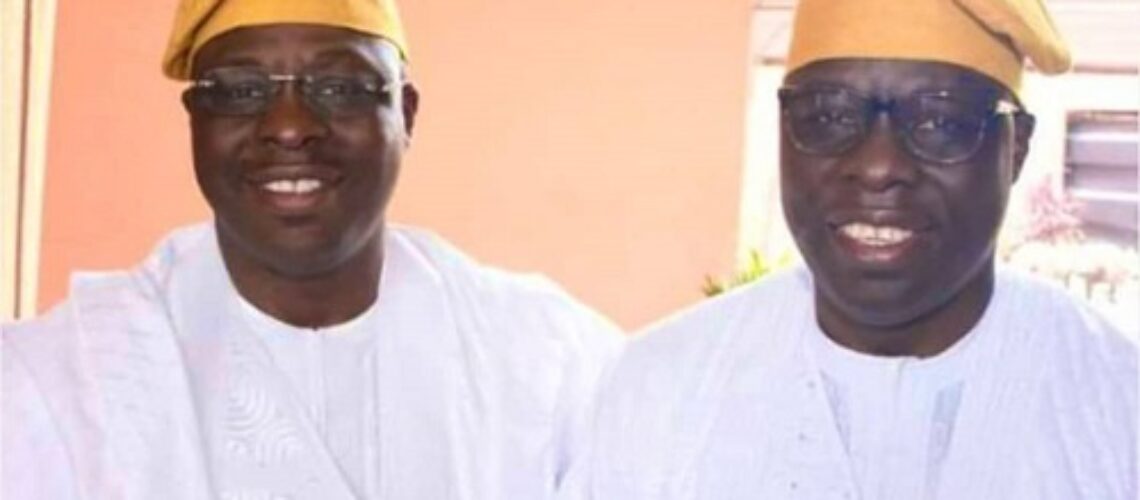
Nigeria has produced oil executives. It has produced gas technocrats. It has produced boardroom survivors and government-adjacent dealmakers. What it has rarely produced is this: two brothers, identical in face and formation, who climbed entirely on merit to sit simultaneously at the top of the country’s most powerful energy institutions — one leading indigenous production and the other anchoring global LNG.
Adegbite (Gbite) and Adeleye (Leye) Falade were born in 1972 into a household that did not traffic in excuses. Their father ran Government College, Ibadan. Their mother dressed chickens. And from that precise combination of intellectual rigour and honest labour, two identical twins were being prepared, without anyone quite knowing it yet, to one day command the most consequential levers of Nigeria’s energy future.
As of April 2026, Gbite serves as Managing Director and CEO of Aradel Holdings Plc, Nigeria’s leading indigenous energy company, while Leye has assumed the helm at Nigeria LNG Limited, the country’s flagship gas corporation. One is driving homegrown energy independence from the inside; the other is projecting Nigerian technical excellence onto the global stage. Together, they are rewriting what it means to lead from the front in Africa’s most consequential resource economy.
The Making of Two Future Leaders
The Falade twins grew up in Ibadan, the heart of Southwest Nigeria’s educational landscape. Their father was the principal of Government College Ibadan (GCI), one of Nigeria’s most storied model public schools. He nurtured Adegbite (Gbite) and Adeleye (Leye) through their early years at St. James’ Anglican Primary School, after which they proceeded to GCI for their secondary education. The Falade household was in itself an institution that did not merely raise children; it trained leaders. Baba Ibeji, as fathers of twins are typically called in Yorubaland, was methodical, exacting, and visionary. Under his watchful guidance, discipline combined with intellectual rigour became the daily liturgy for these young twin brothers.
Their mother, equally formidable, was industrious in a different register. While their father shaped their minds, she shaped their hustle. She ran a poultry business, supplying dressed chickens to Joyce-B, a popular Ibadan supermarket, and she enlisted her sons in the effort. For every chicken dressed, they earned 50 kobo. Leye, who had his eye on a “Disco Watch” that cost ₦13, quickly understood the arithmetic of honest effort.
“My mom was extremely industrious. For every chicken you dressed, you got 50 kobo. I quickly understood helping my mom to dress chickens was a way to get the watch, so I was very enthusiastic.”
This early exposure to earned reward, to the idea that effort, not entitlement, is the currency of progress, would remain the foundation of both brothers’ worldview. Their parents, both civil servants navigating Nigeria’s battered middle class of the 1980s, modelled persistence under pressure with extraordinary grace.
Government College, University of Ibadan, and the Birth of a Shared Path
Both brothers attended Government College Ibadan, where the ethos of academic excellence, cricket, and character formation left a lasting impression. Leye became captain of the school cricket team and went on to represent Nigeria’s Senior National Cricket Team from 1994 to 2000, a detail that speaks to the wholeness of their education: not just minds trained, but characters forged.
When the time came for university, their father was characteristically decisive. Leye had wanted to study Accounting at the University of Lagos, but given the campus unrest of the era, their father insisted both sons attend the University of Ibadan so they could return home quickly during any crisis. Leye discovered his twin was applying for Electrical and Electronics Engineering. The decision was made.
At the University of Ibadan, they sought advice from a senior Government College old boy about how to thrive academically. The counsel they received was deceptively simple, and they followed it with the same precision their father had instilled in them.
“Whether it’s sports or academics, the secret to success is being consistent day in day out in what you do. That is what I took away from the university.”
Gbite graduated with a First Class in Electrical and Electronics Engineering. Leye matched him. Both then pursued MBAs at world-class British institutions — Gbite at Warwick Business School and Leye at Henley Business School, University of Reading. Their academic journeys were not merely parallel; they were, in a very real sense, one conversation between two minds.
Shell Nigeria: The Crucible That Forged Both Executives
In 1996, both brothers joined Shell Nigeria as young engineers. This was the same year, the same company, and the same entry point. For Leye, who would spend 28 years within the Shell Group, the experience was transformational. He worked across seven countries spanning Europe, Asia, the Middle East, Russia and Africa, rising to become Country Chair of Shell Namibia, then Managing Director of Brunei LNG, the world’s longest-running liquefaction plant, before his appointment as MD/CEO of NLNG in April 2026.
Gbite’s path diverged in 2009 when he left Shell to enter the world of indigenous Nigerian energy companies. He served as Executive Director at Oando Gas & Power, COO of Oando Energy Resources, and Managing Director at Oilserv Group before joining Aradel Holdings (then Niger Delta Exploration & Production) as MD/CEO in February 2021. The poetic irony of his career is inescapable: the man who started as an engineer at Shell in 1996 became one of the architects of the $2.4 billion acquisition of Shell’s onshore Nigerian assets through the Renaissance consortium decades later.
“The only limitation is in your mind. Hard work pays, diligence pays. Shell lets you know that you are not limited in how far you can go.”
Corporate Governance and Institutional Building: Their Living Philosophy
What distinguishes the Falade twins from their peers is not merely the altitude of their positions but the philosophy with which they occupy them. Both men have demonstrated a consistent, visible commitment to corporate governance, institutional integrity, and ethical leadership — values that trace directly back to their father’s household.
Under Gbite’s stewardship, Aradel Holdings achieved a landmark listing on the Nigerian Exchange Group in October 2024, bringing transparency and accountability to a company that had long operated as a quiet but powerful force. He championed the company’s attainment of the ISO 45001:2018 certification for Occupational Health and Safety, signalling that world-class governance standards are not the exclusive preserve of multinationals.
“Aradel is firmly committed to creating a workplace where safety is our top priority, because for us, the first measure of success is safety.”
Leye, upon assuming office at NLNG, immediately signalled his governance priorities by leading his management team on a courtesy visit to the EFCC headquarters in Abuja, publicly affirming NLNG’s commitment to ethics, transparency and anti-corruption standards. He declared:
“We are guided by ethics and ethos that will not only stand in Nigeria, but outside the country. We are proud to say that as a company we will continue to be above board.”
For both men, governance is not a compliance exercise. It is character, the same character their father demanded from them while growing up in Ibadan.
Building Nigeria from the Inside Out
Gbite’s vision for Aradel, and for Nigeria’s broader energy future, is anchored in what he calls an “indigenous-first” strategy. Under his leadership, Aradel expanded from upstream oil production into gas commercialisation, refining operations, and renewable energy, becoming one of Nigeria’s most diversified energy companies. Indigenous producers now account for more than half of national output, a milestone he celebrated as both economic and symbolic.
As the newly appointed Chairman of the Independent Petroleum Producers Group (IPPG), Gbite set an agenda at the 2026 Nigeria International Energy Summit that was nothing short of transformational. He called for an end to Nigeria’s reliance on raw hydrocarbon exports and a pivot toward domestic value creation.
“Our future lies in building a self-sustaining energy industry that creates value at home, powers our industries and protects us from external shocks. Self-sufficiency is no longer optional — it is urgent.”
Leye, meanwhile, inherits NLNG’s most ambitious chapter yet. He arrives as the Train 7 expansion project, a $7 billion undertaking designed to raise Nigeria’s LNG output from 22 million to 30 million tonnes per annum, nears completion. His mandate is to translate that expanded capacity into real forex earnings and energy security for a nation that has for too long exported its potential.
Industry Accolades
The distinctive paths carved by the Falade twins have not gone unnoticed; their complementary corporate journeys are heavily decorated with prestigious institutional awards, engineering recognition, and industry honours. As prominent Nigerian energy executives, Adegbite (“Gbite”) and Adeleye (“Leye”) Falade have established themselves as standard-bearers for corporate leadership and industry advocacy across the continent.
Their respective climbs to the apex of the energy sector are marked by significant institutional milestones, as highlighted by these major awards and recognitions:
- Championing Workplace Equality: In 2023, the Women in Energy Network (WIEN) conferred the Gender Advocate of the Year Award upon Adegbite Falade. This accolade recognizes his personal commitment to driving gender diversity, equity, and inclusivity within the workspace at Aradel Holdings Plc. [1]
- Cross-Border Leadership Milestones: Highlighting his international enterprise development, Adegbite was honoured with the Distinguished Leadership in Energy & Business Award in 2026 by the North American Ministerial Coalition (NAMC). The award celebrates his strategic leadership across the oil, gas, and power sectors.
- Pioneering Gas Infrastructure: Representing the other side of their synchronized impact, Adeleye Falade accepted the Gas Infrastructure Project Company of the Year Award (2021/2022) on behalf of Nigeria LNG Limited (NLNG) during his tenure as General Manager of Production. The honour was presented at the highly regarded Nigeria International Energy Summit (NIES).
- Setting the Benchmark for Operations: At the NIES 2026 Summit, Adegbite stepped up to receive the Best Full-Field Integrated Operator Award on behalf of Aradel Holdings Plc. This coveted recognition highlights the company’s exceptional operational performance and coordinated asset growth strategy across the energy value chain.
- Driving Strategic National Growth: Further cementing their market dominance, Aradel Holdings Plc was named the Outstanding Oil & Gas Company of the Year by the Energy Times. Conferred under Adegbite’s executive leadership, the award celebrates the group’s historic 20 consecutive years of uninterrupted production and vital contributions to national energy development.
These accolades prove that the system can produce excellence without compromise. For a nation searching for role models who personify meritocracy, these decorated honours serve as a mirror, showing the next generation of African youth what is entirely possible when discipline meets opportunity.
Conclusion
The Falade twins represent something Nigeria desperately needs: proof that the system can produce excellence without corruption, that African professionals can rise from entry-level positions to billion-dollar boardrooms, and that the values taught in Ibadan compounds are portable to Brunei, The Hague, and Houston.
Born in the same moment, raised by the same hands, educated in the same halls, and launched into the world from the same company, they have nevertheless carved distinct, complementary legacies, one stewarding Nigeria’s indigenous energy revolution, the other anchoring its global gas ambitions.
In a nation searching for role models who look like possibility rather than compromise, Gbite and Leye Falade are not just power twins. They are a mirror, showing Nigeria what it can become when discipline meets opportunity, and when the values of home are carried all the way to the top. The Falade story carries particular weight for the youth of Southwest Nigeria, the region that produced them and whose values remain encoded in every chapter of their careers.