
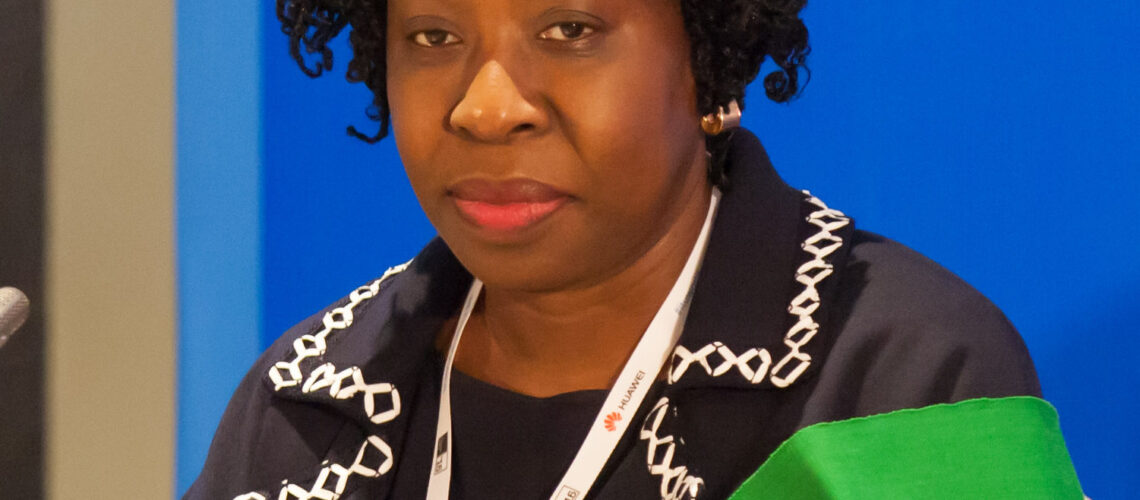
Your place of birth does not determine your greatness, neither does your gender. Yoruba Akinkanju women have continued to affirm this reality through their exploits in various fields. Here is Funke Opeke, an Ibadan-born woman whose digital infrastructure connected an entire sub-Saharan region to the world, allowing children, youths, and nations access to digital technologies and opportunities that were previously out of reach.
Through her company, Main Street Technologies, Funke built the MainOne cable, a 7,000-kilometer fiber optic cable system that connected West Africa to Europe, specifically Portugal. This was no ordinary infrastructure project; it was the first privately owned undersea cable in West Africa, bringing high-speed internet to countries like Nigeria, Ghana, Côte d’Ivoire, and Senegal, which had previously relied on expensive, slow satellite connections. The MainOne cable dramatically improved internet connectivity and laid the foundation for the region’s digital transformation, establishing Main Street Technologies as one of Africa’s most significant tech infrastructure companies and a leading communications services and network solutions provider in West Africa.
The Foundation: Growing Up in Ibadan
Born in 1961 in Ibadan, the capital city of Oyo State, Funke Opeke grew up in a household where education and excellence were not just encouraged but expected. Her father served as the first Nigerian director of the Cocoa Research Institute of Nigeria, while her mother worked as a teacher and later became headmistress of Sacred Heart Primary School on Ring Road, Ibadan, the very school young Funke attended. Born into a family of nine children, she was surrounded by intellectual curiosity and the pursuit of knowledge from her earliest days.
The environment of academic rigor at home was complemented by the strong female role models she encountered at Queen’s School, Ibadan, where she completed her secondary education. It was here, in the all-girls boarding school, that Funke’s passion for science crystallized. Her physics teacher, Mrs. Olukui, and a female lab technician became pivotal figures in her journey, encouraging her interest in electronics and engineering at a time when brilliant female science students were typically steered toward medicine.
“I remember physics in particular having Mrs Olukui as our physics teacher and a lab technician who was also female and so while you know brilliant science students especially women were encouraged to study medicine I wanted to study engineering.”
This early exposure to female mentors in technical fields would prove formative, giving her the confidence to chart her own course in a male-dominated field.
Academic Excellence and the American Journey
Funke’s determination to study electrical engineering led her to Obafemi Awolowo University (formerly the University of Ife), where she was admitted at a remarkably young age. By her own admission, her first three years were “probably a blur, a little too much partying,” but maturity and focus eventually took hold. She had initially broached the idea of studying abroad for her first degree, but her father firmly declined, insisting that none of his children would pursue undergraduate education outside Nigeria. However, he supported her ambition to earn a master’s degree abroad.
After completing her youth service, Funke was admitted to Columbia University in New York for graduate studies in electrical engineering, with a focus on data communications and signal processing. She even secured admission to a PhD program but made a pivotal decision that would shape her career trajectory.
“I was going to go on for a PhD program actually got admitted and then I thought you know I’ve been studying all this time… when you’re at that age you feel like there’s a lot of time I’m studying all this time I haven’t even applied all this I know why do I want to study more.”
Instead of pursuing further academic credentials, she chose to enter the workforce, taking her first job in the United States. What was meant to be a brief exploration of career opportunities before returning to Nigeria turned into nearly 25 years of building expertise in telecommunications and network infrastructure.
Building Leadership in Corporate America
Funke’s American career began during the early days of the internet revolution. She worked as a consultant with some of the world’s largest companies, then moved into operational management roles, deploying cutting-edge telecommunications technologies. During the dot-com boom, she joined friends in California to help build Sendmail, an open-source email company that reached a paper valuation of $8 billion. Though the company crashed during the dot-com bust of April 2000, the experience taught her invaluable lessons about entrepreneurship, risk, and resilience.
She then joined Verizon’s wholesale division in New York City, where she rose to become an executive director. At Verizon, she managed Harvard MBAs, oversaw multi-million dollar projects, and learned the art of leadership at scale. The experience was transformative.
“I learned the ability to create value and to lead… through that journey I grew from being an entry-level engineer to having a director-level position in Verizon which is a really large corporation and so through that journey I learned to manage people to manage resources the practice of just management getting large complex multi-million dollar projects done.”
Yet even as she climbed the corporate ladder, Nigeria called to her. During her Sendmail days, when the company’s valuation soared, colleagues spoke of yachts and ranches. Funke had a different dream: she wanted to return to Africa and contribute to its development.
The Homecoming: MTN and the Infrastructure Gap
In 2005, that dream became reality when Funke joined MTN Nigeria as Chief Technical Officer. Nigeria’s telecommunications sector was experiencing liberalization, creating opportunities to apply her decades of expertise. However, the return exposed her to a stark reality: despite the growth of mobile telephony, Nigeria lacked the foundational digital infrastructure that could truly transform the economy.
Every morning, driving to her office, she witnessed the human cost of this gap—hundreds of young people sitting or wandering aimlessly, unemployed or underemployed. The contrast between their potential and their circumstances haunted her. She recognized that mobile networks alone weren’t enough; the country needed robust backbone networks, submarine cables, internet access, and data centers to unlock true digital transformation.
When business leader Fola Adeola called seeking her advice on saving NITEL (Nigerian Telecommunications Limited), what began as informal consultation evolved into a position as Chief Operating Officer. Though the NITEL turnaround effort ultimately failed, Adeola’s offer to support any future venture gave Funke the opening she needed.
“I thought about it for a few minutes and I came back and said we want to do MainOne I want to build a submarine cable he said you got to be crazy I said no and yeah the rest is history.”
MainOne: A Leap of Faith That Connected Continents
In 2008, armed with engineering expertise, business acumen, and unwavering determination, Funke founded Main Street Technologies and embarked on what many considered an impossible mission: building a privately owned submarine cable system connecting Portugal to West Africa. The MainOne cable would stretch 7,000 kilometers, landing in Nigeria and Ghana and eventually expanding to Senegal and Côte d’Ivoire.
The fundraising journey was gruelling. She invested her own savings from Verizon stock options to conduct feasibility studies. The first $3 million raised from friends and family, led by Fola Adeola, was the hardest. But between April 2008 and January 2010, she successfully raised $240 million in equity and debt financing, a staggering achievement for a first-time entrepreneur in Africa, let alone a woman in telecommunications.
On July 22, 2010, the MainOne cable went live, immediately slashing international bandwidth prices to less than 20% of previous rates. Internet penetration in Nigeria jumped from under 10% to over 50%. The digital plumbing was finally in place for the tech ecosystem explosion that would follow: fintech innovations, e-commerce platforms, digital payments, and countless startups that define Nigeria’s technology landscape today.
But Funke wasn’t finished. In 2015, MainOne launched Nigeria’s largest Tier III data centre, providing the infrastructure for cloud services and enterprise computing. The company expanded its terrestrial fibre networks and points of presence across West Africa, creating the comprehensive digital infrastructure she had envisioned.
“If you stay focused if you’re doing the best you can if you’re looking to create value the reward will come… ultimately if you’re really committed to a good value adding goal and you’re doing the best you can one way or the other it will manifest.”
Recognition and Legacy
Funke’s achievements have earned global recognition. In 2012, CNBC named her All Africa Businesswoman of the Year. In 2018, Forbes included her on its list of the World’s Top 50 Women in Tech, the first person from Nigeria to earn that distinction. In 2022, she received the Officer of the Order of the Niger (OON), one of Nigeria’s highest honours, and most recently, in 2024, she was honoured as the WISCAR Distinguished Award Recipient.
The ultimate validation came in 2022 when Equinix acquired MainOne for $320 million, marking one of the largest exits for a company led by a female African founder. Today, MainOne employs 600 people, serves over 1,000 enterprise customers, and has created 100,000 jobs directly and indirectly across 10 African countries.
Yet for Funke, the numbers tell only part of the story. Her legacy lives in every Nigerian who can now access information, learn new skills, or build a business online. It lives in the tech entrepreneurs who build on the infrastructure she created. And it lives in her enduring message to the next generation.
“Find your career find your passion and do the very best you can to make your mark and leave a legacy… it has to be something you would do even if you were not paid… if you find your passion and give it your very best then even when you’re long gone I certainly hope that when I’m long gone I will be remembered for birthing MainOne.”
From the daughter of educators in Ibadan to the woman who connected West Africa to the world, Funke Opeke’s journey exemplifies the transformative power of vision, perseverance, and an unwavering commitment to creating value for others. Her story is not just about building a cable—it’s about building possibility.