
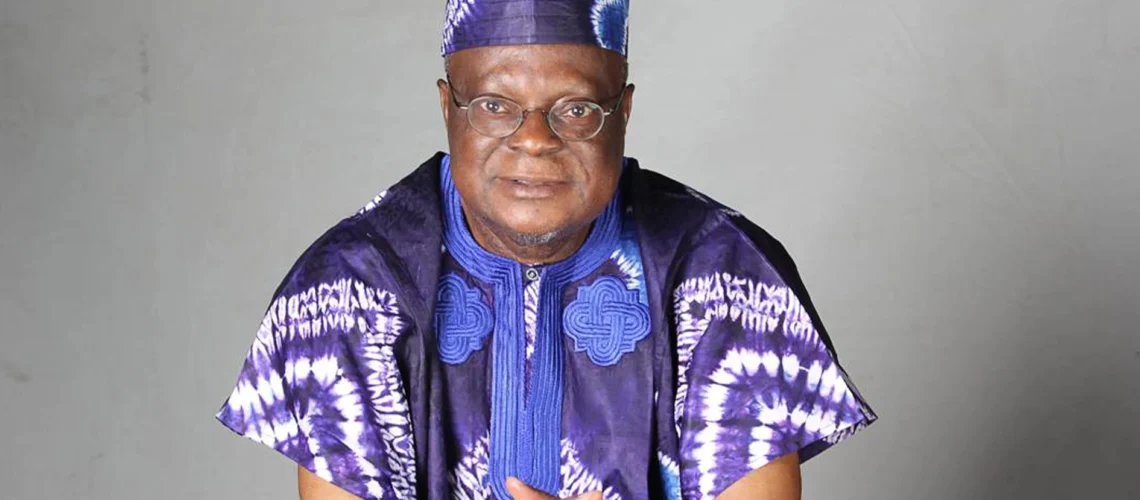
On June 16, 2026, Professor Babafemi Osofisan will turn eighty years old. There will be tributes, formal gatherings at universities, commendations from literary bodies across three continents, and columns in the papers. But the most honest tribute one can offer a man like Osofisan is not applause. It is attention: close, sustained, and uncomfortable enough to actually reckon with what he has spent eight decades saying. Because Professor Femi Osofisan has never stopped saying it. Not when governments came for the arts. Not when academia tried to contain him. Not when the world’s most prestigious universities told him that African drama was not a serious subject. Eighty years on, he is still writing, still directing, still arguing, with the same controlled fury that has made him, in the estimation of scholars from Harvard to Leeds, one of the most purposeful and the most prolific playwrights the African continent has ever produced.
To understand how he arrived here, still publishing, still staging, and still teaching at Kwara State University after retiring from the University of Ibadan in 2011, one must go back to the beginning. Not to his first play, nor to his first prize, but to a small community in Ogun State in the mid-twentieth century, where the story that became Femi Osofisan quietly started.
Erunwon, 1946: The Household That Valued Words
On June 16, 1946, Babafemi Osofisan was born in Erunwon, Ogun State, to Ebenezer Olatokunbo Osofisan, a school teacher, lay reader, and church organist, and Phoebe Olufunke Osofisan, herself a teacher. The household was modest, but it was one thoroughly saturated in language: the spoken rhythms of Yoruba oral tradition, the formal cadences of the church, and the disciplined grammar of the classroom. Two teachers for parents and a father whose Sundays were given over to music, it is not difficult to see where the sensitivity to sound, structure, and meaning began.
From 1952 to 1958, Osofisan attended primary school in Ile-Ife, one of the spiritual and cultural heartlands of Yoruba civilisation. The choice of Ile-Ife for his earliest education is biographical in the truest sense: the city’s deep mythology, its oral histories, its identity as the origin point of Yoruba cosmology would become, decades later, a recurring resource in his literary imagination. What he absorbed as a child in Ile-Ife, he would later reconstruct on stages across four continents.
Government College, Ibadan: The First Prize and the First Signal
From primary school, Osofisan proceeded to Government College, Ibadan, one of the Southwest’s most distinguished secondary institutions, whose alumni roll reads as a catalogue of Nigerian intellectual and public life. It was here, in the corridors of one of colonial Nigeria’s finest grammar schools, that his literary instinct first received formal recognition. In 1963, he sat his West African School Certificate examinations and emerged with the inaugural T. M. Aluko Prize in Literature. Aluko himself, the novelist and civil engineer after whom the prize was named, was among the first Nigerians to write English-language fiction that took the collision of tradition and modernity seriously. That Osofisan won his prize at sixteen was less a coincidence than a signal.
Secondary school also gave him the social and intellectual formation that the Southwest’s grammar school tradition was designed to produce: grounding in English literature, exposure to classical texts, and a seriousness about ideas. What it could not give him, a framework adequate to the African experience, he would spend the rest of his life constructing himself.
University of Ibadan, 1963–1969: Honours, Ideas, and the Theatre Society
Osofisan entered the University of Ibadan, Nigeria’s oldest and, at the time, most intellectually alive university, to read French. He graduated in 1969 with a Bachelor of Arts degree with honours. But a degree classification, however distinguished, is a poor measure of what Ibadan gave him. The university in the 1960s was a ferment: Wole Soyinka had already begun his career there, the arts faculty was producing some of the sharpest minds on the continent, and the Drama Society was a genuine creative laboratory rather than an extracurricular decoration. Osofisan threw himself into it, eventually serving as President of the University of Ibadan Drama Society, his first experience of institutional leadership and a formative one.
These were also the years of Nigeria’s civil war, of military governance, and of the political turbulence that would define much of what Osofisan’s generation felt called to respond to through their art. He graduated in 1969, one year after the war ended, into a Nigeria that was physically reunited but ideologically unresolved. The tension between that unresolution and the demand for a literature that could speak to it would animate every play he subsequently wrote.
“The most African playwright of the post-colonial era… the most prolific playwright on the African continent.”
— late Professor Biodun Jeyifo, Harvard University, 2006
Paris, 1972–1973: The Sorbonne and the Act of Refusal
After a period of early professional activity following graduation, Osofisan won a scholarship for postgraduate study at the Sorbonne in Paris, one of the world’s most storied academic institutions. He arrived in 1972 with a clear intellectual purpose: to research African drama and write a doctoral thesis that took it seriously as a field worthy of rigorous academic inquiry. What he encountered instead was the closed door of a supervising mind unwilling to extend that seriousness to the African stage. His supervisor declined to approve a thesis on African drama as a legitimate subject.
The decision Osofisan made at that moment is, in retrospect, the hinge on which his entire intellectual identity turns. He did not renegotiate his subject. He did not find a more accommodating angle. He walked away from the degree. It was not an act of pique but of clarity, a refusal to allow a European institutional framework to determine what was worthy of serious thought. He returned to Nigeria in 1973, joined the University of Ibadan as an Assistant Lecturer in the Department of Modern Languages, and began building the career and the argument that the Sorbonne had tried to foreclose.
“Like Soyinka and Fugard before him, Osofisan has attacked repressive governments wherever they have emerged , and he has been attacked in turn.”
Ibadan, 1973–1977: The PhD, the Classroom, and the Stage
In 1974, barely a year after returning from Paris, Osofisan completed his PhD at the University of Ibadan, a doctoral dissertation on the origins of drama in West Africa, the very subject the Sorbonne had refused to entertain. The speed of its completion suggests not only intellectual readiness but also accumulated conviction. He had been thinking about this argument for years. He had simply been waiting for the right institutional context in which to make it.
As an Assistant Lecturer, then Lecturer, in the Department of Modern Languages, Osofisan began the parallel work of building his literary output alongside his academic career. His early plays, including Once Upon Four Robbers, were not exercises in dramatic theory but direct interventions in the social and political life of Nigeria. To produce these works with the artistic independence and communal energy they demanded, he founded the Kakaun Sela Kompany in the 1970s. It was a bold experiment in ensemble theatre, a cultural movement that staged plays in open spaces and treated performance as a living civic ritual. The troupe, which included gifted performers like Jimi Solanke, Demola Onibonokuta, and Tunji Oyelana, became a training ground for the ensemble practices that would later define Nigerian theatre. Its ethos was famously humble, as media guru Ohi Alegbe noted, the entire cast and crew once toured universities in the Southeast in a single Volkswagen Beetle to perform The Oriki of a Grasshopper and The Engagement. In 1977, he served as Drama Consultant to FESTAC, the Second World Festival of Black and African Arts and Culture in Lagos, his first formal engagement with cultural policy at the highest level and evidence that the Nigerian state, whatever its governance failures, recognised the weight he carried.
The 1980s: The Guardian, MAMSER, and a Growing Reputation
The decade of the 1980s consolidated what the 1970s had begun. In 1982, Osofisan was appointed to the pioneer Editorial Board and think tank of The Guardian newspaper in Lagos, one of the most consequential media institutions in Nigerian history at its founding. The Guardian was not a publication that sought safe opinions; its founding board was assembled to produce serious journalism for a serious reading public. Osofisan’s presence on that board placed him at the intersection of intellectual life and public discourse in a way that purely academic careers rarely allow.
Also in 1985, he was appointed Visiting Professor of Drama at the University of Ife, now Obafemi Awolowo University, deepening his formal roots in the Southwest while continuing to lecture at the University of Ibadan. By the close of the decade, he had served as President of the Association of Nigerian Authors from 1988 to 1990 and had worked with the Movement for Mass Mobilisation, Social and Economic Recovery (MAMSER) in Abuja, a government body established to rebuild civic consciousness after years of military rule. These were not contradictory engagements. They were a consistent pattern: Osofisan moving between critical independence and institutional participation, always on his own terms.
“The roles of theatre and literature in society, gender and empowerment of women, style and language, the mobility of oral tradition, these are the territories his work has covered.”
The 1990s: International Stages and the French Honour
By the 1990s, Osofisan’s reputation had outgrown its Nigerian address. His 1997 play Many Colours Make the Thunder King was produced at the Guthrie Theatre in Minneapolis, one of America’s most respected regional theatres, marking the moment his work entered the mainstream of international theatrical discourse. Productions followed at other major venues in the United States, the United Kingdom, Germany, Sri Lanka, Canada, and China. His adaptations of Greek and Shakespearean texts – Antigone, Hamlet – were not reverent reproductions but pointed reinterpretations, each tailored to address a specific political condition in post-colonial Africa. To adapt Antigone for a Nigerian audience living under military governance was itself an argument about the universality of resistance.
The world began to formally recognise what Nigeria had long known. In 1999, the French government awarded him the Officier de l’Ordre Nationale de Mérite, one of France’s highest civic honours, and a pointed irony for a man whose Sorbonne supervisor had once decided that African drama was beneath academic consideration. His collected prose works, Ma’ami, Abigail, and Cordelia, initially written as newspaper columns in the Daily Times and The Guardian, were by now in wide circulation. His pseudonymous poetry collections, Minted Coins and Dream Seeker on Diving Chain, published under the name Okinba Launko, added another dimension to a body of work that had already become difficult to contain within any single category.
“Nigeria’s most purposeful writer and social critic cum activist, he has incessantly used his creativity to champion the cause of the marginalized.”
The 2000s: Neustadt, Governance, and the Weight of Honour
In 2000, Osofisan was shortlisted for the Neustadt International Prize for Literature, the award often described as the American Nobel, placing him in the company of the world’s most distinguished living writers. He did not win, but the shortlisting said something important: that the case for Osofisan’s significance was no longer being made only in African academic circles. In 2001, his collected essays were published under the title Insidious Treasons, gathering his major critical writings, including Drama as Insurrection, the Terror of Relevance in Contemporary Nigeria, and the Frontiers of Terror in a Post-Colonial State. These were not polite academic arguments. They were indictments, carefully assembled and precisely aimed.
The awards that followed in the mid-decade confirmed a pattern of recognition spread across disciplines and borders. The Nigerian National Order of Merit in the Humanities (NNOM) came in 2004, the same year he became President of PEN Nigeria, a position he held until 2010. In 2006, the Fonlon-Nichols Prize for Literature and the Struggle for Human Rights arrived from Cameroon, alongside election as a Fellow of the Nigerian Academy of the Arts. That same year, a critical volume on his work, Portraits for an Eagle, was published in Germany in the Bayreuth University African Studies Series, featuring essays from scholars at Harvard, Leeds, and South Africa. Harvard’s Biodun Jeyifo, lecturing at the University of Ibadan in 2006, called him ‘the most African playwright of the post-colonial era’ and placed him alongside Wole Soyinka at the centre of the radical literary and cultural movements of the preceding three decades. In 2009, yet another critical volume, Emerging Perspectives on Femi Osofisan, was published by Africa World Press in the United States.
In 2016, Osofisan received two significant international recognitions. The first was at the 20th Cairo International Festival of Contemporary and Experimental Theatre (CIF-CET) in Egypt, held on 20 September, 2016, where six international theatre icons were honoured. Shortly after, he received the prestigious Thalia Prize of the International Association of Theatre Critics (IATC) during its 28th Congress in Serbia on September 27–28, 2016, held in conjunction with the 50th Anniversary of the Belgrade International Theatre Festival (BITEF). As the tenth recipient of the award instituted in 2006, Osofisan became the first African to be so honoured.
“He is referred to as Nigeria’s most purposeful writer and social critic cum activist — a writer who has led his generation on the path of mobilizing creativity for social and political change.”
On Governance: What Institutions Are For
Any honest account of Femi Osofisan must engage with his relationship to institutional life, not because it is peripheral to his literary achievement, but because it is central to his argument about how society should function. He served on the founding board of The Guardian. He led the Association of Nigerian Authors and PEN Nigeria across two separate decades. He founded CentreSTAGE Africa (the Centre for the Study of Theatre and Alternative Genres of Expression in Africa), an NGO dedicated to sustaining African theatrical scholarship outside Western institutional frameworks. He served as General Manager and Chief Executive of the National Theatre, Lagos. He was Vice-President of the Pan African Writers’ Association.
These roles were not honorary positions collected for their titles. There were arguments made in organisational form, each one a demonstration that the health of culture depends on the health of the institutions that carry it. His essays in Insidious Treasons make the intellectual case; his decades of institutional service make the practical one. For Nigerian youth, particularly those in the Southwest navigating a landscape of civic disillusionment, this is perhaps Osofisan’s least celebrated but most instructive contribution: he built things, joined things, led things, and stayed long enough to matter. He did not confuse presence with participation, or participation with transformation. He worked for transformation, institution by institution, for fifty years.
June 16, 2026: Eighty Years, Still Writing
On June 16, 2026, the man born in Erunwon eighty years ago will mark his birthday still at work. He remains Emeritus Professor at the University of Ibadan and a distinguished professor at Kwara State University. He continues to guest-direct his own plays at theatres and universities across Canada, Germany, and China. His most recent play, Ajayi Crowther, extends his lifelong project of recovering African historical figures from the distortions of colonial narration. His poetry, published under the name Okinba Launko, continues to circulate. His essays remain in print and in use.
Femi Osofisan was born in Ogun State, educated in Ile-Ife and Ibadan, and built the bulk of his intellectual life at the University of Ibadan. His formation is deeply rooted in the Yoruba Southwest, a landscape where oral traditions, communal ethics, and the belief that language is action converge. Indeed, one of his most significant contributions has been the transformation of these performance traditions into a global intellectual resource. His plays draw on Yoruba cosmology, the fluidity of masquerade traditions, the celebratory power of oriki, and the accountability of communal ethics. He does not merely borrow from this culture; he reinterprets it as a strategic lens to interrogate contemporary political realities—examining corruption, tyranny, memory, and justice on a world stage. Yet, for all this global impact, the lessons his life offers to the current generation are not about fame. They are about structure.
There are not many figures in Nigerian public life of whom it can honestly be said that their eightieth year finds them still at the frontier of their discipline, still insisting that the theatre matters, still arguing, through form as much as content, that society can be other than it is. Femi Osofisan is one of them. The Southwest produced him. It owes him the tribute of attention, of serious study, and of the kind of inheritance that is the highest form of respect: not imitation of his style, but adoption of his refusal, his stubborn, principled, lifelong refusal to look away from what is wrong, and his equally stubborn insistence that beauty and rigour, together, can do something about it.