
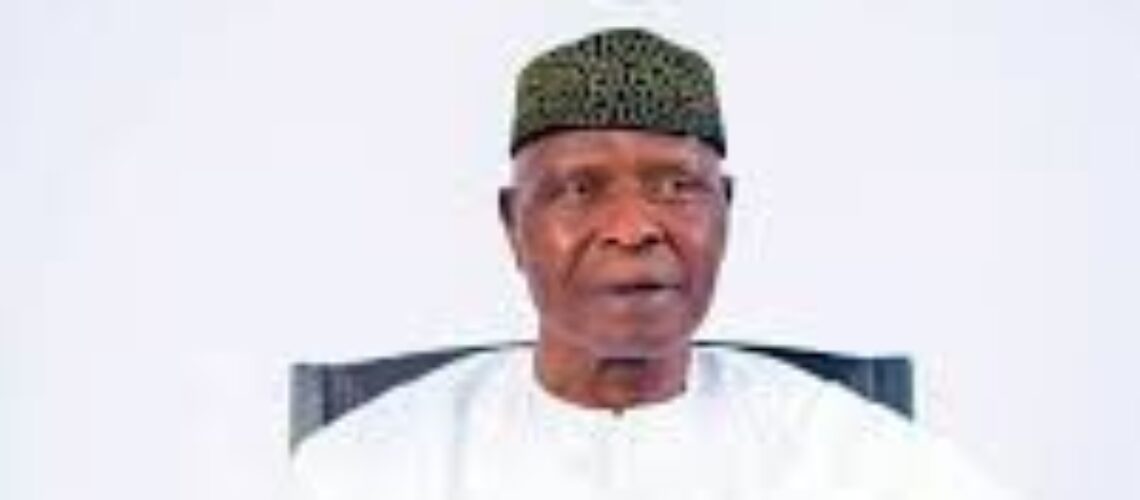
Cornelius Olatunji Adebayo, a distinguished figure in Nigerian politics and governance, has navigated various roles throughout his career, leaving a profound impact on education, telecommunications, and infrastructure development in the country. Born on February 24, 1941, in Igbaja, Kwara State, Adebayo’s journey of service began early in life and continued to shape the trajectory of his contributions to Nigerian society.
Adebayo’s educational journey prepared a strong background for his future exploits. He attended All Saints Anglican School in Oke-Onigbin before progressing to Provincial Secondary School in Ilorin. His pursuit of higher education led him to the elite institution called Barewa College, Zaria, where he honed his intellectual prowess from 1962 to 1963. Subsequently, he pursued higher studies at Ahmadu Bello University, Zaria, from 1964 to 1967, and later at the University of Ghana, Legon, from 1967 to 1969.
After completing his studies, Adebayo embarked on a career in academia, joining the University of Ife as a lecturer in 1969. His passion for education and commitment to scholarly pursuits led him to assume the role of Head of the English Department in 1974 when the Kwara State College of Technology was newly established. During his tenure, he demonstrated a deep dedication to educational advancement, laying the groundwork for his future endeavors in public service.
With a short but successful period in the academia, Adebayo transitioned into the realm of politics and his ascent was marked by significant milestones. With return to democracy and democratic elections in Nigeria’s second republic in 1979, he emerged as a Senator of the Federal Republic of Nigeria, representing the Unity Party of Nigeria. His tenure as a Senator was characterized by a steadfast commitment to the welfare of his constituents and the advancement of democratic ideals as guided by his party philosophy of egalitarianism.
Adebayo’s leadership prowess was further evident when he assumed the governorship of Kwara State in 1983. Despite the brevity of his tenure, he left an indelible mark on the educational landscape of the state. Adebayo’s three months administration spearheaded initiatives to enhance educational infrastructure, constructing numerous classrooms in secondary schools and advocating for the abolition of the shift system in primary education. However, his tenure as governor was cut short by the military overthrow led by Major General Muhammadu Buhari on December 31, 1983. Despite this setback, Adebayo’s commitment to public service remained unwavering, as evidenced by his subsequent engagements in the political arena.
In 1993, Adebayo’s steadfast principles and support for democratic governance were tested when he declined a ministerial office offered by the military regime of General Sani Abacha. His unwavering dedication to democratic ideals and advocacy for the return of democracy during Abacha’s regime led to his interrogation following a bomb explosion in Ilorin in 1995.
When democracy was restored in 1999, Adebayo was appointed as Minister of Communications in June 2003 by President Olusegun Obasanjo. He championed initiatives to enhance telecommunications infrastructure and fostered partnerships with industry stakeholders. Adebayo’s advocacy for the privatization of NITEL, the state telecommunications company, marked a pivotal moment in Nigeria’s telecommunications landscape.
Adebayo’s contributions were transformative. Under his leadership, Mtel, the mobile subsidiary of NITEL, embarked on ambitious expansion plans, signaling a new era of growth and innovation in the telecommunications sector. His tenure witnessed the acquisition of NITEL by Transnational Corporation of Nigeria in 2006, further underscoring his instrumental role in shaping the telecommunications industry.
In September 2006, Adebayo’s legacy of service continued as he assumed the role of Minister of Works, succeeding Engineer Obafemi Anibaba. His tenure in this capacity was characterized by a commitment to infrastructure development and the enhancement of transportation networks across the country.
Cornelius Olatunji Adebayo’s remarkable journey manifests a committed dedication to public service and a tireless pursuit of excellence. His contributions to education, telecommunications, and infrastructure development have left an indelible mark on Nigerian society, underscoring his enduring legacy as a statesman and leader.