
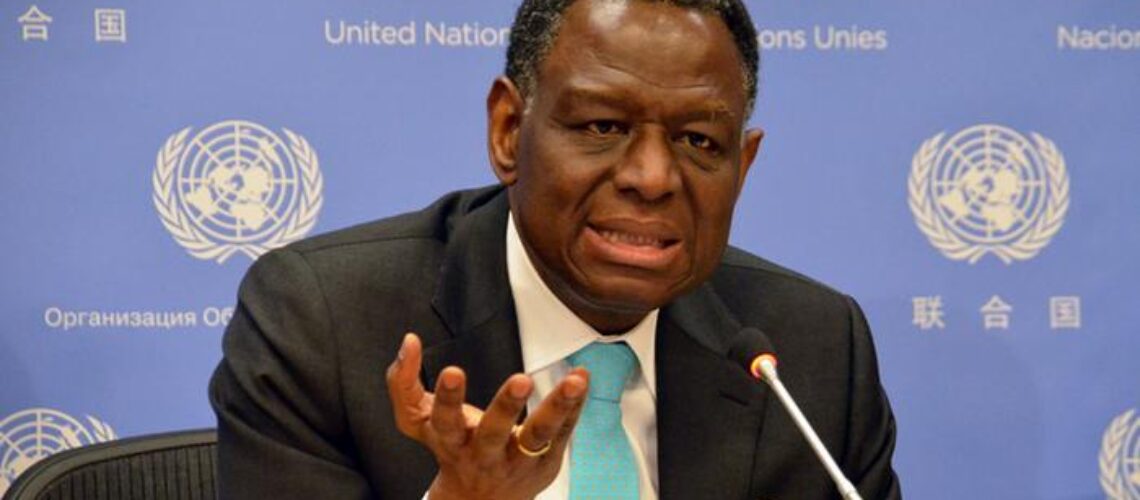
Professor Babatunde Osotimehin might be resting in Abraham’s bosom, but his journey from the modest streets of Ijebu to the highest echelons of the United Nations represents both extraordinary individual achievement and the remarkable contributions of Yoruba people to medicine, education, and humanitarian service worldwide that we on earth can still learn from.
As Nigeria’s Minister of Health and later as Executive Director of the United Nations Population Fund, Osotimehin championed the rights of women, adolescents, and young people with a moral clarity that transformed international health policy. His life embodied a philosophy of humility wedded to excellence, service grounded in expertise, and a vision of development that placed human rights and dignity at its center.
His story is that of a man who never forgot where he came from, who taught everyone to “always be humble,” and who demonstrated that one individual, armed with compassion and unwavering commitment, can indeed change the world—a story that reflects not only his personal brilliance but also the rich tradition of Yoruba excellence that has profoundly shaped Nigeria and the global community.
The Making of a Humble Giant
On February 6, 1949, Babatunde Osotimehin was born in the ancient town of Ijebu, Ogun State. His journey from the modest streets of Ijebu to the corridors of the United Nations exemplifies not only individual brilliance but also the rich tradition of Yoruba excellence that has shaped Nigeria and the world.
His early years were marked by the values that would define his entire life. Between 1966 and 1971, young Babatunde attended Igbobi College, an institution known for producing some of Nigeria’s finest minds. From these formative years emerged the humility that would become his defining characteristic. Even as he ascended to the highest echelons of international service, colleagues and family members would remember him teaching everyone around him to “Always be humble.” This was no mere platitude but a lived philosophy that made him approachable to heads of state and field workers alike.
The Scholar’s Path
The trajectory of Osotimehin’s academic journey reflects the Yoruba cultural premium placed on education and excellence. After completing his secondary education, he entered the University of Ibadan to study medicine, graduating in 1972 with the qualification that would open doors to a lifetime of healing and service. But for Osotimehin, one degree was merely the beginning. In 1979, he pursued a doctorate in medicine at the University of Birmingham in the United Kingdom, demonstrating the intellectual rigor and commitment to continuous learning that characterized his approach to life.
Between 1979 and 1980, he served as a fellow in endocrinology at Cornell University Graduate School of Medicine in New York, gaining exposure to cutting-edge medical research and international best practices. This international experience would prove invaluable in shaping his global perspective on health challenges.
Rise Through Academic Excellence
Returning to Nigeria in 1980, Dr. Osotimehin was appointed Professor of Clinical Pathology at the College of Medicine, University of Ibadan, at the remarkably young age of 31. His brilliance was undeniable, but it was his work ethic and dedication that truly set him apart. Through persistent effort and unwavering commitment to excellence, he rose to become Provost of the College of Medicine at the University of Ibadan from 1990 to 1994. This administrative role revealed his capacity not just for clinical excellence but for leadership and institutional development.
His appointment as Provost represented more than personal achievement; it continued a legacy of Yoruba leadership in Nigerian higher education. The Yoruba people have consistently produced scholars, administrators, and innovators who have transformed Nigeria’s educational landscape. From pioneering universities to groundbreaking research institutions, Yoruba contributions to Nigeria’s intellectual infrastructure remain foundational to the nation’s development.
Where Medicine Meets Humanity
Professor Osotimehin’s approach to medicine was holistic and deeply humanistic. He understood that healthcare was not merely about treating diseases but about affirming human dignity, promoting rights, and ensuring equity. His philosophy integrated three core principles that guided every initiative he undertook: human rights as the foundation of development, equity and gender equality as non-negotiable standards, and youth empowerment as the pathway to sustainable progress.
His belief in the indivisibility of health and rights found expression in every policy he championed. For Osotimehin, without rights, there could be no development—a conviction that informed his advocacy for universal access to healthcare services, particularly for the most vulnerable populations. He recognized that investing in women and young people was not charity but strategic necessity for any society seeking sustainable development.
“We need to ensure that young people of both genders have equal participation, not only in reproductive rights and health but also within society and in the economy.”
This was a practical framework that informed policy decisions, program designs, and resource allocations throughout his career.
Transforming Nigerian Healthcare
Before becoming Minister of Health, Osotimehin held numerous critical positions that prepared him for national leadership. From July 2002 to March 2007, he served as Chairman of the National Action Committee on AIDS in Nigeria, coordinating the nation’s response to one of its most pressing health challenges. He was also the Project Manager for the World Bank-assisted HIV/AIDS Programme Development Project and later became Director-General of the Nigerian National Agency for the Control of AIDS.
These roles showcased his ability to navigate complex bureaucracies, coordinate diverse stakeholders, and deliver results in resource-constrained environments. In 2005, his growing reputation earned him the position of Vice President of the 14th International Conference on AIDS and STIs in Africa, cementing his status as a continental leader in the fight against HIV/AIDS.
Professor Osotimehin’s appointment as Minister of Health for the Federal Republic of Nigeria under President Umaru Musa Yar’Adua represented the apex of his national service. In this capacity, he introduced reforms that would have lasting impacts on Nigeria’s healthcare delivery system.
His most notable achievement was the development of a comprehensive national health plan focused on strengthening primary healthcare, which forms the foundation of any effective health system. Recognizing the critical role of emergency medical care, he championed legislation requiring medical institutions to treat accident and gunshot victims, with penalties including jail terms for refusal. This single policy saved countless lives and demonstrated his commitment to practical, enforceable solutions to systemic problems.
His particular focus on maternal mortality reflected both his medical expertise and his values. He worked tirelessly to reduce the unacceptably high rates of women dying in childbirth, a tragedy he believed could and should be eliminated.
“We must develop zero tolerance to women dying.”
This statement encapsulated his approach: moral clarity combined with technical expertise to drive transformative change.
The United Nations Years
On January 1, 2011, Dr. Babatunde Osotimehin made history as the fourth Executive Director of the United Nations Population Fund (UNFPA) and the first from sub-Saharan Africa to hold this position. He brought to this role the rank of Under-Secretary-General of the United Nations, placing him among the highest-ranking international civil servants.
At UNFPA, he introduced major reforms that made the organization more focused and results-oriented. He intensified efforts to promote youth rights and capabilities, particularly in sexual and reproductive health. His leadership was instrumental in advancing the consensus reached at the 1994 International Conference on Population and Development in Cairo, ensuring that sexual and reproductive health remained central to the global development agenda.
Upon moving into his second term in 2015, he implemented additional reforms that increased UNFPA’s effectiveness and efficiency. His vision for improving the lives of women, adolescents, and youth worldwide became more robust and comprehensive. He championed Family Planning 2020, co-chaired its Reference Group, and chaired the World Economic Forum’s Global Agenda Council on the Demographic Dividend.
His advocacy extended beyond reproductive health to encompass humanitarian action and efforts to eliminate gender-based violence and harmful practices such as child marriage and female genital mutilation. Speaking at the Family Planning Summit in Addis Ababa, his passion was unmistakable when he declared his commitment to protecting girls:
“For as long as we marry our girls off at 12, and for as long as teenage pregnancy remains at epidemic levels, for as long as we violate the rights of the girl child, we will not progress. I believe we can stop this—and we must. No parent should be happy to see an 11- or 12-year-old child become paralyzed from childbirth. Let us stop teenage pregnancy. Let us stop child marriage. We can do it.”
This was more than rhetoric. Under his leadership, UNFPA launched initiatives specifically targeting the 7.2 million girls who became pregnant every year—200,000 daily. He understood these issues as interconnected elements of a larger struggle for human rights and dignity, refusing to separate reproductive health from education, economic opportunity, and fundamental freedoms.
His collaborative approach to these challenges was encapsulated in his frequent reminder:
“If you want to go fast, go alone. If you want to go far, go together. Let me encourage you to make your voices heard in this enterprise.”
This wisdom guided his work, building coalitions and empowering partners across continents.
Top Three Achievements and Contributions
First, his leadership in HIV/AIDS control in Nigeria. As Chairman of the National Action Committee on AIDS and later as Director-General of the National Agency for the Control of AIDS, Professor Osotimehin transformed Nigeria’s response to the epidemic. He coordinated efforts across a nation of over 160 million people, bringing together government agencies, civil society organizations, and international partners. His work helped reduce HIV prevalence rates and improved access to treatment and prevention services for millions of Nigerians.
Second, his transformative tenure as Nigeria’s Minister of Health. During his time as minister, he built a national health plan centered on primary healthcare, recognized as the most cost-effective approach to improving population health. His legislation requiring the treatment of accident and gunshot victims addressed a critical gap in emergency care. His focus on maternal mortality, childhood diseases like poliomyelitis, and reproductive health established frameworks that continue to guide Nigerian health policy today.
Third, his global leadership at UNFPA. As Executive Director, he placed youth empowerment and sexual and reproductive health at the center of the international development agenda. He spearheaded efforts that reached millions of young people worldwide with comprehensive sexuality education, family planning services, and rights-based approaches to health. His reforms made UNFPA more effective, and his advocacy influenced policy decisions in countries across Africa, Asia, and Latin America. His championing of the demographic dividend helped governments understand that investing in youth is essential for economic transformation.
Recognition and Honors
Professor Osotimehin’s contributions earned him numerous accolades. In December 2005, he received the Nigerian national honour of Officer of the Order of the Niger (OON), one of the country’s most prestigious civilian awards. This recognition acknowledged his exceptional service to the nation in the field of health and medicine.
Beyond formal awards, his greatest recognition came from the lives he touched and transformed. At the first edition of the Professor Babatunde Osotimehin National Reproductive Health Legacy Forum held at the University of Ibadan, speakers described him as one of Nigeria’s greatest icons in reproductive health, whose impact transformed both national and global policy. The establishment of this forum itself, organized by the Academy for Health Development in collaboration with multiple partners, stands as testament to the enduring relevance of his work.
Individual Excellence, Collective Impact
Professor Osotimehin’s achievements cannot be fully understood outside the context of Yoruba contributions to Nigeria and the world. The Yoruba people have a long and distinguished history of excellence across multiple domains, from medicine and education to arts, politics, and entrepreneurship.
In medicine specifically, Yoruba physicians and researchers have been at the forefront of advancing healthcare in Nigeria and beyond. The establishment of the University of Ibadan’s College of Medicine, where Osotimehin studied and later served as Provost, was itself part of a larger project of building indigenous capacity in medical education and research. Yoruba medical professionals have filled leadership positions in teaching hospitals, research institutions, and health ministries, contributing to improved health outcomes for millions.
Beyond medicine, Yoruba contributions span the entire spectrum of Nigerian national life. In education, Yoruba intellectuals established some of Nigeria’s first schools and universities, promoting literacy and learning as pathways to individual and collective advancement. Chief Obafemi Awolowo’s pioneering Universal Primary Education program in the Western Region during the 1950s transformed educational access for millions and set standards that influenced national policy.
In the arts and culture, Yoruba writers, musicians, and artists have shaped global perceptions of African creativity. Wole Soyinka became Africa’s first Nobel Laureate in Literature in 1986. Fela Anikulapo Kuti created Afrobeat, a musical genre that continues to influence artists worldwide. Yoruba filmmakers have built Nollywood into the world’s second-largest film industry by volume.
In politics and governance, Yoruba leaders have played pivotal roles at every stage of Nigeria’s development, from the independence struggle through military rule to democratic governance. In business and entrepreneurship, Yoruba innovators have built enterprises that drive economic growth and create employment for thousands.
What Professor Osotimehin understood, and what made him effective on the global stage, was that Africa’s greatest resource was its people, particularly its youth. Speaking at the Family Planning Summit, he articulated a vision of African development that went beyond extractive industries:
“Africa is rising. Today, seven of the ten fastest-growing economies in the world are in Africa. But that’s not enough—much of this growth is from extractive industries. Africa needs to grow through its young people and build human capacity. The youth of this continent—a large and vital segment of the population—must be empowered. Africa must harness this potential to create a second phase of growth after extractive industries decline.”
This vision of the “demographic dividend”—turning Africa’s youthful population from a potential burden into an engine of prosperity—required investment in education, skills, and rights. It required ending child marriage, preventing teenage pregnancy, and ensuring girls could complete their education.
Professor Osotimehin embodied these values perfectly. His commitment to education drove him from Ijebu to Ibadan, Birmingham, and Cornell. His pursuit of excellence took him from classroom to laboratory to ministry to the United Nations. His sense of service motivated his focus on the most vulnerable populations—women, adolescents, and those affected by HIV/AIDS. And his humility, that most distinctive of his traits, reflected the Yoruba understanding that true greatness lies not in self-aggrandizement but in uplifting others.
A Father’s Legacy
Beyond his professional achievements, Professor Osotimehin was remembered as a devoted father and family man. His daughters fondly recalled that he never discriminated simply because they were girls, giving them responsibilities he would have given to sons. This approach reflected his broader philosophy of gender equality and his belief in the capabilities of all people regardless of gender.
His wife poignantly observed that two years after his passing, the family felt his absence even more acutely:
“When a person ceases to be around, you begin to see the gaps that only God can fill.” Yet she found comfort in his achievements and the recognition he received, noting that “He lived for a purpose, made an impact, and his achievements were recognized.”
This personal dimension of his life—as husband, father, and family man—reminds us that greatness is not incompatible with ordinary human relationships. Indeed, his commitment to his family and his professional dedication to improving lives were two expressions of the same fundamental values: love, service, and responsibility.
Conclusion: A Legacy That Endures
Professor Babatunde Osotimehin passed away on June 4, 2017, at West Harrison, New York, at the age of 68. His death was mourned not just in Nigeria but around the world, by everyone from field workers in rural villages to heads of state. The tributes that poured in celebrated not just his achievements but his character—his humility, his dedication, his vision, and his kindness.
The legacy he left behind continues to shape global health policy and practice. The reforms he introduced at UNFPA continue to guide the organization’s work. The national health structures he helped build in Nigeria continue to serve millions. The young people he empowered through education and advocacy continue to build the better world he envisioned.
More than specific programs or policies, Professor Osotimehin left a legacy of values: the conviction that health is a human right, that women and young people must be at the center of development, that humility is strength, and that service to others is the highest calling. These values, deeply rooted in both his personal character and his Yoruba cultural heritage, represent his most enduring contribution.
Professor Babatunde Osotimehin was a global health icon, but he was also, and perhaps most importantly, a humble servant who never forgot where he came from and who always remembered that his purpose was to uplift others. In this, he exemplified the best of Yoruba values and the best of human possibility.