
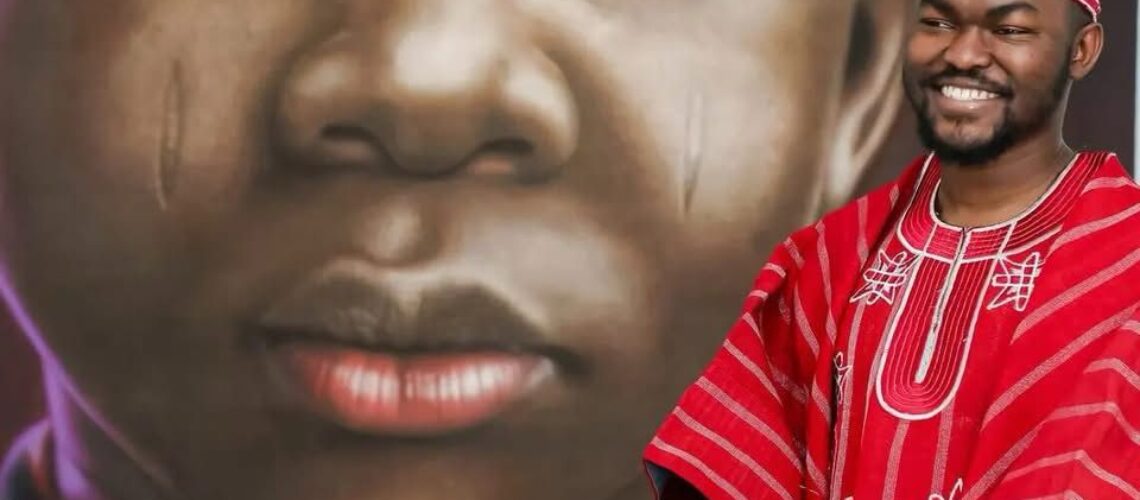
Babajide Olatunji is not just a hyperrealist painter; he is a cultural archivist, a modern-day griot with a brush painting history and making the past real in the present to a global audience. A storyteller of the ancestral Yoruba spirit, Babajide’s work spans intimate portraiture to monumental historical compositions, he has carved a unique identity that blends the meticulous realism of Renaissance art with the sacred traditions of Yoruba culture. His story is one of relentless passion, artistic discipline, and a visionary quest to reframe how the world sees African history.
His most iconic works—the Tribal Mark Series and The History of the Yorubas—are not just exhibitions of technical brilliance but acts of cultural preservation and reclamation.
“All I’m trying to do is just make it as direct as possible,” he says. “And I like this style, so I just want to use it.”
From a childhood of doodles on classroom desks to global exhibitions and sales at Sotheby’s, Babajide has become a powerful voice for Yoruba heritage, weaving anthropological scholarship and visual storytelling into monumental canvases. He mirrors the Renaissance masters who chronicled European history and mythology through paint—but this time, the stories are unmistakably African, and in doing so, he offers a bridge—between generations, cultures, and continents.
Early Life and the Birth of a Vision
Babajide is the youngest of six children, born on October 8, 1989, in Port Harcourt, Nigeria to Samuel Adeyemi Olatunji, a civil servant, and, Florence Omolola Olatunji, a trader. He was raised in a household that balanced tradition and ambition and encouraged education and resilience. However, Babajide’s earliest influences came not from academic institutions but from his elder brother, Olumide, whose talent for drawing lit the first spark of artistic curiosity in him. Babajide recalls fondly,
“He used to make these smiley faces with grimaces or smiles… I would try to copy them. I just wanted to follow his path.”
Tragically, Olumide passed away in 2005 from sickle cell anemia, leaving behind not only a family in mourning but a younger brother determined to honor his memory through art. Babajide’s natural inclination for drawing—on sand, books, and any surface available—began to take form, even as formal education led him in another direction.
Despite earning a degree in Botany from Obafemi Awolowo University, his real education unfolded in sketchbooks and quiet reflections.
“Being able to draw was always an advantage,” he admits. “It helped me visualize and remember things better—even in my science exams.”
From drawing portraits on commission to capturing campus celebrities like Ramsey Nouah and Asa, he evolved from a side hustler to a full-fledged artist.
A Self-Taught Master: Training with the Ancients
While many artists gain exposure to the old masters in academic settings, Babajide discovered them through relentless personal research. Inspired by the works of Caravaggio, Rembrandt, Velázquez, and Jan van Eyck, he dissected Renaissance techniques with scholarly fervor.
“I wanted to know who the champions were,” he says. “These were human beings too, and they could do this then—so I wanted to learn how they thought and presented their art.”
He was particularly drawn to chiaroscuro, the dramatic interplay of light and shadow made famous by Caravaggio.
“I believe that if someone in a painting is looking at the viewer, it’s like they’re inviting you into the creation,”
He reflects. This philosophy informs much of his portraiture and history painting, creating a direct emotional connection with the audience.
While Babajide’s university training was in science, his artistic passion continued to develop through constant practice and self-study. His dedication soon paid off when his work caught the attention of Ayo Adeyinka of Tafeta Gallery in London. This pivotal connection catalyzed his ascent into the professional art world and gave birth to the now-iconic Tribal Mark Series, which launched in 2014 and propelled him into international acclaim. Inspired by the Yoruba practice of facial scarification, this series is more than a technical feat in hyperrealism; it is a spiritual and historical preservation project.
“The marks are like a flag of the family,” Babajide explains. “Wherever you go, you carry it with you.”
Through painstakingly detailed imaginary portraits, he captures the specificity of Yoruba identity, using research to authentically replicate tribal incisions without photographic references. These portraits are not just faces; they are stories etched in flesh, reintroducing a nearly vanished tradition to a global audience.
Art as Education: Rewriting the Museum Canon
What makes Babajide’s work truly radical is its dual role as visual spectacle and educational tool. “Art can educate,” he insists. “I want people around the world to understand Yoruba culture without needing a textbook.” His ongoing project, The History of the Yorubas, exemplifies this ambition. With each canvas, he constructs a visual syllabus for a history long ignored in Western museums. Adopting the monumental scale and narrative clarity reminiscent of Caravaggio, Velázquez, and Jacques-Louis David, yet the subjects are resolutely telling the Yoruba story.
In Volume I: Obatala at the Forge of Sokoti, he reimagines the mythical Yoruba origin story. Obatala, descending to earth on a golden chain, is depicted in chiaroscuro against a rich tapestry of symbolism. This isn’t mere mimicry of European history painting; it is a reformation. Obatala gazes directly at the viewer, inviting them into the act of creation, much like Velázquez did with viewers in Las Meninas.
“I wanted to use this style not because I’m trying to reclaim it, but because it’s the most direct way to tell our stories,” he says. “These are biblical-scale stories, and they deserve to be seen that way.”
Volume II: Efunsetan Aniwura, Iyalode of Ibadan, continues this visual historiography by immortalizing the 19th-century Yoruba merchant queen and political leader. Rendered with the golden ratio and linear perspective, the painting captures a negotiation scene that emphasizes her command and complexity.
His work counters the colonial gaze, which has long reduced African traditions to anthropological curiosities. Instead, his portraits are intimate, dignified, and imbued with agency.
“It’s about reclaiming the narrative—not just the marks on the face, but the soul behind them.”
To him, the mission is not to reclaim European styles but to use them as vessels for Yoruba stories.
“I don’t need to reclaim anything. I just want to use the style to tell my story—our story. It’s direct, it’s powerful.”
Global Stage, Local Voice
Babajide has successfully exported Yoruba narratives to the global art market without diluting their cultural essence. Exhibited in the UK, US, UAE, and Hong Kong, and featured at Sotheby’s and the Royal Academy of Arts in London, his works have attracted collectors like the Mott-Warsh Collection in Michigan. His Tribal Mark Series III #57 sold at Sotheby’s in 2022, fetching up to $12,000. Yet, for Babajide, the true currency is cultural transmission.
“Art is the most direct language I know,” he reflects. “You don’t need translation to feel something when you look at a portrait.”
Babajide’s innovative approach to art and cultural preservation has also attracted attention from international media. He has been featured in esteemed publications such as The Art Newspaper, Financial Times, Christie’s Magazine, Art Africa, The Cut, and The New York Times . These features have not only amplified his global presence but have also underscored the significance of his work in contemporary art discourse.
In a testament to his impact, Babajide had the honour of sharing Yoruba culture with Her Majesty Queen Camilla through his works. This recognition by the British monarchy signifies the profound resonance of his art beyond Nigerian borders, highlighting its role in fostering cross-cultural understanding and appreciation.
This universality allows his distinctly Yoruba narratives to resonate globally, bridging the gap between past and present, Africa and the diaspora. And yet, he remains grounded.
“I’m just getting started,” he says. “I have enough stories and sketches to work on for the next 20 to 30 years.”
Crafting Timelessness: Artistic Process and Philosophy
For Babajide, art is a deeply intuitive yet disciplined process—an act of remembering, reimagining, and rendering culture with clarity. His portraits begin as conceptual sketches, often sparked by a passing glance or a cultural proverb. From there, he builds each face from imagination, layering anatomical precision with emotional depth. “Symmetry is rare in real life,” he says. “One nostril is never quite like the other.”
Using oil pastels and acrylics—an unconventional pairing in hyperrealism—he constructs form from contour to light, paying obsessive attention to detail: eyelashes reflect light, tear ducts glisten, and the lips shine with subtle anatomical realism. Yet his process is never rigid. Influenced by the Chinese philosophy of wu wei (effortless action), Babajide allows each work to evolve naturally. “I’ve learned not to force things,” he explains. “The painting changes as I change.”
Though self-taught, Babajide is steeped in classical art history. He draws from the chiaroscuro of Caravaggio, the sfumato of Da Vinci, and the realism of Rembrandt and Velázquez—not to replicate, but to reframe. “We had biblical-scale stories in our culture too,” he says. “Why aren’t they being painted?” In response, he reclaims the language of European masters to elevate Yoruba myth, history, and identity—on his own terms.
Crucially, Babajide adopts a documentarian’s neutrality, especially in works like the Tribal Mark Series. “I’m not for or against it. I just want future generations to know it existed,” he asserts. His art is not nostalgia—it is cultural preservation. It offers Yoruba people a mirror to their roots and invites global audiences to engage with one of Africa’s richest traditions.
With a vision that stretches decades ahead, Babajide dreams of building a collaborative studio in the mold of Rubens—a creative hub that sustains his lifelong goal: to tell Yoruba stories on a global scale. “The culture is so rich, diverse, and underexplored,” he says. “It’s a lifetime’s worth of work.”
Conclusion: The Yoruba Vanguard
Babajide Olatunji stands at the intersection of tradition and innovation. Through hyperrealist technique and scholarly intent, he is globalizing Yoruba history and aesthetics with the visual gravitas of a Renaissance master. His art does not merely represent; it reclaims, retells, and redefines. In him, the Yoruba culture has found a new kind of bard—one whose canvases speak louder than any song.
In a world hungry for authenticity and narrative, Babajide Olatunji offers both—brushstroke by brushstroke, portrait by portrait, history by history.