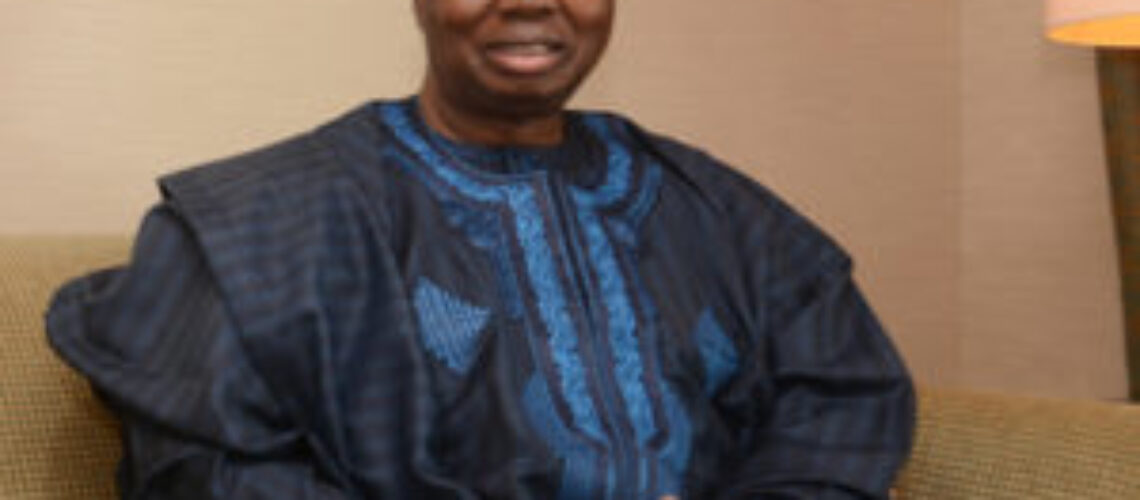
Asiwaju Khamis Olatunde Badmus, who turned 80 on 9 May 2026, was born in Akim Oda, Ghana, in 1946. He has been a police cadet, a Special Branch detective, a television reporter, an importer of broadcasting equipment, a poultry farmer by accident, national president of Nigeria’s poultry farmers, and, since 1992, the Asiwaju Musulumi of Yorubaland. He planned few of those turns. Government policy kept closing one door and opening another, and each time he turned the unexpected door into an enterprise that employed, fed or trained other people.
Asked at 80 what advice he would give someone who wants to farm, he gave the answer that fits every one of those careers:
“You just have to be focused and determined because business is up and down, and it is never straightforward. Even the government itself is not stable. Nothing is stable, but you must have focus and determination.”
1946–1966: A Ghana birth and an education his father insisted on
Badmus was born on 9 May 1946 in Akim Oda, where his father, Alhaji Adekilekun Badmus, lived as a trader. His father was an Islamic scholar and produce buyer who later became the Olori Alalahaji of Osogbo, leader of the town’s Hajj pilgrims. His mother, Alhaja Munirat, came from the Ogboriefon family of Ibadan and was a businesswoman in Osogbo. His family’s ancestral home was the Ayogun compound in Isale-Osun.
To Badmus’s parents, rather than training their children in business, they ensured they were given, first, quality education. Badmus told Punch:
“Education was very important to my father. There are not many of his children who were graduates, but at least he was able to educate us to a certain level to prove to us that education is very important.”
He returned to Nigeria and attended Muslim Primary School in Ikare, then Laro Primary School in Isale-Osun, and finished his secondary education at Okebadan High School, Ibadan, in 1966, and then adding an A-Level by correspondence to complete his early education circle enough to set his career path to greatness. His biographer, Dr Lasisi Olagunju, sums up the household:
“Together, his parents produced a man who is confident without being reckless, generous without being careless and powerful without being impulsive.”
1967–1985: From police cadet to broadcast importer
In 1967, at 21, Badmus joined the Nigeria Police as a Cadet Inspector. After an incident took him to a police station in Osogbo, the Divisional Police Officer, CSP Iyamu, saw something in him and told him to join. He trained at the Police College in Ikeja and was drafted into the intelligence unit then known as the Special Branch.
After serving in the Nigerian Police for two years, Badmus left the service in 1969 for journalism at Western Nigeria Television (WNTV), first in Osogbo and then in Lagos, where he covered crime and sport. His mentor, Chief Kunle Adeleke, the Director of News and Current Affairs, had got him the job. And he paid his mentor well with his good conduct at work, particularly for the weekly programme Issues of the Day. Badmus found important people, like ex-president Shehu Shagari, among other personalities, for Adeleke to interview. After Oyo State was created in 1976, he moved to Radio Oyo, where he became editor and head of its news department in Lagos. In all of these, passion rather than the price drove Badmus, as he remembers the pay as secondary to the access:
“At that time, I didn’t know anything about brown envelopes. My joy was just about the personalities I brought to take part in the programme.”
Integrity and the courage to leave a secure post for an uncertain one marked these years. He did it twice, first from the police to the newsroom and then from the newsroom to business.
The turning point came from an interview. Chief J.S. Tarka, a minister in President Shagari’s government, invited the young reporter to lunch and asked what he wanted. Badmus, ignorant of brown envelopes or asking for an appointment, said he wanted to go on pilgrimage to Mecca. Chief Tarka phoned a travel agency, and Badmus left with a ticket and about £1,500. Unlike any other pilgrims, Badmus saw the trip as more than a pilgrimage but an opportunity to solve Nigeria’s problem. He says:
“I saw camcorders. I felt they would help our people in Nigeria. I bought about 20 pieces and brought them back.”
They sold easily. On later trips he bought more and began supplying stations across the Western Region and the North. When his employers heard about the side business, he was transferred to Ibadan, and to avoid persecution, he resigned to set up Tuns International in 1981. Through Tuns International, Badmus imported broadcasting equipment for the Nigerian Television Authority (NTA) and installed it across its state stations in Lagos, Ogun, Oyo, Ondo, Kwara and the old Bendel State. His starting capital was trust: the station managers who bought from him already knew him as a reporter.
1985–1999: The licence that said “agriculture”
Another opportunity came amidst the 1985 economic recession when the Babangida government required importers to own farmland. Badmus applied for a licence to import studio equipment and was given one to import agricultural inputs instead, mainly feed concentrates and Izal disinfectant. “I was given an import licence to import agricultural materials which I didn’t know anything about,” he told ThisDay.
The first attempt cost and tested his resilience in business. Although the Izal arrived during a cholera outbreak in Oyo State, the official who was meant to help him sell it to government did not do so, and he was forced to sell it on the open market at a loss. His maize produce also could not compete with maize from the North, and to avoid another loss, a friend suggested he mill them into feed. But customers who had bought the feed on credit sometimes blamed it for killing their birds. From these difficulties and investment turning to loss, he took the bold step of keeping the birds himself and starting his own poultry farming:
“Since I had the feed, I had the premises and that was how I started poultry farming.”
He began with layers, then moved to meat production. This is resilience in plain form: each setback closed one route, and each time he found the next use for what he already had.
1990s–2002: The farm that gave him a name
The farm that began as a way to use up feed became the business Badmus is known for. By the late 1990s Tuns Farms was one of the larger employers in Osun State and a major supplier of eggs, live birds and dressed chicken. Osun’s press has since described it as the state’s largest private employer. Badmus chaired the Poultry Group of the Manufacturers Association of Nigeria (MAN), and he had entered the trade in 1985 with capital from his broadcast-equipment business. A tribute published for his 80th birthday says the growth “was not sudden. It was slow, deliberate, and hard-won.” Four choices explain how it happened.
The first was to build a chain rather than a farm. Breeding, feed milling, rearing and processing all sat in Osogbo, so Tuns did not depend on outside suppliers or sell only in the open live-bird markets. In time the group added hatcheries and mills, and a slaughterhouse and processing plant that can dress about 70,000 birds a day.
The second was to let other people carry part of the load. Under the outgrower model, which later became the base of his government contracts, Tuns supplies independent farmers with day-old chicks, and often feed and veterinary drugs, then buys the grown birds back after six to eight weeks and processes them. A small farmer gets a guaranteed buyer, and the processor expands without building every poultry house.
The third was to sell to steady buyers rather than volatile markets. Badmus won bulk business from quick-service restaurants and supermarkets, including KFC, Shoprite and Chicken Republic, whose owner, Food Concepts, later named Tuns its supplier of the year for 2008. The fourth was to spend early capital on what smaller farms could not afford: cold-chain and industrial processing equipment bought with money from his earlier businesses.
Each choice repeats the habit of the earlier chapters: he built from what he already held, whether feed, premises, contacts or cash. Asked at 80 what four decades in poultry had given him, Badmus answered:
“The business is okay because I went through the hard way, but eventually, it gave me a name. I became the National President of the Poultry Association of Nigeria.”
The name was about to be put to work because, by 2002 the industry that had made it was close to collapse.
2002–2017: A national figure and the state’s partner
In 2002 the poultry industry was in trouble. Imports of chicken, eggs, feed and drugs had pushed many big farms out of business. Badmus, newly president of the Poultry Association of Nigeria, credits a rare alignment: himself, President Olusegun Obasanjo, a poultry farmer, and Chief Audu Ogbeh, then party chairman and also a poultry man. As he told ThisDay:
“So all along we were able, with the combination of those three, to revive the poultry sector to what it is today.”
In his four years in office the association pressed for a ban on poultry imports, pushed foreign grandparent-stock breeders to set up in Nigeria and began talks on exporting day-old chicks to West Africa. Investment in the industry tripled between 2002 and 2005, and Badmus used his position to open doors for the whole trade, not only his own farm. His term ended as the industry met its worst crisis: in February 2006 the H5N1 strain of bird flu was confirmed on a farm in Kaduna State, the first outbreak in Africa.
That standing carried over into government work, and the outgrower model he had built at home became a public programme. In December 2011, Governor Rauf Aregbesola’s administration made Tuns the private partner in the Osun Broiler Outgrowers Production Scheme. Much of the chicken went into O’Meals, the state’s free lunch programme for primary pupils, which the federal government later used as a model for its national scheme. In December 2016 Badmus put the result in one sentence:
“Over 100 millionaires have been made so far since the state introduced Osun Broiler Outgrowers Production Scheme.”
He later put a figure on it: about ₦680 million paid out as profit to farmers in the scheme over roughly four years. The Osun results led to his largest national mandate. In 2016 Tuns signed a memorandum of understanding with the Federal Ministry of Agriculture and Rural Development and became the national anchor of the National Egg Production Scheme, designed to reach 50 million eggs a day and create at least a million jobs. “We were appointed for this job because of the achievements we recorded in Osun,” Badmus said.
2017–2020: Losing the Osun scheme, and the worst year
Public partnerships brought reach, and they brought exposure. The National Egg Production Scheme never reached its targets: funding stalled over problems between the Central Bank and the Bank of Agriculture, a planned egg powder plant was cut from about ₦12 billion to about ₦2 billion, and Badmus later acknowledged that the programme had not been effective. In Osun the partnership ended badly. After the first phase, the state brought in Amo Byng Ltd., one of Nigeria’s largest poultry companies, as anchor for a second phase in 2017 on revised terms. Badmus says only that the second cycle ended when the government changed the programme and brought in new players and conditions. He named no villain, and he kept building. Tuns went on supplying broilers for school feeding in Osun and now has processing facilities in Ondo State, and he says the company will not take on projects in places where it does not control the facilities, because it cannot guarantee its standards there. Losing contracts was one test. The next took buildings, stock and a life.
In March 2020, three years after the Osun change, U.S. consul general Claire Pierangelo toured the Osogbo plant to check its compliance with international standards. Her verdict:
“We are happy with the facility here and we are satisfied with the products.” — Claire Pierangelo
The plant, which processes about 70,000 birds a day by Badmus’s account, supplies KFC, Shoprite and Chicken Republic. Seven months later came what he calls the lowest period of his career. On 24 October 2020, during the unrest that followed the #EndSARS protests, a crowd broke into the plant, took stock and equipment and damaged buildings. A staff member, Abdul-Rasheed Olawale, was shot dead. Badmus told Punch the farm lost about half a billion naira and that the Osun government later gave ₦50 million. He recalls:
“We had to go back to the drawing board to start the farm all over again.”
Within two months he was building again away from home: Tuns funded the first cycle of a 3,000-bird demonstration broiler farm at Alex Ekwueme Federal University in Ndufu-Alike, Ebonyi State, and the university gave him an honorary doctorate in business administration at the same convocation. His response at the farm itself is the clearest picture of the man. He pulled down two of the damaged buildings and built a mosque on the site:
“I had to pull them down and build a mosque as a sort of gratitude to Almighty Allah.”
At 80 he named it as his greatest fulfilment, and he was frank that little compensation had come. It is resilience joined to gratitude. The Sultan of Sokoto, represented by Alhaji Rasaki Oladejo of the NSCIA, commissioned the mosque during the birthday celebrations.
Philanthropy, faith and public life
Badmus began giving scholarships in 1985, first to ten children of his Ayogun compound at university and colleges of education. From 1999/2000 the programme became annual: South-West institutions each nominated five students, and 20 to 40 were selected, with awards from ₦40,000 to ₦250,000. He told Punch:
“For about 20 years or so, we ran a scholarship programme where we sponsored people for higher education every year, and we don’t know where the students came from. Their hometown was not part of the conditions for eligibility.”
Giving without asking for a hometown or religion is generosity in the Omoluabi sense: help for the person in need, not for one’s own circle.
His faith work was as organised. He was turbaned Asiwaju Musulumi of Yorubaland on 12 April 1992 and made Otunba Akayejo of Osogboland by the Ataoja the same day. Makinde records an annual Zakat distribution, Iftar feeding, Qur’an competitions and free Hajj tickets. In 2002 he advised NASFAT to build a university, helped secure land for what became Fountain University, Osogbo, and sits on its board of trustees. Tuns Water supplies free water to the neighbouring community.
What his life leaves behind
Badmus’s career is usually summarised by its changes of direction. A better summary is what stayed constant. At each turn he used the access, relationships or licence he already held to build something other people could stand on. A reporter’s contacts became a supply business. An import licence for goods he did not know became one of Nigeria’s largest chicken producers. The outgrower scheme gave small farmers in Osun a guaranteed buyer and, by his own figures, made more than a hundred of them millionaires. The record also holds the setbacks, and he speaks of them plainly.
The people who gathered in Osogbo, and those who wrote to him from Abuja and elsewhere, described that pattern from different angles. President Olusegun Obasanjo, in his foreword to Man of Many Frontiers, wrote:
“Asiwaju Badmus belongs to that distinguished company of Nigerians whose influence has been exercised less loudly and steadily – through enterprise, faith, community leadership, and mentoring.” — Olusegun Obasanjo
Dangote, who met him as a young businessman and drove four hours from Lagos to honour him, described him this way:
“A very religious person and also an astute businessman.” — Aliko Dangote
President Bola Tinubu thanked him for his “encouragement and support for our Renewed Hope Administration over the years” and added:
“His multidisciplinary background as a policeman, journalist, businessman, and agriculturist helped bolster his leadership across many sectors, making him invaluable.” — President Bola Tinubu
Former Governor Adegboyega Oyetola, now a federal minister, wrote:
“Your leadership continues to inspire a culture of discipline, faith, and peaceful coexistence.” — Dr Adegboyega Oyetola
A Tribune tribute for the birthday put the same verdict in plainer words. It called him “self-made, community-minded, unwavering”, described a lifelong pattern of investing “in home first”, and wished him “the same quiet grace that has defined your journey.”
Each of them praised a different part of the man: the businessman, the believer, the adviser, the leader. Together they describe someone who built quietly, gave without conditions and was still useful to the people around him at 80.
Asked at 80 whether any dream was left unfulfilled, he answered in five words:
“There is no unfulfilled dream.”
References
- Bamigbola, B. (2026, 9 May). Why I still work at 80 – Ex-journalist-turned poultry farmer, Badmus. Punch.
- Lawal, S. (2026, 10 May). 80 years of purpose: How Olatunde Badmus built industry from community need. Tribune.
- How Nigerian tycoon Olatunde Badmus built Tuns Farms into a poultry giant. Africa, 23 November 2026.
- Emejo, J. (2016, 15 August). Badmus: FG should encourage long-term repayment plans for agriculture credit. ThisDay.
- For a man of many frontiers. Review of Lasisi Olagunju, Man of Many Frontiers: The Life, Faith and Influence of Asiwaju Khamis Olatunde Badmus(Safari Books, 2026). Tribune.
- Sultan commissions ultra-modern mosque built by business mogul, Badmus at 80. The Nation.
- Makinde, A. K. (2012). Asiwaju Khamis Olatunde Badmus. In S. Oyeweso (ed.), Eminent Muslims in Osun State. Abuja: Mega Press.
- Tuns Group. Leadershipand Company history.
- Press statements by President Bola Tinubu (via Bayo Onanuga) and Dr Adegboyega Oyetola on Badmus’s 80th birthday, May 2026.
- 2023: Olatunde Badmus, Yoruba Muslim leader, drums support for Tinubu. Within Nigeria, 2 May 2022.