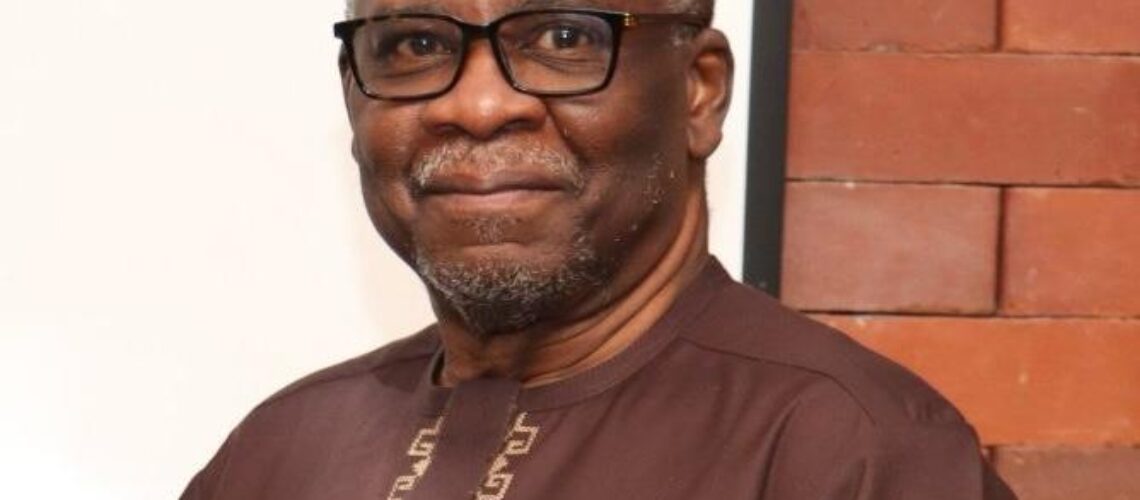
Akinyemi Oluseun Adegbola retired from the United Nations in February 2026, after some thirty years of electoral assistance in fragile and post-conflict places. That service is worthy of celebration. As he went to countries where peace was being restored, Akin helped nations build the democratic institutions and systems through which their citizens choose their leaders. Even more notable than his work are the discipline, generosity, and humility he brought to it, which were formed long before he joined the UN, in a home where, as his brother puts it, the living room was an international conference. That is why his story deserves to be told.
A Home Without Borders (1961–1982)
Akinyemi Oluseun Adegbola was born on 27 February 1961 in Shagamu, one of four children raised by two educators: his mother taught at a local school, and his father prepared young men for the priesthood. The household was never only six. Relatives, children of out-of-town friends arriving for the holidays, and his father’s colleagues and guests from Russia, Sweden, Australia, and New Zealand kept its doors open to the world. His brother Gbenro, who shared the games on the Immanuel College compound, the daily trek to Abadina School and, later, accommodation at the University of Ife, remembers what that openness taught them:
“From our early days growing up under the guidance of our teacher-parents, our home was always open to the world. We shared our childhood not just as four siblings, but alongside extended family, holiday visitors and Baba’s constant stream of international colleagues and collaborators, visiting from such far flung places as Russia, Australia, Sweden and beyond. Long before you ever set foot in a UN meeting room, you had started living the international experience. Our modest living room was your first international conference, teaching us empathy, connecting across cultures, and the art of living together.” — Gbenro, his brother
The same brother describes the character that was home-formed in Akin.
“You were thrifty with your resources, yet boundless in your support for others,” he writes, and the proof lies in small things. At Ife, when Gbenro mistakenly collected the whole allowance meant for the two of them, Akin had not even noticed it was missing, because he still had money from the last one. And when Gbenro borrowed “a few Naira” and never repaid it, “you never asked.”
Carrying these sound disciplined character traits, he attended Government College, Ibadan (1972-1976), and the International School, Ibadan (1976-1977), and then read French and Portuguese at the University of Ife (1977-1982), now Obafemi Awolowo University. By the time he graduated, the pattern was set: a young man at ease across languages and cultures, calm under pressure, and in the habit of giving more than he kept. It was unusually good preparation for the work ahead.
Languages as a Passport: Ife, Brasília and Harare (1982–1993)
Adegbola’s first working years combined language, teaching, and diplomacy. From 1982 to 1990 he was a Graduate Assistant in the Department of Modern European Languages at Ife, teaching Brazilian literature, Portuguese grammar and translation, and helping to develop a locally grounded approach to Portuguese-language and Lusophone studies. In the same decade he deepened that commitment with a master’s in Literature at the Universidade de Brasília (1985–1987) and, from 1986 to 1990, worked at the Nigerian Embassy there as a translator, interpreter, and administrative assistant, producing press summaries and political reports.
His family gave him a nickname that points back to those years. His niece, Adetoun, recalls:
“My brothers and I called him ‘Uncle Brazil’ when we were little children. We were always excited anytime he arrived in Ibadan from overseas. Several work tours later, he simply became Uncle Akin.”
In Harare, as a South-South Fellow at the Southern Africa Research and Documentation Centre, he designed and managed a key elections and democratisation project during the region’s ‘boom’ period of democratisation and undertook third-party consultancies that generated revenue to help meet the Centre’s running costs. At the same time, he lectured part-time on Brazilian literature at the University of Zimbabwe (1991–1992). This was the bridge from the lecture hall to the field: the linguist had become an electoral practitioner, and the expertise he built there prepared him for the international missions that followed.
The Field Years: Mozambique to East Timor (1993–2002)
Adegbola has described the nature of this work plainly:
“Very often, in my line of business (electoral assistance), we have to step in in the immediate aftermath of a conflict … before the rules of normal social intercourse get fully restored.” — Akinyemi Adegbola
His peacekeeping service began in Mozambique, where from September 1993 to November 1994 he was an electoral officer with the United Nations Operation in Mozambique (ONUMOZ), which helped consolidate the peace after the country’s 16-year civil war. During a tense post-electoral period, through a series of meetings and the review of hundreds of complaints, he managed the ONUMOZ side of addressing RENAMO’s electoral claims, a process that ended in RENAMO’s acceptance of the election results. It was an early demonstration of what would become his signature: patient, impartial handling of grievances so that a result could be trusted.
He then became a senior election coordinator under the UN Department for Development Support and Management Services (UNDDSMS). At a time when relations between electoral commissions and the UNDP needed careful handling, he diplomatically advised the Provisional Independent Electoral Commission of The Gambia through voter registration, a referendum, and presidential and parliamentary elections during the transition from military to civilian rule (1995–1997).
The assignments that followed show how far his reputation travelled. He worked in Croatia in 1997, then in Angola and Cambodia in 1998, before serving as Chief Technical Adviser to the National Electoral Commission of Guinea-Bissau (1999–2000), a sensitive post that demanded technical standards, diplomacy and tight timelines. In 2001 he ran the District Electoral Office in Dili, East Timor, where the constituent assembly elections met high standards of transparency. Sierra Leone (2001–2002), as Electoral Analyst, and a needs assessment in the Central African Republic (2002) followed.
Gbenro’s summary of these years is brief and exact. For three decades, he writes, Akin carried the values of their home into the United Nations.
“making a quiet, powerful difference in the world, mostly in dangerous places like East Timor, Bosnia, DR Congo, Chad, South Sudan, Mozambique, etc.”
Headquarters and Back to the Field: New York, Kinshasa, and Kenya (2003–2010)
In August 2003 Adegbola joined the Electoral Assistance Division (EAD) in New York, covering the Democratic Republic of the Congo, Côte d’Ivoire, the Central African Republic, Liberia and Sierra Leone. Barely ten days into the posting, still finding his bearings in a crowded city, he found himself among colleagues mourning the bombing of the UN premises in Iraq, which killed more than 20 staff. Recalling how that grief drew strangers together, he wrote:
“You don’t have to know the individuals, in such circumstances, to get sucked into the grief.”— Akinyemi Adegbola
In 2006 he returned to the field as Senior Electoral Officer for Field Coordination with the UN mission in the Democratic Republic of the Congo, overseeing a network of field offices and results compilation centres in the largest electoral process the UN system had then supported. He served as Deputy Secretary to the Kriegler Commission of Inquiry into Kenya’s 2007 elections, then supported Ghana’s 2008 process, and from 2009 to 2010 was UNDP’s Chief Technical Adviser in Benin, overseeing the start of digital voter registration. The work carried a human cost: he lost six colleagues in a plane crash in Kinshasa and felt the Haiti earthquake keenly. It is to these years that his niece points when she writes,
“I celebrate him for his years of service and sacrifice in the United Nations.”
Leading for Africa: From New York to Addis Ababa (2010–2026)
From May 2010 to June 2017, Adegbola served as Team Leader for Country Support, heading needs assessment and advisory missions across the world. In May 2017 he became Chief Electoral Officer and the Division’s lead for Africa, embedded in the UN Office to the African Union in Addis Ababa, where he served until his retirement. In July 2017 he led a mission to Cameroon, consulting government officials and political parties on support to its electoral body. In October 2025, at the request of the Independent Electoral and Boundaries Commission, he led the UN Needs Assessment Mission to Kenya ahead of the 2027 General Election, meeting IEBC chairperson Erastus Ethekon and Prime Cabinet Secretary Musalia Mudavadi. Youth engagement and voter inclusion, electoral security and conflict prevention, and voter education were among the areas discussed.
His UN colleagues are in no doubt about what this final chapter meant. In a farewell email to colleagues on the eve of his last day, a member of the Electoral Assistance Division wrote:
“There is almost nothing Akin does not know about elections, especially in Africa. He has been an invaluable resource for EAD, DPPA, our SRSGs and RCs in the field, and above all for African countries themselves as they navigate a complex and evolving electoral landscape. In my own year at EAD, every conversation with Akin has enlightened me, humbled me, and convinced me that he is an international treasure.” — Michele, farewell email to colleagues
The same email notes that a session was organised so that colleagues could learn from him before he left. To be asked to teach in one’s final days is among the highest compliments a profession can pay.
What He Stands For: Impartiality and National Ownership
Adegbola’s view of governance is that of an institution-builder, not an outcome-manager. In 2011 he observed that independent electoral commissions had become a standard feature across Africa, supported by UNDP and international partners through the training of observers, voter registration, vote monitoring and tallying. Of countries whose post-conflict elections had produced mixed results, he urged:
“Now what this category of countries needs is to build on the gains they’ve made in such difficult circumstances.” — Akinyemi Adegbola
In Cameroon in 2017, party leaders told his mission that the electoral body needed more financing, a reminder that institutions need resources as well as independence. By 2025 he described the UN’s focus in Kenya as moving from logistics towards strengthening institutional capacities, and he stressed that the mission would assess needs impartially and sensitively. The principle is that a commission must stand on its own: assisted, but independent, and owned by the nation it serves. That demands discipline about the limits of one’s role.
The same discipline shows in his private life. Adetoun, who spent her university breaks with him in New York and New Jersey, says:
“He gave me the tools and freedom to know my way around and explore the city both by myself and with friends while also making sure I was alright.”
At one of the most critical decisions of her life, he
“met with me to listen, share his mind, and ensure I was on the right path,” speaking, in her words, “with humility and grace.”
An adviser who assists without taking over is the same man at work and at home.
Legacy: Trust, Institutions, and a Home Without Borders
Measured by what he leaves behind, Akinyemi Adegbola’s thirty years amount to one sustained contribution: he helped make elections something people could trust. In Mozambique, that meant patient work on hundreds of complaints until a losing party accepted the result. In The Gambia, it meant advising an electoral commission through a transition from military to civilian rule. In the Democratic Republic of the Congo, it meant coordinating field operations for the largest electoral process the UN had then supported. In Kenya, from the Kriegler inquiry to the 2025 needs assessment, it meant helping an institution examine itself and prepare for the next contest. From East Timor to Guinea-Bissau, from Cameroon to the African Union, the pattern held.
Akinyemi Adegbola holds legacy of character. Those who know him describe the same man in every setting: thrifty with his own resources and generous with others’, composed under pressure, humble in advice. His family remembers him as someone who made a home in Banjul, New York and New Jersey, kept his doors open to relatives wherever he lived, and quietly supported a niece through university. The home without borders in which he grew up became a career without borders, and then a home again for those around him.
Nigeria and the Southwest can say of him what he once said of Kofi Annan, that he is a great gift to the world. That is why the DAWN Commission names him Akinkanju. His valour lies in showing up where peace was fragile, in standing impartially where partisanship was the easier path, and in staying humble while the world called him an international treasure. As he begins his retirement, we borrow his family’s prayer:
“As you retire and embrace this next chapter of your life, my prayer is that you experience as much joy as you have given us, your loved ones.”
The DAWN Commission celebrates you, Sir. You are an Akinkanju.
References
- Independent Electoral and Boundaries Commission (Kenya). “Commission meets UN Electoral Needs Assessment Mission team, discusses areas of support and collaboration for GE 2027.” https://www.iebc.or.ke/news/?Commission_meets_UN_electoral_Needs_Assessment_Mission_team,_discusses_areas_of_support_and_collaboration_for_GE_202
- Eastleigh Voice. “UN assesses Kenya’s election readiness as government promises integrity in 2027 polls.” https://eastleighvoice.co.ke/national/221607/un-assesses-kenyas-election-readiness-as-government-promises-integrity-in-2027-polls
- The Star (Kenya), 6 October 2025. “UN officials in Kenya to assess IEBC’s preparedness ahead of 2027 polls.” https://www.the-star.co.ke/news/2025-10-06-un-officials-in-kenya-to-assess-iebcs-readiness-ahead-of-2027-polls
- Africa Renewal (United Nations). “The good, the bad, and the rest in African elections.” https://africarenewal.un.org/en/magazine/african-elections-works-progress
- The Africa Report. “The good, the bad and the rest in African elections.” https://www.theafricareport.com/8310/the-good-the-bad-and-the-rest-in-african-elections/
- allAfrica, 14 July 2017. “Cameroon: Organisation of Elections — UN Mission Consults Political Parties.” https://allafrica.com/stories/201707140205.html
- Adegbola, Akinyemi. “Kofi Annan Thoughts.” Personal reflection article.