
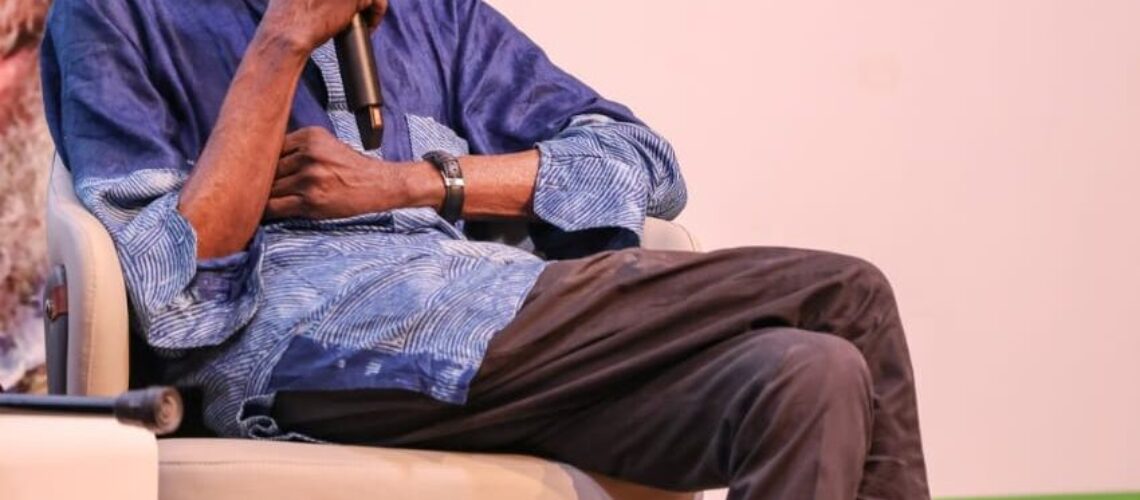
On January 5, 1946, Biodun Jeyifo was born in Ibadan, Nigeria, a child who would grow to become one of Africa’s most formidable literary critics and intellectuals. Now at 80, this once-expelled high school student stands as one of Africa’s most distinguished literary scholars. His life reads like a masterclass in transforming youthful rebellion into scholarly brilliance, political activism into pedagogical excellence.
The Making of a Rascal Scholar
Young Jeyifo’s childhood in Ibadan was, by his own admission, “tempestuous”. He was an “ipata”, a rascal who read voraciously but cared little for conventional academic excellence.
“I was satisfied to be among the first eight in the class, not the first, second or third pupil, …from primary school to high school. I was never first, second or third.”
This was far from mediocrity, it was selective engagement. While other students memorised for grades, young Jeyifo attended public debates at USIS, British Council, and Obisesan Hall, absorbing the firebrand speeches of nationalist leaders. He read everything he could find, but “not with an intention to do extra well in class.”
The turning point came dramatically in 1964. As an 18-year-old at Ibadan Boys High School, Jeyifo led a student protest that crippled the school for an entire day. Chosen by classmates to present their Charter of Demands, he spoke with such force and eloquence that students chanted: “BJ, fire on! BJ, fire on!!” Three weeks later, the principal, who also served as organist at St. James Cathedral where the Jeyifo family worshipped, expelled him.
It could have been catastrophic. Instead, Jeyifo wrote his school certificate and A-Level examinations as an external candidate, passing with flying colors. The University of Ibadan admitted him to study English, where he would eventually make a First Class—only the third student to achieve this distinction in the department’s history since 1948.
The Intellectual Awakening
“It was in graduate school that I became a very diligent student and the workaholic ethic grabbed me and it has never left me.”
This transformation at New York University, where Jeyifo pursued his PhD in dramatic literature in the early 1970s, proved foundational. But the real revelation came earlier, upon returning to Nigeria after his studies.
“What stands out most clearly in retrospect was a slowly dawning consciousness of absences and exclusions from the heritage of world theatre, world history, world literature, and critical theory,”
he reflected.
He discovered that there was an omission of African voices in his education. While studying English at Ibadan, Achebe’s Things Fall Apart—though a creation of the same department—was absent from the syllabus. Later at NYU, no African authors, texts, or playwrights were included, despite the ongoing contributions of luminaries like Wole Soyinka and Tsegaye Gabre-Medhin.
This awakening sparked Jeyifo’s scholarly mission: the recuperation and decolonization of African literature and theatre. His inaugural book on Nigerian travelling theatre went beyond scholarship; it sought to reclaim a neglected history. Although he grew up in Ibadan, home to over 150 professional theatre companies with roots spanning four centuries, their contributions were entirely missing from existing theatre histories.
Marxism and the Complexity of Freedom
Jeyifo’s intellectual journey led him to Marxism, discovered, ironically, in America during his graduate years. But his was never a dogmatic Marxism. When Harvard’s president asked him to explain his Marxism before his appointment, Jeyifo wrote a tongue-in-cheek response titled “Who’s Afraid of Biodun Jeyifo’s Marxism?”
“My absolute insistence now is that I be taken, I be judged on how consistent I am with my passion for redistributive justice in our country and our world.”
This philosophical stance shaped his groundbreaking scholarship on Wole Soyinka. Initially a fierce critic of Soyinka’s “bourgeois aesthetics,” Jeyifo later demonstrated remarkable intellectual honesty by revising his position. His 2004 book Wole Soyinka: Politics, Poetics and Postcolonialism, which won the American Library Association’s Outstanding Academic Texts prize, showed profound complexity, acknowledging Soyinka’s work as
“variously traditionalist and modernist, pan-Africanist and liberal-humanist, individualistic and communalistic.”
The Revolutionary Who Built Institutions
Before becoming ASUU’s first National President, Jeyifo did something extraordinary: in the 1970s, he resigned from the University of Ibadan and withdrew with comrades, including Edwin Madunagu, to a commune in Ode Omu, Osun State, to prepare for socialist revolution. After the commune’s dissolution a year later, he returned to academia—but the revolutionary fire never dimmed. The commune dissolved after a year, but Jeyifo’s commitment to transformative change never wavered.
As ASUU president from 1980 to 1982, Jeyifo travelled across Nigeria, often late at night for strategy meetings, yet he never missed or rescheduled any of his classes, demonstrating remarkable dedication to both his students and the union. His leadership transformed ASUU from a nascent organization into a formidable union, setting standards that endure four decades later.
His leadership transformed ASUU from a nascent organization into a formidable union. Through meticulous preparation and rigorous argumentation, the union under Jeyifo consistently outmaneuvered federal government negotiators.
“We never lost a single contention with the Federal Government, never, …We were so well prepared, we baffled them. It wasn’t magic; we just set out to do a very thorough job.”
Jeyifo’s leadership of ASUU was not about militancy for its own sake; it focused on building sustainable structures to safeguard academic freedom and workers’ rights. Colleagues such as Festus Iyayi, Mahmud Tukur, Dipo Fasina, and T.U. Nwala formed a formidable team that implemented initiatives whose impact endures today, according to human rights lawyer Femi Falana.
“Apart from his Spartan lifestyle, he believes very much in the supremacy of ideas as the foundation for social upliftment. Without doubt, we owe the vibrancy of the intellectual struggle of [ASUU] to Professor Jeyifo and his colleagues.”
This observation by Professor Charles Taiwo Akanbi captures how Jeyifo’s unionism transcended bread-and-butter issues to encompass intellectual freedom and institutional integrity.
Pedagogy as Liberation: Professor “O le gan ni o”
Jeyifo’s pedagogical philosophy became legendary. Students called him “Professor O le gan ni o”—Yoruba for “It’s tough beyond measure!” His teaching method demanded intellectual rigor: He urged his students:
“In order for you not to be intellectually slack as you write your term paper or even your dissertation, pose to yourself the strongest possible objections that anyone who doesn’t take your position can make to your paper.”
This approach stemmed from his graduate training and natural disposition.
“Even back to my Ibadan Boys High School days, there was always a Friday afternoon session with the school principal… everybody in the school waited for my questions at these sessions because the principal always found my questions intriguing.”
Former student Kunle Ajibade remembered:
“A teacher of formidable intellectual ability, he would reference appropriate radical books in economics, political science, philosophy, social anthropology, history, and so on, as he taught. He was, to the best of my knowledge, the most erudite, brilliant and sincere of the literary theorists on the left in Africa at that time.”
Jeyifo’s teaching was deeply influenced by Paulo Freire’s ideas, emphasizing a problem-solving approach where students are not passive recipients but active participants, engaging critically with their teachers and helping to shape the learning process through dialogue and shared reflection. This philosophy animated Jeyifo’s teaching across institutions: Ibadan, Ife, Oberlin College, Cornell University, Harvard University, University of Peking, and The Free University of Berlin.
A Prolific Scholarly Legacy
Jeyifo’s scholarly output spans five decades and multiple continents. His bibliography includes groundbreaking works that have shaped African literary studies:
The Truthful Lie: Essays in a Radical Sociology of African Drama (1985) established his reputation for lucid, polemical criticism. These essays, delivered at conferences across Nigeria, combined rigorous analysis with political engagement. He expressed that:
“All the essays without exception… derived from positions taken on an ideological terrain and I needed clarity to establish those grounds,”
The Yoruba Popular Travelling Theatre of Nigeria recovered an entire theatrical tradition from historical erasure, documenting 150 professional theatre companies in Ibadan alone with antecedents stretching back four centuries.
His Soyinka trilogy—Art, Dialogue and Outrage (1988), Perspectives on Wole Soyinka: Freedom and Complexity (2001), and Wole Soyinka: Politics, Poetics and Postcolonialism (2004)—remains the most comprehensive critical engagement with Africa’s Nobel laureate. These works demonstrate what Olakunle George called Jeyifo’s ability to navigate “the radically dispensed accents or strands of thinking the post-colonial.”
His Norton anthology Modern African Drama brought African theatrical works into the mainstream of world literature pedagogy. Contemporary Nigerian Literature: A Retrospective and Prospective Exploration mapped the evolution of Nigerian letters with characteristic insight.
Later works include Conversations with Wole Soyinka and the Bookcraft publication on Achebe, Things Fall Apart, Things Fall Together. His political journalism collections—Against the Predators Republic (Carolina Academic Press) and Apostrophes to Friendship, Socialism and Democracy (Bookcraft)—demonstrate his commitment to public intellectual work.
Beyond books, Jeyifo’s scholarly articles on Femi Osofisan, Niyi Osundare, Emmanuel Obiechina, Dan Izevbaye, and Abiola Irele are foundational texts in African literary criticism. His essay “Okonkwo’s Mother: Things Fall Apart and Issues of Gender in the Constitution of African Postcolonial Discourse” pioneered gender analysis in African literary studies.
No other scholar except Edward Said, Gayatri Spivak, and Homi Bhabha, according to the late Professor Tejumola Olaniyan,
“is more attentive to the radically dispensed accents or strands of thinking the post-colonial the way BJ has done.”
Administrative Excellence and Institutional Impact
Jeyifo’s administrative contributions extended beyond his ASUU presidency. At the University of Ife (now Obafemi Awolowo University), he served as Head of the Department of Literature-in-English, editing the Ife Monographs on Literature and Criticisms Series with Dr. B.M. Ibitokun and Dr. Adebayo Williams. This series published original creative works and criticism, including Niyi Osundare’s collection A Nib in the Pond and his essay “The Writer as Righter.”
His eleven-year stint at Ife (1976-1987) ended controversially. When authorities refused his application for unpaid leave to write a commissioned study of Soyinka for Cambridge University Press, he resigned. The book eventually published—Wole Soyinka: Politics, Poetics and Postcolonialism—won international acclaim, vindicating his decision.
At Cornell University and Harvard, Jeyifo supervised numerous doctoral students who now hold distinguished positions globally. His impact on American academia includes pioneering courses on African and African-American literature, challenging Eurocentric curricula, and mentoring generations of scholars.
In 2018, Obafemi Awolowo University conferred upon him an honorary Doctor of Letters, recognizing his contributions to literature and education.
The Public Intellectual
For nearly two decades, Jeyifo has written weekly columns—first in The Guardian, now in The Nation—in his “Talakawa Liberation Herald” series. These essays demonstrate his commitment to making complex ideas accessible without sacrificing intellectual depth.
“Anywhere I am in the world, except it is an emergency that takes me to hospital either for myself or someone else, I know that on Friday morning, I must spend X hours writing my column.”
His journalism consistently addresses Nigeria’s political economy, cultural politics, and social justice. He writes about figures who came before his generation, facilitating intergenerational dialogue.
Legacy and Continuing Influence
At 80, Jeyifo remains Professor Emeritus at both Cornell and Harvard. His influence extends beyond academia: former students include journalists, lawyers, activists, and teachers who carry forward his vision of education as liberation. One former student, now a primary school proprietor in Ile-Ife, structures her curriculum around Nigerian literature and mother-tongue education—a direct application of Jeyifo’s decolonising pedagogy.
Femi Osofisan, his close friend, captured Jeyifo’s essence: their friendship is “built not essentially on what is spoken, but rather, on silence, on nuggets of unvoiced, introspective exchange.” This paradox—the voluble columnist who cherishes silence, the public intellectual who is intensely private, the Harvard professor who calls Harvard “a snotty place”—defines Jeyifo’s complexity.
As celebrations for his 80th birthday echo across continents, one truth emerges: Biodun Jeyifo proved that intellectual rigour and political commitment, scholarly excellence and popular engagement, and African rootedness and global citizenship need not be contradictory. In making complexity beautiful and accessible, he didn’t just study freedom; he lived it, taught it, and continues to embody it.
His long-awaited memoir remains unwritten, but his life, radical, rigorous, and profoundly humanistic, already tells the story of how one rascally boy from Ibadan became a beacon for generations seeking to understand what it means to be truly free.