
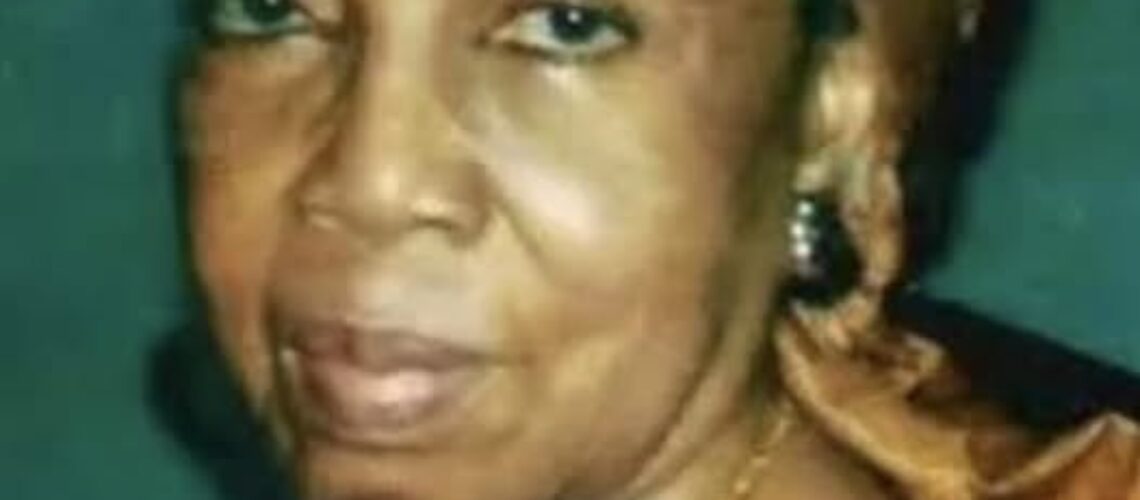
In 1935, when Kofoworola Aina Moore walked across the stage at St. Hugh’s College, Oxford, to receive her degree, she shattered a centuries-old barrier. She became the first Black African woman to graduate from Oxford University, a milestone that would reverberate across continents and generations. Yet what makes Lady Ademola’s story truly extraordinary is not merely what she achieved, but what she chose to do with those achievements: she returned home to serve until she died in 2002.
A Legacy Born from Distinguished Roots
Oloori Kofoworola Aina Ademola, affectionately known as Lady Ademola, was born on May 21, 1913, into the prominent Moore family of Lagos, a lineage already distinguished by education and public service. Her father, Olawolu Moore, was a barrister educated at Monkton Combe School near Bath and the Middle Temple in London, who would later serve as First Member of the Lagos Division of the Legislative Council. Her mother, educated at the C.M.S. Girls’ School and finished in England, was described by those who knew her as one of the most accomplished young ladies of her time. Lady Ademola’s great-grandfather was an ordained minister of the Church of England, and her grandfather attended an English public school before also entering the ministry. The paternal branch of her mother’s line originated from America, maintaining connections that persisted across generations. This was a family immersed in both Western education and Yoruba cultural pride, a foundation that would shape Kofoworola’s extraordinary journey.
Her childhood in Lagos was spent between their central town house and her mother’s farm sixteen miles outside the city, in a large household filled with cousins and extended family. It was a world where Western ideas blended seamlessly with Yoruba traditions, where the excitement of Egungun demonstrations and the appearance of Eyo, the ‘Breathless God’, coexisted with her father’s tales of driving a coach-and-four in England. This dual heritage, deeply rooted in Yoruba culture yet comfortably conversant with Western civilization, would become the hallmark of her identity and her life’s work.
Early Education and the Journey to England
Lady Kofoworola’s precocious nature revealed itself early. Having learned the English alphabet from older cousins before she could properly walk, she began attending the Church Missionary Society Girls’ School in 1916, shortly after her third birthday. She excelled academically, becoming one of their most promising pupils. However, two circumstances converged to change the trajectory of her young life: her delicate health, marked by frequent bouts of malaria, and her complete inability to sew, a deficiency that mortified her mother when she submitted “a grubby pillow-case” for their terminal examination. Combined with a severe illness in late 1923, these factors prompted her parents’ decision to send her to England’s more temperate climate in May 1924, at just eleven years old.
Arriving at Plymouth, young Kofoworola was immediately captivated by England’s colourful advertisements and the “rows and rows” of chimney pots she counted from their Kensington flat. Her mother wisely chose a private school in Reading where eight other West African pupils were already enrolled, a decision that proved providential. Reflecting years later on the controversy among African parents about school selection, she wrote with conviction:
“I believe that only by a gradual process of introducing people into a foreign country and to foreign life can adjustment be achieved. There is less of a break and less harm done to their self-confidence and confidence in the world in general, so difficult to retain by children thus uprooted, than when they are abruptly transplanted into entirely foreign soil.”
Finding Her Voice Through Folklore
Her first year in England brought unexpected challenges. Placed in a form far more advanced than her Lagos schooling had prepared her for, the previously precocious child became timid and withdrawn, sometimes too frightened to submit completed homework, crying when asked to run errands alone. The transformation disturbed her mother deeply. But salvation came through culture. When Kofoworola began sharing Yoruba folklore stories with her English schoolmates, their fascination was immediate. The simple dramatization of these tales one night became “a great success,” and she later recalled:
“I remember how enthusiastic my friends were and I cannot help feeling that these performances made them more sympathetic. I found myself gradually losing my timidity and having more confidence in myself.”
This episode illuminated a profound truth: cultural pride and authentic self-expression could be bridges rather than barriers. By sharing her heritage rather than suppressing it, she found acceptance and reclaimed her confidence. The next four years passed in a blur of examinations in academics, music, and elocution, with new African students arriving as others departed, keeping her connected to Lagos through more than mere letters.
Oxford: Breaking Barriers in Dreaming Spires
The choice of a career proved immensely difficult. Her father wanted her to study law—she would have been West Africa’s second lady barrister with a guaranteed position in his established practice. But Lady Ademola felt differently.
“I felt there was a pressing need for the development of what an African friend of mine once called the ‘sense of the modern world in all its intricacies’, with which we are compelled by natural force of circumstances to come into contact. The most rapid way of attaining this aim, as I saw it, lay in education, and particularly in education as it could be translated by Africans who have had the opportunity to live in the Western world.”
Her father agreed on one condition: she must first obtain a degree from Oxford or Cambridge. When St. Hugh’s College, Oxford offered her a place, she experienced the most miserable days I have ever passed, dreading four more years away from Nigeria. Yet she went, and in 1935, made history as the first Black African woman to graduate from Oxford University, reading English Literature and Education.
Her Oxford experience was complex. She arrived feeling tossed in a sea of intellect with highly earnest students, but gradually discovered she was among a sympathetic crowd. The invitations to coffee parties in her first terms ranked higher than the number received by the other first-year students, with discussions invariably centering on Nigeria’s politics and her presence as an isolated case. She found this isolation deeply troubling, later expressing her wish that there could be, at least, two African girl scholars in Oxford each year. Some reactions bordered on the absurd, one student even hallucinated seeing Kofoworola walk into her room at one o’clock in the morning to read her lecture notes!
Yet she also encountered genuine curiosity and evolving liberal attitudes. She formed deep friendships with six students reading diverse subjects, Greats, Modern Greats, History, Theology, and English, whose “diametrically opposed characters” and “divergent views” created space for meaningful dialogue. Oxford, she observed, was “keenly alive to the question of the Colonies,” no longer the exclusive preserve of the privileged but “throbbing with interest” in matters of social justice.
Returning Home: Education as Nation-Building
Upon graduation, Lady Kofoworola returned to Nigeria with singular purpose. Reflecting on her Oxford experience, she wrote powerfully of her sense of vocation, convinced that what was needed was a sense of the modern world in all its intricacies cultivated through education, so that
“women and children could be uplifted and empowered to shape the future they desired for themselves.”
She began immediately, becoming the first Nigerian graduate teacher at Queen’s College, Lagos in 1936. Her memorable teaching refrain captured her philosophy perfectly:
“Brains have no sex… You can do as well and even better than some boys. You have brains too.”
Between 1936 and 1945, she taught at multiple institutions, Queen’s College, Government College Ughelli, and New Era College, while helping establish Oriel Girls’ School as its joint principal. Her commitment went beyond classroom instruction; she authored children’s books based on West African folklore, including Tortoise and the Clever Ant, Tutu and the Magic Gourds, and Greedy Wife and the Magic Spoon. These works, part of the “Mudhut Book” series, ensured that young Nigerian children saw themselves reflected in their reading materials, a pioneering contribution when foreign narratives dominated.
Champion of Women and Architect of Social Change
Lady Kofoworola’s influence expanded far beyond teaching. In 1953, with four children, she accepted a full-time position as Secretary to the Western Regional Development Production Scholarship Board, playing a crucial role in preparing the region’s successful free primary education scheme. In 1958, she became the first President of the National Council of Women’s Societies (NCWS), serving until 1964 and transforming it into Nigeria’s most powerful voice for women’s rights. Under her leadership, the NCWS championed day nurseries, art and craft centres, adult education, family planning, and scholarship awards, all dedicated to uplifting and empowering women.
Her role as Nigeria’s First Chief Commissioner of the Girl Guides Association proved equally transformative. She recognized that the organization could be more than recreational, it could be
“a platform for empowering young Nigerian girls to become articulate, confident, and socially responsible women.”
Thousands of girls across the country developed leadership skills, civic responsibility, and moral vision under her guidance.
She also served as Director of the Western Region Red Cross, member of the Lagos University Provisional Council, and in 1962, became the first female member and later chairperson of the Board of Trustees of the United Bank for Africa. Her approach to leadership was marked by quiet strength, intelligence, and diplomatic grace, she was never confrontational, yet her presence commanded respect and her contributions shaped policies affecting Nigerian women and families.
Honours, Recognition, and Enduring Impact
Lady Ademola’s contributions earned widespread recognition. In 1959, she received the Member of the Order of the British Empire (MBE) from Queen Elizabeth, the Queen Mother, at an investiture at Buckingham Palace, an honour presented for her voluntary social service in Western Nigeria. Nigeria’s Prime Minister Abubakar Tafawa Balewa later awarded her the Officer of the Order of the Federal Republic (OFR). She also held the chieftaincy titles of Mojibade of Ake and Lika of Ijemo, acknowledging her status not just through her marriage to Sir Adetokunbo Ademola (later Chief Justice of Nigeria), but through her own substantial achievements.
At age 82, she reflected with characteristic humility on how many of her fellow countrywomen had risen to the very pinnacle, remarking simply: “Someone had to be first.” She passed away on May 15, 2002, at age 88, after a brief illness, leaving behind a legacy that continues to inspire.
Lessons for Contemporary Young Women
Lady Kofoworola Ademola’s life offers profound lessons for young women today, particularly those of Yoruba heritage. First, she demonstrates that education is not merely personal advancement but a tool for community transformation. She chose teaching over law not because it was easier or more prestigious, but because she believed it would create the most meaningful impact.
Second, her experience shows that cultural pride and global competence are not mutually exclusive. She never abandoned her Yoruba identity to succeed in Western spaces; instead, she used her heritage as a source of strength and a bridge to understanding. Her folklore performances at school and her children’s books celebrating African stories proved that authentic representation matters.
Third, her life exemplifies purposeful leadership, leadership that prioritizes service, character, and impact over positions or accolades. She didn’t simply occupy roles; she transformed institutions. The Girl Guides, NCWS, and numerous schools she touched became vehicles for empowering others.
Fourth, she understood that grace and determination can coexist. She defied restrictive gender expectations not through confrontation but through consistent excellence and dignity. As an akinkanju—a warrior-woman in Yoruba tradition, she fought her battles through education, institution-building, and unwavering commitment to her values.
Finally, Lady Kofoworola Ademola teaches the importance of returning home to serve. Despite opportunities to remain in comfortable global environments after Oxford, she chose to come back to Nigeria, to invest her education and energy in building her nation. Her life asks contemporary young women: What will you do with your opportunities? How will you use your education to uplift others?
In an era when many chase personal success divorced from community impact, Lady Kofoworola Ademola’s legacy reminds us that true greatness lies in service, that real pioneering work requires courage and vision, and that one woman’s determination, guided by purpose, can indeed change history. She remains an enduring symbol of Nigerian womanhood at its finest, educated, visionary, culturally rooted, and committed to the wellbeing of generations beyond her own