
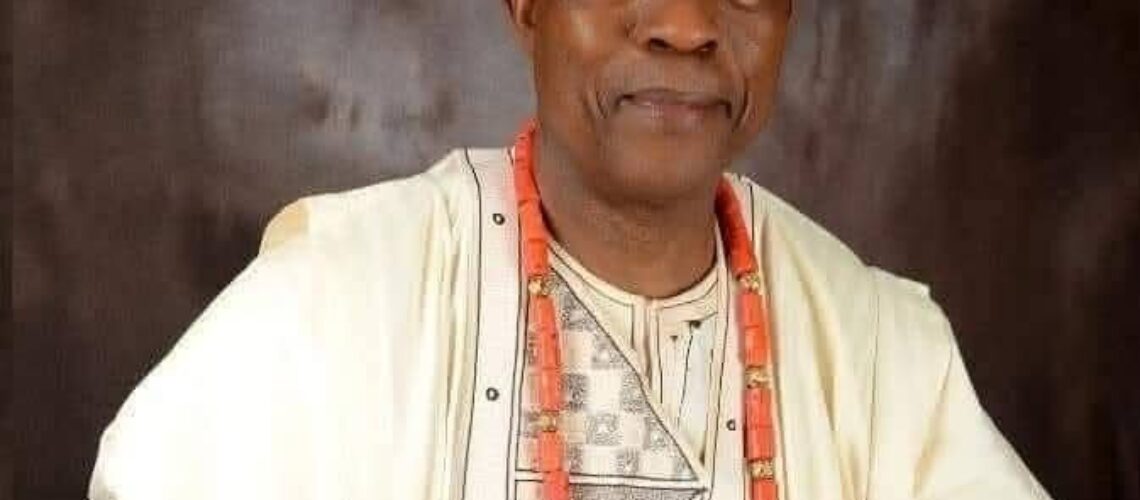
Chief Oludare Babarinsa is widely regarded as one of the most respected and historically significant figures in Nigerian journalism. A legendary journalist, editor, historian, teacher, and mentor, Babarinsa is not merely a man of words, but one whose words have helped shape the trajectory of Nigeria’s democracy. His remarkable career spans over four decades of unwavering courage, sharp insight, and generous mentorship—from his formative years at Drum and Concord, to his fearless reporting at Newswatch, his pivotal role in co-founding TELL Magazine, and his current leadership as founder of Gaskiya Media Limited. As he marks his 70th birthday on May 9, 2025, this moment invites reflection not just on his personal milestones, but on the enduring legacy he has etched in the annals of Nigeria’s media and democratic evolution.
Early Days in Oke-Mesi
Oludare Babarinsa was born on May 9, 1955, in the quiet town of Oke-Mesi, Ekiti State, a place that served not only as his birthplace but also as the crucible of his earliest education in culture, ethics, and communal life. His early schooling at St. Andrew’s Anglican Primary School, Ife, and later Anglican Grammar School, Ile-Ife, laid a solid academic foundation. But his true education, he would later say, came from the village itself.
“Oke-Mesi was a school on its own… We all participated in the yearly Egungun festival and other community festivals, and we thought the whole world was Oke-Mesi.”
This early grounding in culture and communal values would influence his journalism and sharpened his early appreciation for storytelling.
After studying English Education at the University of Ife and Mass Communication at the University of Lagos, Babarinsa found his journalistic voice early. His first published work came while he was still a student, and by 1982, he had joined Drum magazine. A pivotal moment came later that year when, at Concord, he and a friend were unexpectedly sent to interview Aminu Kano.
“They have sent me my children,” the elder statesman said, upon seeing the youthful reporters. But he welcomed them, made them tea, and gave them a story that changed their careers.
That encounter signaled the beginning of a professional journey defined by preparedness, empathy, and fearless reporting.
Vanguard of Guerilla Journalism
By 1984, Babarinsa had joined Newswatch as a pioneer staffer, working alongside industry titans like Dele Giwa, Ray Ekpu, and Dan Agbese. These weren’t just reporters—they were revolutionaries in ink, scribes in battle with tyranny.
It was during this era that Babarinsa earned the nickname “The Historian.” He earned it not just because he knew history, but because he wrote journalism steeped in context, insight, and continuity.
“He had an aptitude for infusing most of his reports with historical contexts, captivating colleagues with specific events—political or social—in different epochs of global history.”
In Newswatch and later TELL, he proved to be more than a journalist. He was a thinker, a strategist, a watchdog. In 1991, with Nosa Igiebor and others, he co-founded TELL Magazine—a publication that dared to confront Nigeria’s military dictators with the power of investigative journalism. Here, journalism became resistance.
“We didn’t create the challenge of military rule, but there was nowhere to run to, so we had to confront it.”
This confrontation came at a price. TELL was banned multiple times. Journalists were hounded, arrested, detained. But Babarinsa and his team stood firm, crafting what came to be known as “activist journalism.”
“Our colleagues nicknamed us guerilla journalists… there were guerilla fighters fighting with guns, but we were fighting with pens.”
Their pens were sharp, deliberate, and dangerous to despots. At a time when it was life-threatening to speak truth to power, Babarinsa and his crew defied fear to keep Nigeria informed. They turned journalism into a form of civic resistance as it was not just about reporting, for them, it was about defending democracy.
Surviving the Storm
One cannot speak of Babarinsa without mentioning the storm he weathered during the Sani Abacha dictatorship. The regime was notorious for suppressing dissent, and TELL Magazine became a primary target. It was not merely an editorial operation—it was a clandestine network of resistance.
They operated like an underground press, with secret locations, code words, and allies in surprising places—including within the security services themselves. Once, when his usual car was being tracked, a friend in military intelligence secretly warned his wife:
“That Volkswagen, they know it o… you had better tell your husband to change it.”
He switched to another vehicle, courtesy of a cousin, and continued working under the radar. It was this kind of vigilance, this constant state of alert, that helped him survive.
He told a gripping story of traveling to Ethiopia to deliver a lecture. Unable to fly through Nigerian airports, he went through Ghana and had to return via Togo. In Lomé, security officials became suspicious of his multiple passports.
“I told them: I know people in this city. I have been a guest of your president before… You can’t take me to your office. You can only take me to your Minister of Information who is my friend.”
That blend of wit and audacity may have saved his life. He vanished from the hotel where he was placed under watch and returned to Nigeria—by bus, through Mile 2 in Lagos.
“That was the kind of special experience you had under the Abacha regime.”
Colleagues were arrested, offices raided. Babarinsa himself narrowly escaped a sting operation one Sunday morning when he sensed something was wrong at the office gate and simply drove away. The others weren’t so lucky.
“We survived day by day. We didn’t know whether we were going to survive, but by the grace of God, we did.”
While colleagues like Bagauda Kaltho were tragically lost to state violence, Babarinsa remained a prominent voice, refusing to retreat into silence. It was not just physical courage he demonstrated, but moral tenacity. Such was the crucible in which his brand of journalism was forged.
Mentor, Builder, Patriot
Beyond the frontlines of battle journalism, Babarinsa has been an extraordinary mentor to younger professionals. Many who worked under him while he was Executive Director at TELL, Editor-in-Chief at The Westerner, and now Managing Director of Gaskiya Media recall his accessibility, humility, and deep generosity of knowledge.
“Many of the things I learned in the profession flowed from Babarinsa’s rich experience. He was always there, with no airs, to put one through.”
His mentees often describe him as a “professor of practice,” someone whose field experience eclipses textbook theory. Adegbenro Adebanjo aptly noted:
“He is one of the builders of Yorubaland and Nigeria… an essayist par excellence and Omoluabi of the finest breed.”
President Bola Ahmed Tinubu, in his tribute, called him “a towering figure in Nigeria’s media landscape,” whose life has been “marked by courage, integrity, and an unyielding commitment to national development.”
Babarinsa has continued to elevate truth, accuracy, and mentorship as the bedrock of journalistic excellence.
The Nationalist Penman
Never content with just reporting, Babarinsa has authored several works, most notably House of War, a political history of Nigeria’s Second Republic.
“Indeed, this well-researched, meticulously documented and instructive book held me in thrall,” wrote Wole Soyinka. “Any candidate for public office in Nigeria should be asked if they’ve read it.”
At 70, Babarinsa marked his birthday not with pomp alone but with purpose—launching two new books: Eat Now, Pay Later and Nigeria and the Pascal Question. These are not mere collections of essays—they are meditations on the nation’s past, present, and future.
“I love writing. I use the word to affect my world for better.”
These works continue his tradition of combining reportage with philosophical inquiry, always with a view to Nigeria’s betterment.
Looking Forward, Not Back
As Chief Oludare Babarinsa celebrates this milestone, he remains deeply concerned about the intellectual and civic health of the nation. His greatest worry is not censorship or oppression, but what he terms “the epidemic of ignorance.” His eyes are on the next challenge: reviving the intellectual culture of Nigerian youth.
“The greatest threat to press freedom is not the military… it is the increasing epidemic of ignorance that many of our young people find dangerously attractive.”
He decries the growing superficiality of public discourse, the abandonment of reading culture, and the failure to invest in truth-seeking. In a world overwhelmed by social media noise, he urges younger generations to rediscover the discipline of research, analysis, and critical thinking.
Seventy Cheers, and More to Come
At 70, Chief Dare Babarinsa remains a beacon of principled journalism. His life is not merely a record of personal accomplishments, it is a testimony to the enduring power of truth, history, and integrity. In a nation that often forgets its heroes, he stands out not just as a chronicler of events, but as a participant in history’s making.
As the nation navigates its future, Chief Babarinsa’s voice continues to remind us that a nation without memory is a nation adrift—and that it is the sacred duty of journalists to remember, record, and resist.
So how do you celebrate Dare Babarinsa at 70?
You read him.
You tell others to read his works.
You emulate his courage, his clarity, and his compassion.
And you keep fighting—not just for press freedom, but for an informed, thoughtful, and just Nigeria.
May the ink never run dry.