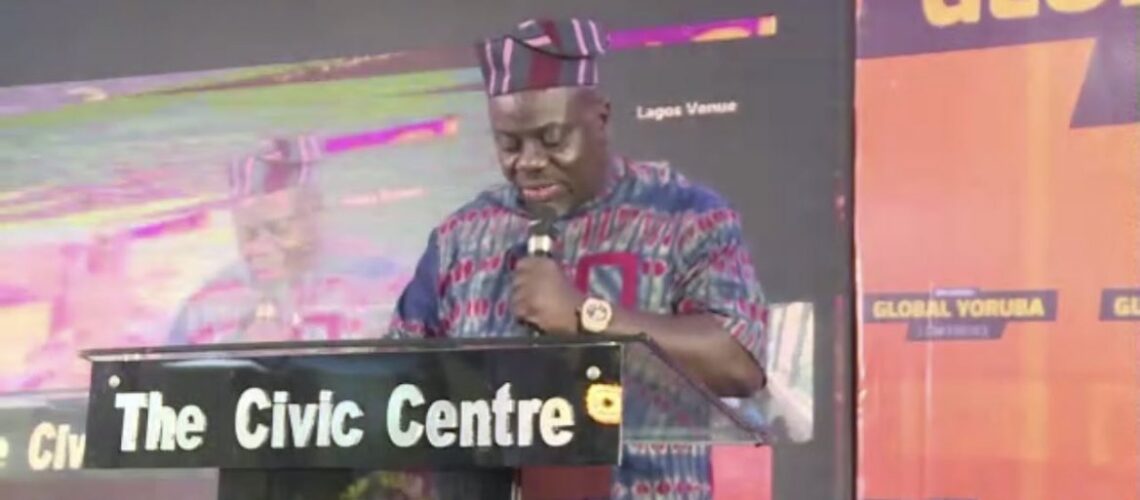
Being the paper delivered by Dr. Seye Oyeleye, FIAP, FIIHP DG, DAWN Commission at the 3rd Annual Yoruba Youth Conference organised by Think Yoruba First Organization at Civic Center, Lagos, Nigeria on June 14th, 2025.
Introduction
Distinguished guests, respected elders, esteemed captains of industry, entrepreneurs, and business leaders who continue to build prosperity in our land; media practitioners and digital content creators who shape our collective narrative; and most importantly, the vibrant, innovative, and creative Yoruba youth—sons and daughters of Odùduwà, inheritors of an ancient legacy and architects of tomorrow’s greatness, ladies and gentlemen, I warmly welcome you to today’s event.
I salute the visionary spirit behind Think Yoruba First—an initiative that resonates with the deep nationalism and practical wisdom that acknowledges the Yoruba nation not as a scattering of people or acephalous societies with no relevance, but as an integral part of African continental history. We are heirs to empires dating back to the BCE when the Ife Empire emerged to dominate the subcontinent, and more recently—though historians say “recently” for anything within 500 years—when the Kingdom of Oyo rose to become a political edifice, an Empire, whose imperial power spread from the Niger-Belt to the Atlantic Ocean.
What distinguished these empires was their systematic spread of culture and knowledge systems that became ingrained within their territorial domains. Just as English became the global language through imperial expansion, Yoruba knowledge systems and practices became embedded across vast regions of West Africa. Our knowledge practice and system is so scientifically robust that it has withstood the test of time, climate changes, and world-disordering events that have shaken civilizations across the globe.
I have made a purposeful adjustment to the title of my keynote today: “The Yoruba Youth: Architects of Tomorrow’s Legacy”
Picture this: In 1533, a Portuguese explorer stood on the shores of Lagos and gazed northward. Ten miles away, he witnessed something that would forever change his understanding of African civilization—a magnificent city called Ibu, known today as Ijebu Ode, surrounded by famous walls and already 400 years old at that time. This was not an anomaly; it was the norm. We, the Yoruba people, had been building cities when others were still learning to gather in villages.
What distinguished our ancestors was not accident but deliberate design. When Clapperton and his expedition travelled from town to town across our land in the 1800s, they documented something extraordinary. Everywhere they went, they found large plantations of yam, corn, cotton, and indigo—the plant from which our women extracted dyes for clothing. Their conclusion was unequivocal: “We are dealing here with a phenomenally industrious nation.”
Before we journey into understanding our role as architects of the future, let me present three fundamental truths that you must learn and carry home today:
First: Yoruba is not in the name but in our cultural identity—the essence lies in refining this essence through actions that reflect our heritage.
Second: Our future depends on refocusing attention from what we are not to what we must become—masters of intelligent productivity, collaborative excellence, and sustainable innovation.
Third: The next 200 years belong to those who understand that being Yoruba means being builders of cities, creators of systems, and architects of sustainable prosperity rooted in our profound knowledge traditions.
Who We Are: The Foundational Elements of Yoruba Identity
To understand our path forward, we must first understand who we are. Drawing from the profound insights shared in our Yoruba Historical Conversations Programme—particularly Professor Banji Akintoye’s illuminating lectures on our heritage—let me present the foundational elements of Yoruba identity that must guide our youth today.
We Are Custodians of Profound Knowledge Systems
The Yoruba are not just people of culture, we are custodians of deep, sophisticated knowledge systems. Our worldview is rich in philosophy, ethics, metaphysics, and social intelligence offers frameworks that remain relevant in today’s complex world.
In one edition of Yoruba Historical Conversations (YHC), Dr. Decker, an Associate Professor of History, Osun State University, delivered a powerful lecture on the Yoruba concept of poverty, revealing the profound depth of our indigenous understanding. His insights remind us that Yoruba thought goes far beyond surface-level interpretations; it is layered, reflective, and deeply humanistic.
At the heart of this worldview is the concept of Ori, often translated as “destiny” but encompassing much more. Ori is a metaphysical framework that combines pre-existence, identity, purpose, and the essence of being. It determines a person’s life path, but it is not deterministic. While someone may come to earth with a “good Ori,” that alone is not enough. Yoruba wisdom teaches that without Iwa, one’s character, even the best Ori can be destroyed.
Iwa, the ethical dimension of life, is what shapes destiny on earth. It includes behaviors and traits like Iwa Otito (truthfulness), Iwa Pele (gentle character), Iwa Ole (laziness), and Iwa Buruku (bad conduct). These are not just moral labels, they are forces that interact with your Ori, either enhancing or undermining it.
In Yoruba thought, wealth has many dimensions: Imo (knowledge), Oye (understanding), Alafia (peace of mind), Itelorun (contentment), Itunu (inner rest), Ireti (hope), Igbagbo (faith), Omo (children), Ipa (ability/capacity). Even money (Owo), revered in the modern world, is seen as only a segment of wealth, not its totality, but merely the beginning of it.
The Yoruba worldview teaches us that true progress begins with honest self-awareness. It is neither defeatist nor utopian. It is deeply human, eternally relevant, and radically empowering. It teaches us that understanding our inadequacies becomes the catalyst for meaningful action and growth.
We Are a People Defined by Intelligent Productivity
The Yoruba concept of work transcends mere labour, it embodies intelligent productivity rooted in our cultural DNA. When we recited “Iṣẹ́ lògùn ìṣẹ́” in primary school, we were not just learning poetry; we were internalizing a fundamental truth about our identity. As J.F. Odunjo taught us, work is the antidote to poverty, but more importantly, work in the Yoruba context is productivity that creates value for both the individual and society.
Our forefathers understood that work is not just about earning money, it is about creating reference points that elevate both the worker and the community. The story of Yesufu Ojewumi, who traveled from Ibadan to Lagos in the early 1900s, exemplifies this principle. Starting as a porter carrying meat on his head in Oyingbo market, he eventually built a transportation empire. His success gave birth to the proverb or saying: “Eni ti ko le se bi alaaru l’Oyingbo, ko le se bi Adegboro loja Oba” (He who cannot work like a porter in Oyingbo market cannot be like Adegboro in the king’s market).
This ethos teaches us that whatever we do as good work and executed with excellence becomes the foundation for honour and societal contribution. Your work becomes your worth, and your productivity speaks for your character.
The industrious nature that Clapperton documented was not mere physical labour, but intelligent productivity, the ability to see opportunity where others see obstacles, to create wealth where others see scarcity. Our ancestors didn’t just farm; they created agricultural systems that supported thriving urban centers, something that was rare in medieval Africa. They understood that true prosperity comes from systematic thinking, collaborative effort, and sustained excellence.
We Are Builders of Cities and Civilizations
As revealed in Professor Banji Akintoye’s YHC lectures, when Portuguese explorers arrived at our shores in 1533, they were stunned. What they found was not a scattered collection of villages, but Ijebu Ode, a thriving, walled city, already 400 years old at the time. This was not a historical accident. It was evidence of a deliberate civilization. And it was not the only one. Our cities, Ife, Ketu, Ila Orangun, Ilesa, Ondo, and many others were not colonial creations. They were created by our own people, through our own ingenuity, and for our own flourishing.
At the heart of this civilization was the Agbo-Ile, the large, multi-family compound that housed 50 to 60 families in a single, cohesive structure. These were not chaotic shelters. They were carefully constructed, technologically advanced spaces, built without bulldozers or cranes, only the collective wisdom and will of the people.
In every Yoruba town and city, this was the way of life. Our people did not live with the mentality of “me and my wife and my children.” That was never the Yoruba way. Instead, we built communities, living systems of shared labour, shared learning, and shared love. Our homes were not just dwellings; they were social and spiritual infrastructures, binding generations together under the same roof and vision.
From this foundation emerged remarkable innovations: systems like Owe and Aaro, where individuals or groups could call for collective farming efforts, receiving support in exchange for food, music, and companionship. These were not just economic tools, they were embodiments of what we now call “socialized productivity.”
Even in the 19th century, when most African cities were being carved out by colonial interests—the Yoruba were still building. Cities like Ibadan, Abeokuta, Shagamu, Oke-Odan, Okeagbe, Ayede emerged not from European blueprints but from Yoruba resilience, driven mostly by young men.
Ibadan, for instance, was born from the courage and creativity of displaced youth who turned a small village into a dynamic metropolis, a center of commerce, scholarship, and opportunity. These were not passive citizens. They were active builders of cities, systems, and futures.
We Are Masters of Collaborative Economics
The Yoruba economy was never built on individualism. It thrived, and still thrives, on collaboration, mutual trust, and collective discipline. Long before the rise of modern banks or microfinance institutions, our women had pioneered powerful financial systems that the Western world would only later attempt to refine.
Take the Esusu system, for example. Far more than a simple savings/cooperative club, Esusu was, and remains, a sophisticated financial institution grounded in trust, discipline, and community accountability. Through regular contributions, rotating disbursements, and strict participation rules, Yoruba women created a grassroots economic engine that lifted entire households and communities out of poverty.
If you’re late, you’re out. If you default, you’re replaced.
This was not harshness, it was responsibility. The rules of Esusu were strict because the stakes were high. It demanded timeliness, reliability, and integrity, and rewarded participants with access to capital and financial growth. It democratized wealth creation before the world even coined the term.
Even in times when currency was scarce, our foremothers found innovative alternatives. In Owu Esusu, for instance, participants used bundles of yarn as a form of currency, demonstrating not just economic creativity, but adaptive thinking. They understood that wealth wasn’t just in money; it was in materials, networks, and shared effort.
Our women built the commercial backbone of Yoruba civilization. They were not just market women, they were economic strategists, creating and sustaining sophisticated systems of trade and finance that spanned cities and even crossed continental boundaries. Yoruba women were among the greatest traders in Africa, reaching as far as the Upper Nile in present-day South Sudan.
This collaborative lifestyle was deeply economic. In Yoruba land, a person’s success was not measured by what they accumulated alone, but by how many others they uplifted along the way. That spirit birthed systems that were structured, dependable economic arrangements rooted in a belief that we are stronger together.
We Are People of Democratic Values and Justice
For over a thousand years, since the founding of Ife (Omode gbon, Agba gbon lafi dale Ife), the Yoruba have practiced forms of participatory governance rooted in justice, accountability, and the people’s will. Our ancestors understood that leadership must be earned and checked, not imposed. They built institutions that balanced power, encouraged free expression, and upheld justice through spiritual and communal obligations.
The Ogboni institution, for instance, represented a sophisticated system of checks and balances. Even the most powerful among them swore fearful oaths of honesty and impartiality. Kings ruled, but they did not legislate. Councils of elders and titled chiefs legislated, but laws were only announced in the king’s name after consensus. This was a governance system anchored on checks and balances and in both spiritual and social responsibility.
But it wasn’t only formal institutions that protected the people’s voice. Freedom of speech was institutionalized through cultural practices. Festivals and public gatherings were designed as platforms for open criticism, structured yet fearless. During such events, citizens, including the youth, were encouraged to voice grievances, challenge authority, and mock even the king, without fear of punishment.
In Ibadan, during the reign of Olubadan Kobiowu, the youth once sang a song that mocked their king, claiming he has Scrotal lymphedema (Kobiowu has swollen testicles, one testicle is bigger than the other!)
Of course, the king suffered no such ailment, it was satire. This tradition wasn’t borne of malice but served to remind leaders of their humanity, their fallibility, and their duty to serve. In Yoruba society, speech was not only protected, it was respected.
As much as freedom of speech was encouraged, they also understood the power of the tongue. We Yoruba are men and women of words, not just words, but words of wisdom. Hence, “Ọ̀rọ̀ sísọ“, the art of thoughtful speech, is a cornerstone of the Omoluabi ethos. To speak is not merely to talk, but to shape minds, build peace, and inspire progress.
This deep democratic spirit carried forward into modern politics. In the 1950s, as colonial rule gave way to self-governance, Yoruba towns and cities conducted some of the most transparent elections on the continent. Even the most revered leaders were held accountable at the ballot box. Chief Obafemi Awolowo, despite his towering achievements in education and social welfare, lost elections in his own hometown. In Ibadan, he was consistently defeated by Chief Adegoke Adelabu, whose charisma and connection to the people made him a political force. In our land, there was no attempt to use government power to overturn or manipulate the will of the people.
These foundational elements, our knowledge systems, work ethic, urban ingenuity, collaborative economy, and democratic values, are not just relics of a proud past. They are blueprints for our collective future. To move forward, we must reclaim and reapply these truths and cultural identity, not sentimentally, but strategically. Because if this is who we are, then we already have what it takes to confront the present. And that brings us to where we now stand: a moment in our history where every challenge we face must be reimagined as a strategic opportunity.
Today’s Challenges = Tomorrow’s Opportunities
Now that we understand who we are, the foundations of our identity, let us examine where we stand today. Understanding our current position requires seeing beyond surface-level challenges to identify the structural opportunities they create. Rather than viewing difficulties as reasons for despair, we must recognize them as the very conditions that will drive our transformation.
The Global Demographic Dividend
We stand at a unique historical convergence. The World Economic Forum’s Future of Jobs Report projects that by 2030, approximately 92 million jobs may be displaced by automation, but 170 million new roles will emerge, a net gain of 78 million jobs globally. However, nearly 40% of core skills required for most jobs will change, and 59% of workers will need reskilling.
Africa’s demographic trajectory positions us uniquely within this global shift. By 2050, the continent will contribute 57% of global population growth, adding 1.4 billion people.Sub-Saharan Africa’s population will double, with 60% under 25 years old, strong, vibrant, and full of potential. Africa’s working-age population will reach 62% of the total, creating an unprecedented opportunity for economic transformation.
In Southwest Nigeria, over 60% of our population is already under 35. This presents a critical question: will this youthful population become a blessing or a burden? An economic time bomb or a creative explosion? The answer depends entirely on how we position ourselves in this competitive demography.
The Challenge of Disconnection from Cultural DNA
Unfortunately, many of our youth have become disconnected from the work ethic, collaborative spirit, and innovative thinking that made our ancestors great. This disconnection manifests as preference for shortcuts over productivity, individual success over communal development, and consumption over creation.
However, this disconnection creates a unique opportunity for conscious reconnection. Think about it: every young person who deliberately reclaims Yoruba values of work ethics, excellence, collaboration, and innovation becomes a catalyst for broader cultural renewal. The absence of cultural grounding in one generation can become the driving force for its restoration in the next, yours is the generation called to lead that restoration.
Urban Development Crisis as Innovation Catalyst
Our cities today face significant challenges in housing, infrastructure, and planning. But when we view these problems through the lens of our heritage, we begin to see not obstacles—but opportunities.
In another edition ofYoruba Historical Conversations (YHC), Dr. Joseph Adeiran Adedeji who in his book “Ecological Urbanism of Yoruba Cities in Nigeria” presented a compelling framework for traditional Yoruba urbanization—both what it was and what it should be today. He described how our ancestors designed urban spaces using three integrated zones: the core areas with indigenous dwellings, intermediate transitional zones, and suburban developments. Most importantly, they understood that urban space, not just buildings, is the true foundation of society.
We are the descendants of people who built sophisticated urban centers without modern machinery, people who practiced what is now called ecological urbanism, long before it became a global sustainability concept. Our traditional homes featured utilitarian gardens with medicinal and dietary plants. These gardens were not just functional—they were collaborative family spaces that nurtured social unity, kinship ties, and collective memory. They reflected a harmonious balance between human settlement and nature, deeply rooted in Yoruba values of community and ecological co-creation.
Our ancestors also allowed foreign settlers, but crucially, they remained the architects and designers of their own spaces. A contemporary parallel is Dubai—a place where indigenous people retained early ownership of urban development and controlled how their land was utilized. This is part of why, similar to ancient Yoruba settlements, modern Dubai has no slums: development was strategic, not imposed.
The current housing crisis, then, is not a death sentence, it is a doorway. It offers us the opportunity to revive ecological principles and social design embedded in Yoruba ancient urban architectural wisdom. Rather than imitate Western planning models that marginalize green spaces and fragment community life, we can lead the world in sustainable, culturally-rooted urbanism.
Economic Inequality and Unemployment
High unemployment and economic inequality present challenges, but they also create opportunities for innovation. Our ancestors created economic systems that ensured widespread prosperity through collaborative models. The Esusu system, cooperative farming arrangements, and communal economic activities can be modernized and scaled to address contemporary economic challenges.
The absence of adequate formal employment becomes the driving force for entrepreneurial innovation rooted in our collaborative economic traditions.
A shining example of this is Wemimo Abbey, a young Yoruba innovator who reimagined the Esusu concept for the digital age. Drawing on this indigenous financial model, he co-founded a fintech company in the United States that now serves thousands, helping underserved communities access credit and build wealth. Recognized by Forbes as one of the world’s most promising startups, his company has projected Yoruba ingenuity onto the global stage—turning ancestral wisdom into 21st-century value.
Through entrepreneurs like Wemimo Abbey, we see that tradition is not a burden of the past, but a blueprint for the future.
Loss of Biodiversity and Environmental Degradation
Yorubaland’s rich biodiversity is more than a natural treasure, it is a wellspring of untapped economic and scientific potential. Our ancestors lived in harmony with nature, not by accident, but through a deep understanding of ecological balance. Environmental integration was a guiding principle in how they built communities, sourced food, and administered healing. They practiced what we now call sustainable development centuries before the term was coined.
Traditional medicine, in particular, was a sophisticated science. Babalawos and other indigenous healers possessed vast botanical and spiritual knowledge. British explorers in the 19th century were often astonished by both the scientific efficacy and humanistic values of Yoruba healers. In one account, a white man suffering from severe malaria was treated by a local Babalawo, whose herbal remedy made the illness “disappear like a miracle.”
Today, the environmental crises we face, deforestation, climate stress, biodiversity loss, can become the trigger for renewal. They present an opportunity to revive and refine our indigenous ecological knowledge systems. By reintegrating traditional practices into modern science, we can lead not only in biodiversity conservation but also in global sustainability innovation.
The marginalization of traditional medicinal plants and ecological wisdom has created a gap in mainstream research, but this very gap is where our greatest opportunity lies. We can take advantage of advancements in biotechnology to pioneer pharmaceutical discovery, and regenerative agriculture by returning to our roots, literally and intellectually.
Yorubaland can become a global leader in sustainable development, not by imitating others, but by reactivating the genius that has always been ours.
The Role of Youth: Strategic Innovation Rooted in Cultural Excellence
The role of Yoruba youth is not merely to preserve tradition but to innovate within our cultural framework to address contemporary challenges and create tomorrow’s solutions. This requires understanding that true development stems not from shallow nationalism, but from creativity and innovation grounded in empirical and epistemic scientific endeavors that improve the living standards of people we culturally identify with.
Cultural Innovation and Digital Leadership
Yoruba Youth must establish Yoruba as a language of global digital commerce and innovation. You must lead the digital codification of Yoruba language and culture. With the rapid evolution of Artificial Intelligence, the task of ensuring Yoruba is comprehensively represented on global digital platforms rests on your shoulders. This involves building Yoruba capabilities into AI systems, creating digital educational content, and developing business applications in Yoruba.
The goal is not mere preservation but cultural leadership—positioning Yoruba heritage as a global point of interest and inspiration. When Wemimo Abbey domesticated the Esusu concept into a startup recognized by Forbes, he demonstrated how traditional wisdom can create global value while projecting our identity internationally.
The standardization of Yoruba orthography presents a transformative opportunity. Scholars like Professor Ayo Bamgbose have laid essential foundations, while cultural champions like Chief Adedayo Alao, the publisher of Alaroye who doubles as the founder of Yoruba World Centre, with young minds at the Yoruba Wikimedia Foundation continue to build on that foundation.
This involves:
- Building Yoruba capabilities into AI assistants and translation software
- Creating expansive Yoruba-language digital assets for education and entertainment
- Developing business applications and social media platforms in Yoruba
- Creating case studies of traditional financial systems and other socioeconomic innovations for global consumption
Urban Development Excellence
Beyond the digital space, Yoruba youths must also rise as visionary builders of cities—urban environments that embody our aesthetics, values, and communal spirit. This calls for a shift from scattered private developments to coordinated, master-planned estates rooted in the principles of Owe (communal effort) and Aaro (shared responsibility).
To achieve this, we must champion a new planning consciousness, one that breaks free from outdated colonial-era frameworks. Our urban policies must evolve to reflect indigenous ecological intelligence: knowledge of plant life, spatial harmony, and the symbiotic relationship between human settlement and the natural environment.
As Dr. Joseph’s research revealed: In place of ornamental landscaping, our cities should cultivate purposeful greenery—gardens that serve medicinal, nutritional, and social functions. Public spaces must be designed to nurture collaboration, memory, and kinship, not alienation or fragmentation. This is how we create cities that are not just livable, but meaningful.
We must fundamentally shift away from our current conservative mindset that views land merely as a source of immediate profit and quick returns. This shortsighted approach, driven by instant gratification, ultimately shortchanges our long-term potential and undermines sustainable development. Instead, we need to embrace a more strategic perspective that recognizes land as a vital store of generational wealth and enduring value. When we approach land ownership and development with this broader vision, it becomes a powerful leverage tool that can drive purposeful, sustainable development across communities and generations. This paradigm shift requires us to think beyond immediate financial gains and consider how land use decisions today will impact future prosperity, community resilience, and the lasting legacy we leave for those who come after us.
Take for example, the 99-year leasehold granted on the piece of land where the Western House stands expired a few years ago and the owners of the building, Wemabod, had to approach the owning family to renegotiate a new leasehold. That is a fortune that could have been forfeited had the older generations of the family sold the land instead of leasing it. They would have spent the money, leaving the future generation in poverty.
And this is where you come in.
You must step forward as the designers and developers of tomorrow’s Yoruba cities—spaces that combine tradition and innovation, culture and sustainability, vision and functionality.
Economic Innovation and Cooperative Development
Moving from physical spaces to economic systems, our youth must develop more digital platforms that modernize traditional savings groups like Wemimo-Abbey’s Esusu, investment clubs, and micro-lending systems while preserving their foundational values of trust, discipline, and mutual accountability. The Esusu model demonstrates how traditional financial principles can revolutionize modern finance when properly innovated.
The discipline required in traditional Esusu, no lateness tolerated, expulsion for irresponsibility, community accountability, created wealth-generating platforms that made rich women commonplace in every Yoruba town. These principles, when applied to modern financial technology, can create sustainable prosperity systems.
Beyond Esusu, other traditional economic systems present opportunities for digital transformation and scaling. Collaborative production systems, and communal development approaches can be enhanced with modern technology to create sustainable prosperity.
Scientific and Technological Leadership
Yorubaland’s rich biodiversity holds immense economic and scientific potential. Traditional medicine practitioners possess vast knowledge systems that remain largely undocumented and underutilized. Youth must engage deeply with biotechnology, pharmaceutical research, and agricultural science to unlock these assets.
Plants like Garcinia kola (Orogbo), with its active compound Kolaviron offering anti-inflammatory, neuroprotective, and antimicrobial properties, represent just one example of the scientific treasures in our environment. Documenting and developing this knowledge through collaborations between traditional practitioners and modern scientists can elevate Nigeria to global leadership in natural medicine.
Our ancestors’ agricultural systems were so productive that European explorers documented their amazement. These systems, rooted in collaboration and deep ecological knowledge, must now be enhanced through modern technology. Adopt precision agriculture, drone-assisted monitoring, and climate-smart techniques while upholding communal farming traditions like Owe and Aaro—today rebranded as “cluster farming.”
Governance and Democratic Innovation
Our political heritage of balanced governance, participatory decision-making, and accountability provides models for enhancing modern democratic systems. Youth must create technologies that enhance transparency in governance, build digital platforms for civic engagement rooted in traditional participatory values, and advocate for reforms that blend traditional wisdom with modern democratic ideals.
The Agbo-Ile model provides a framework for sustainable communal living. Youth can reimagine it through cohousing developments, community-driven social enterprises, and shared ownership models that advance local economic development.
DAWN Commission: Our Institutional Framework for Development
I’m not just placing all these responsibilities, over the years, from our base on the 10th floor of Cocoa House in Dugbe, we have made, and continue to make, deliberate efforts to put our region on this path.
The Development Agenda for Western Nigeria (DAWN) Commission stands as the institutional embodiment of strategic thinking around regional development. As a think-tank committed to fostering integration among all stakeholders across the six Southwest states, DAWN demonstrates how systematic, collaborative, and forward-looking approaches can effectively confront complex development challenges.
Our five development pillars include Homeland Affairs, which advocates for cultural and heritage preservation while promoting practical development initiatives. The Western Nigeria Security Network Corps (Amotekun) exemplifies how indigenous solutions can address contemporary challenges—it emerged from our Commission’s strategic thinking about regional security rather than reactive responses to security threats.
Our Yoruba Historical Conversations Programme, which has featured distinguished scholars like Professor Bolanle Awe, Professor Banji Akintoye, Akogun Tola Adeniyi, and Professor A.I. Asiwaju, demonstrates how cultural knowledge can inform contemporary development strategies. These conversations don’t just preserve history—they extract practical wisdom for current application.
Through our weekly Akinkanju publication, we promote the Omoluabi ethos by highlighting individuals who embody these values across various endeavors. Our Homeland Alert Newsletter covers development within our region, providing strategic information for stakeholders.
Our diaspora engagement includes active partnerships with Egbe Omo Yoruba North America (EOYNA) and organizations in South Africa, Germany, and even Benin Republic, demonstrating how cultural identity can create economic and development opportunities across borders.
We are currently developing the Community-Led Development Toolkit (COLDET) with the Ara Growth and Development Foundation in Osun State. This toolkit helps communities detect their assets, map stakeholders, and create strategic roadmaps for self-reliant development. This bottom-up approach reflects the Yoruba principle that development is most effective when communities drive their own transformation.
After successful implementation in Ara, we plan to replicate this model across Yorubaland, demonstrating how traditional community development approaches can be systematized and scaled.
We have in our pipeline a social mobiliztion initiative called iYORUBAthat will shape youth mindsets and connect them to Yoruba cultural virtues for personal and collective development. When we are ready to launch, TYF will be a strategic partner. These initiatives recognize that sustainable development requires not just economic programs but the cultivation of values, skills, and perspectives that enable young people to become effective agents of transformation.
Our approach differs from conventional development models by integrating cultural identity with practical skill development, ensuring that progress strengthens rather than weakens our cultural foundation.
Vision for the Yoruba Renaissance
Imagine Yorubaland 200 years from now, a region of cities as sophisticated as Dubai, yet deeply grounded in Yoruba aesthetics and community values. Financial systems that compete globally but remain inspired by the cooperative spirit of Esusu. Educational institutions that nurture global leaders rooted in Omoluabi ethics and Yoruba identity.
This future will not build itself. It demands that today’s youth become the architects of tomorrow’s legacy. It calls for a cultural and developmental renaissance that not only honours the genius of our ancestors but also expands their vision through the tools of our time, technology, innovation, and global networks.
The long-term objective is clear: to position the Yoruba people as global leaders, by aligning our cultural strengths with modern innovation. This is not about returning sentimentally to the past, but about using Yoruba values as a foundation for future relevance, resilience, and global impact.
The long-term goal is to position the Yoruba people as global leaders by aligning cultural strengths with modern innovation. This is not about returning to the past, but about advancing a future where Yoruba values shape global relevance. This call is also not a romanticism with the name “Yoruba”. We can choose to call ourselves any name we want. Rather, this is a call to embrace who we are and to use our cultural identity and values to shape the world round us – physically and digitally.The journey is generational, and youth must lead the charge toward a future where:
- Yoruba could become a fully functional digital language, embedded in AI systems, education platforms, and financial applications. This would enable the language to thrive in commerce, learning, and innovation—not just as heritage, but as a utility in the digital age.
- Yoruba cities might emerge as global exemplars of sustainable urban development, blending indigenous knowledge with modern infrastructure. Drawing from Agbo-Ile architecture and ecological principles, these cities could offer both livability and environmental resilience.
- Strengthened versions of Esusu, Aaro, and other traditional systems could become viable templates for inclusive, community-driven economies. These models may show the world that prosperity and cohesion are not mutually exclusive, and that culture can be a competitive edge.
This is your moment, to design futures worthy of our history and worthy of the world stage.
Conclusion: Your Strategic Imperative
Let me bring this full circle.
In 1533, a Portuguese explorer stood in awe before the fortified majesty of Ijebu Ode, a Yoruba city already four centuries old. He witnessed not a tribal outpost, but a civilization built on order, innovation, and collective vision. Today, we must ask a parallel question:
What will observers see when they look upon Yoruba communities in 2050 or 2100?
The answer depends entirely on the choices your generation makes—today, not tomorrow.
Your generation carries a strategic imperative: to transform every challenge into a platform for innovation grounded in cultural excellence. This is not the time for tokenisms – symbolic protests that merely echo frustration without real transformation. This is the time for strategic creativity—for bold ideas that confront root causes and inspire enduring solutions.
Let the world see that Yoruba wisdom is not a relic of the past, but a compass for the future. Let your innovations reflect our deepest values: discipline, collaboration, equity, and a relentless pursuit of excellence.
Build systems that generate shared prosperity, not just individual wealth. For a civilization that thrives is one that ensures no one is left behind. Our legacy is not in what we accumulate, but in what we build together.
Every young Yoruba person must now find and commit to their own “Cocoa House”—that singular innovation, institution, or movement that will define their contribution to the Yoruba renaissance. Whether your impact comes through technology, agriculture, education, medicine, finance, or urban design, let your work affirm this truth: cultural identity is not a barrier—it is a competitive advantage.
Remember:
- Our ancestors built cities when others built villages.
- Our foremothers pioneered financial systems before modern banks existed.
- Our leaders upheld justice while commanding power.
- Our scholars created frameworks of thought still relevant across the world.
Now, it is your turn.
This moment, this demographic wave, can become a creative explosion or a wasted opportunity. The outcome depends on your clarity of purpose, your unity, and your courage to act.
So rise to the moment:
- Turn every challenge into a strategic opportunity.
- Let your solutions serve both your people and humanity.
- Build the systems and institutions that will anchor Yoruba leadership for generations to come.
Our ancestors laid the foundations.
Your generation must build the future.
You are the architects of tomorrow.
May your vision be bold,
May your hands be diligent,
And may the legacy you leave honor our ancestors while empowering our descendants.
Thank you.