A Review of the Ondo State Investment Summit 2026
History and ambition converged in Akure recently as Ondo State hosted its Investment Summit 2026 under the bold theme: The New Ondo Project: A Pathway to Prosperity. Held to coincide with the first anniversary of Governor Lucky Aiyedatiwa’s administration sworn in on 24th February, 2025 as the 7th elected governor of Ondo State and the state’s 30th anniversary of creation on 3rd February 2026, the summit was far more than a ceremonial assembly of dignitaries. It served as a definitive economic manifesto, establishing Ondo State’s readiness to transition from potential to production, and from conversation to capital deployment.
The Development Agenda for Western Nigeria (DAWN) Commission, as the Southwest Regional Coordinating Agency representing the six Southwest states of Nigeria, attended the summit as part of its mandate to monitor regional development trends and coordinate economic integration. This brief provides a comprehensive overview of the summit’s objectives, key discussions, strategic outcomes, and their relevance to the broader Southwest development agenda.
CONCEPT AND OBJECTIVES OF THE SUMMIT
The summit was conceived as a structured platform to transition Ondo State from a consumption driven economy to a production driven, private sector led industrial powerhouse. It was not designed as a one-off event; Governor Aiyedatiwa announced that it will be institutionalized as an annual engagement, with the next edition scheduled for 2027. At each subsequent summit, the government committed to presenting measurable results and highlighting implemented projects, holding itself publicly accountable to the investment commitments made.
The core objectives were to: unlock investment opportunities across maritime infrastructure, agriculture, solid minerals, energy, real estate, and technology; forge concrete public-private partnerships with domestic and foreign investors; showcase the state’s competitive assets and governance reforms; and sign binding MOUs with identified partners. Underpinning all of this is the administration’s “OUR EASE Agenda” a seven-point policy framework where ‘O’ stands for Order, Security and Rule of Law; ‘U’ for Urban Renewal and Development; ‘R’ for rural and agricultural transformation; ‘E’ for enterprise and economic diversification; ‘A’ for access to quality education and healthcare; ‘S’ for social security and welfare; and the final ‘E’ for enabling infrastructure and environment. All seven pillars synchronize toward one clear objective: creating an enabling environment where investment thrives.
PROGRAMME STRUCTURE AND KEY PERSONALITIES
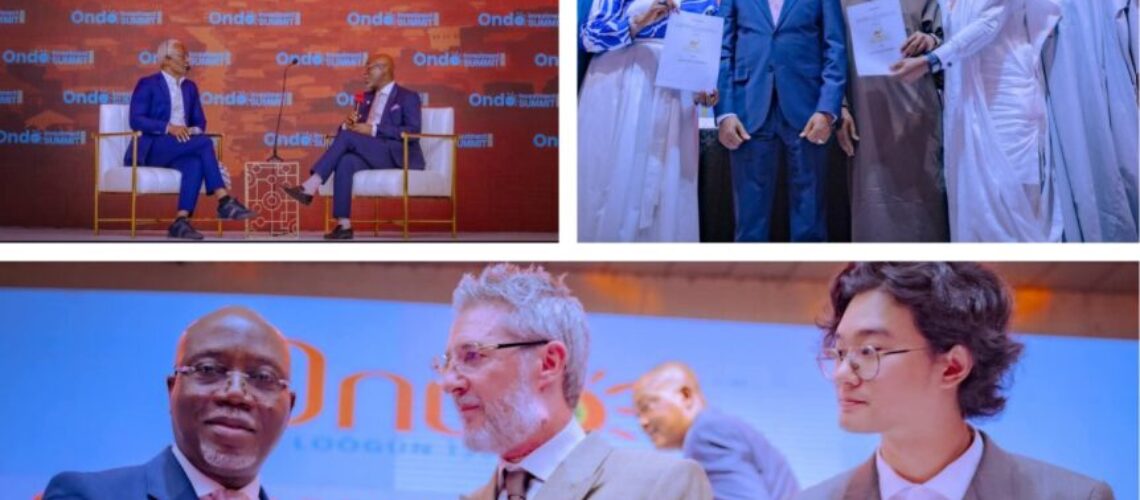
The summit featured plenary sessions, sector-focused investment panels, a fireside chat with the governor, and a formal MOU signing ceremony. The programme was structured to move participants from awareness to conviction and ultimately to commitment.
Host and Convening Authority
The summit was convened by the Ondo State Government, with Governor Lucky Aiyedatiwa delivering his speech on “OUR EASE Agenda” as an investment framework and a clear road map for enabling enterprise, accelerating growth and positioning Ondo State as a competitive destination for sustainable investment.
His Excellency Godswill Akpabio, President of the Senate of the Federal Republic of Nigeria represented by Ibrahim Folorunsho Jimoh, CFR delivering the keynote address on the state’s investment philosophy, strategic assets, and governance reform agenda. The event was operationally anchored by the Special Adviser on Entrepreneurship, Innovation and Investment (Dr. Summy Smart Francis), whose agency the Ondo State Entrepreneurship Agency (ONEA) trains and equips young entrepreneurs, and sponsors the top performers to travel abroad for exposure. The Director-General of the Project Performance Implementation and Monitoring Unit (Engr. Razak Obe) delivered the summit’s conceptual opening address, while the Ondo State Investment Promotion Agency (ONDIPA) served as the investment facing wing of government, specifically designed to simplify processes and remove bureaucratic bottlenecks for investors.
Distinguished Speakers and Panelists
The summit drew a distinguished array of voices from government, the private sector, and development institutions. Dr. Cosmas Maduka, founder of the Coscharis Group and one of Nigeria’s most celebrated self-made entrepreneurs, delivered the business keynote. Federal government representation came through Dr. Tope Fasua, Special Adviser to the Vice President on Economic Affairs, who spoke to the enabling impact of the Tinubu administration’s economic reforms, including fuel subsidy removal, naira unification, and petroleum sector revenue restructuring.
The panel session titled “From Policy to Profit: Investing in Ondo State” featured Honourable Abike Dabiri-Erewa OON (Chairman/CEO, NIDCOM), Dr. Tope Fasua, Dr. Aminu Maida and Ms. Omolola Oloworaran, and representatives from the Federal Ministry of Solid Minerals Development and the National Pension Commission. A fireside chat with the Governor, moderated by a representative of News Central Television, covered infrastructure, healthcare, education, and the long-term vision for the state. Investors already operational in Ondo including JVent Ventures (cocoa processing), Sunbed Global Concept, Rex Forestry, JB Farms, and Dumia Gold lent credibility through their presence as proof that the investment case for Ondo is no longer theoretical.
THE TRIPLE HELIX MODEL: FRAMEWORK FOR INVESTMENT MOBILISATION
One of the summit’s most intellectually compelling contributions came from Engr. Razak Obe in his opening address, where he articulated a “triple helix” model as the conceptual engine behind the New Ondo Project. In development economics, the triple helix describes the productive interlocking of three mutually reinforcing actors traditionally government, industry, and academia each playing a distinct and indispensable role in driving innovation-led economic growth. Obe adapted this framework to Ondo’s specific context, identifying three strands whose simultaneous activation is critical to sustainable investment.
The first strand is local entrepreneurs: Ondo indigene, indigenous business owners, and small and medium-scale enterprises operating within the state who are best positioned to identify market gaps, leverage cultural and geographical familiarity, and drive bottom-up economic activity. These actors are most likely to invest early and most likely to reinvest their returns locally, creating a compounding effect on the state’s economy.
The second strand is corporate and institutional capital: the large private sector firms, conglomerates, financial institutions, and multinational investors whose capital depth and operational scale are required to develop maritime infrastructure, industrial-scale agro-processing facilities, and large energy installations that no individual entrepreneur or government agency can finance alone.
The third and most distinctive strand is the Ondo diaspora referred to throughout the summit as “Ondo Ambassadors.” This global community of Ondo indigene brings not only remittance capital, but also professional expertise from advanced economies, global networks that can connect Ondo businesses to international markets, and the credibility of external validation that often encourages hesitant foreign investors. For the triple helix to function, all three strands must be simultaneously activated and institutionally supported. A state reliant solely on government revenue sharing cannot develop; only the fusion of grassroots entrepreneurship, private sector capital, and diaspora linked knowledge transfer can produce the self-reinforcing economic growth that the New Ondo Project envisions.
“Sustainable development requires a triple helix of cooperation local entrepreneurs, corporate giants, and Ondo ambassadors living abroad. Wealth must be cultivated from within to be sustainable on the global stage.”
— Engr. Razak Obe, Director-General, PPIMU, Ondo State
THE FIRST MOVER PHILOSOPHY: DR. COSMAS MADUKA’S CALL TO ECONOMIC FAITH
One of the summit’s most electrifying moments came from Dr. Cosmas Maduka, chairman of Coscharis Group. Speaking from deeply personal experience that saw him losing his father at age four, having no formal education, and yet building a pan-African conglomerate which from selling motorcycle parts on the streets; Maduka issued a compelling challenge to the assembled investors.
His central argument was the philosophy of the “First Mover Advantage”: those who commit capital to a market early before certainty is established capture the greatest returns and set the standards by which all subsequent entrants are judged. He cited the landmark example of MTN, the South African telecommunications startup that entered Nigeria when established giants like Vodafone were still conducting feasibility studies. Vodafone’s own commissioned research had projected Nigeria could not support more than five million mobile subscribers; today Nigeria has over 200 million mobile phones, and Nigeria contributes approximately 40% of MTN’s total continental revenue, with the Nigerian brand growing larger than the parent company. Maduka also drew on the example of a fin-tech entrepreneur who left a corporate career in 2015 to build a cross-border payment platform, processing $50 billion in transactions within a decade and building a company now valued at over $3 billion.
Dr. Maduka positioned the First Mover philosophy as both a commercial strategy and a patriotic imperative. Nigerian investors who wait for foreign capital to validate a market before entering cede the most lucrative positions and ultimately, national wealth creation to outsiders. He challenged those present to exercise what he termed “economic faith”: the strategic patience and calculated risk-taking required to invest in possibilities before they become certainties. For investors who move early into Ondo’s emerging sectors, the First Mover philosophy promises not only commercial returns but the privilege of shaping the regulatory and industrial frameworks that all subsequent investors will navigate.
“Those who move first will take the profit that exists in the market and set the standard by which others are judged. The biggest rewards do not go to the loudest investors, but to the earliest believers.”
— Dr. Cosmas Maduka, Chairman, Coscharis Group
FROM VISION TO EXECUTION: MOUS AND CONCRETE MILESTONES
The summit’s credibility was anchored by the signing of landmark Memoranda of Understanding at its opening, demonstrating that Ondo State had moved beyond declarations into binding commitments.
Maritime Infrastructure: The Ondo Deep Seaport
A strategic MOU was signed between the Ondo State Government and a consortium comprising Mitark Holdings and the Shandong Port Group of China operators of what is widely regarded as the world’s busiest port by cargo volume. The agreement formalizes the public-private partnership concession framework for the proposed Ondo Deep Seaport, to be developed along the state’s approximately 75-kilometre Atlantic coastline. The port is designed with a natural draft of between 16.5 and 18 meters, requiring only approximately 2 kilometer of sea construction to access that depth compared to the 32 kilometers required for the Chinese consortium’s own port to achieve a comparable draft, a natural endowment of extraordinary commercial significance. Adjacent to the port is the Sunshine Industrial City, a designated Free Trade Zone spanning 2,771 hectares, anchoring a port-linked industrial ecosystem encompassing manufacturing, maritime services, petrochemical processing, agro-industrial facilities, and logistics platforms with direct export access.
Fertilizer and Petrochemical Production
A second MOU formalized a partnership between the Ondo State Government and Resident Fertilizer for a $4 billion petrochemical fertilizer plant to be sited in the southern senatorial district, directly addressing Nigeria’s chronic dependence on imported fertilizers and leveraging Ondo’s proximity to the Niger Delta energy belt for natural gas feed stock. Across the summit, sectors attracting the greatest investor interest included maritime logistics, cocoa and palm agro-processing, solid minerals (particularly limestone and kaolin for cement production), real estate and housing, renewable energy and independent power projects, oil and gas, and digital infrastructure. Ondo State also received formal notification from the Federal Ministry of Finance of its selection as a site for a federal government-backed Diaspora City a planned integrated development comprising housing, hospitals, schools, and entertainment to be co-developed with state-provided land.
“Ondo State is not asking for opportunity. We are presenting opportunity. We are open for business, open for industry, open for innovation, and open for global partnership.”
— Governor Lucky Aiyedatiwa, Ondo State
DAWN COMMISSION’S STRATEGIC ROLE: A CALL TO ACTION
The Ondo Investment Summit is not a state-level event in isolation, its implications reverberate across the Southwest region, and DAWN Commission is uniquely positioned to amplify its outcomes, coordinate regional learning, and ensure that the momentum generated translates into durable, region-wide prosperity.
Monitoring Investment Outcomes
DAWN Commission provides a structured platform for monitoring and evaluation of investment commitments arising from the summit, tracking project implementation and investment inflows in alignment with the governor’s public accountability commitments. The Commission’s independent regional lens would add credibility to the accountability process and align outcomes with the broader Southwest Development Agenda.
Cross-State Learning and Collaboration
The Ondo Investment Summit model annual, themed, sector-focused, and publicly accountable offers a replicable template for other Southwest states. States such as Ekiti and Osun, which possess rich agricultural land and untapped mineral resources, could adopt similar frameworks. Lagos State, with its established investor networks and deep diaspora connectivity, presents a natural collaboration partner for Ondo in port logistics and real estate. Ogun State’s manufacturing corridors and Oyo State’s agro-processing ecosystems represent additional opportunities for coordinated cross-state supply chains and joint investment promotion all of which DAWN is structurally positioned to facilitate. Notably, the Commission was referenced at the summit, highlighting the existing Southwest cooperation framework and the potential for a connected regional rail system that could take the collective balance sheet of the entire Southwest to the international financing market.
Attracting Industrial Giants to Ondo and the Region
The summit opened the conversation about attracting Nigeria’s largest industrial conglomerates to Ondo. Companies such as the Dangote Group and the BUA Group, which have demonstrated appetite for large-scale agro-industrial and infrastructure investments across Nigeria, stand to gain significantly from Ondo’s combination of natural resources, coastline access, favourable geology for cement production, and the emerging Free Trade Zone. The confirmed commercial viability of kaolin deposits at Okeluse, a primary raw material for cement combined with the proposed petrochemical plant, presents an integrated industrial cluster opportunity of the kind that large conglomerates seek. DAWN Commission can facilitate introductions and structure conversations between such players and the state, reducing transaction costs and accelerating project development.
Coordinating Diaspora Investment Across the Region
With the Ondo diaspora identified as a central investment pillar and NIDCOM already engaged, DAWN Commission is set to play a coordination role at the regional level. By working with the six Southwest state governments and NIDCOM, the Commission can support the design of a harmonized Southwest diaspora investment framework including simplified business registration, streamlined land allocation, and coordinated tax incentive structures. The upcoming Global Diaspora Summit in Canada (August 2026), for which Ondo State was ranked among the top five most attractive Nigerian states for diaspora investment, presents an immediate platform for a coordinated Southwest regional presence under DAWN Commission’s facilitation.
WHY THIS SUMMIT MATTERS: THE STRATEGIC CASE FOR ONDO’S INVESTMENT DRIVE
Several converging factors make the Ondo Investment Summit a critical window of opportunity for the state and the entire Southwest region.
The Lagos-Calabar Coastal Highway, currently under federal government construction, passes through Ondo State and is set to transform connectivity along Nigeria’s southern coast. When completed, this corridor will dramatically reduce logistics costs, improve market access for agricultural produce and solid minerals, and increase the commercial viability of investments in Ondo’s southern senatorial district precisely where both the Deep Seaport and the fertilizer plant are located. Investment frameworks must be aligned and ready to absorb the economic activity this infrastructure will generate.
Ondo’s solid mineral endowments remain among the most under exploited in the Southwest. The state holds significant deposits of limestone, granite, kaolin, and bitumen, the latter being the second-largest natural deposit in the world after Canada. Laboratory analysis of kaolin at Okeluse has confirmed commercial viability for cement production, and the same investor developing the fertilizer plant has expressed interest in a cement factory on the same site, reflecting the kind of industrial cluster formation that generates compounding investment returns. Nigeria’s multi-billion-dollar annual expenditure on imported fertilizers and cement underscores the domestic market imperative for value-added manufacturing in Ondo.
The state’s security profile, enhanced through the homegrown Western Nigerian Security Network (WNSN) codenamed Amotekun Corps community policing initiative operating alongside federal security agencies, has been adjudged one of the most stable in Nigeria. This development is a non-negotiable precondition for investor confidence.
Combined with the OUR EASE Agenda’s commitments to regulatory simplification, transparency, and policy stability, the governance conditions for investment are increasingly in place. The summit’s explicit anchoring in accountability with the governor’s public commitment to reporting on every investment commitment at the 2027 edition signals an institutional maturity that distinguishes the Ondo model from performative investment events, and is precisely the kind of structured, results-oriented approach that DAWN Commission exists to support and scale across the Southwest region.
Prepared by: Titilayo Alice Afolabi
Executive Assistant to the Director General, DAWN Commission
March 2026.