
The education landscape in Southwest Nigeria has continued to reflect structural challenges linked to rapid population growth, urban expansion, and uneven public infrastructure distribution. Government-owned schools remain insufficient in number and spatial spread, particularly in peri-urban and low-income communities, resulting in extended travel distances for learners and increased transportation costs for households. This condition has contributed significantly to the persistence of out-of-school children, especially among economically vulnerable populations, where schooling costs extend beyond tuition to include transportation, materials, and opportunity costs.
Within this context, Non-State Schools (NSS), educational institutions operating independently of direct government funding or management, encompassing private schools, faith-based schools, charity schools, and community schools, have increasingly filled access gaps where state provision has been unable to keep pace. These institutions have emerged not merely as alternatives but as functional complements to public education systems, absorbing excess demand and expanding geographic coverage.
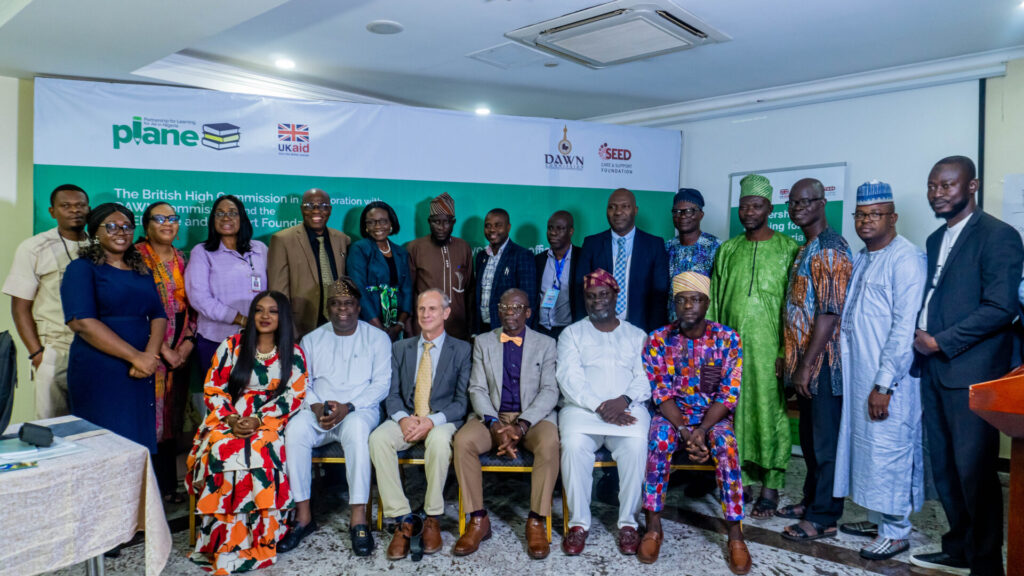
However, despite their growing systemic importance, NSS continue to operate within a fragmented regulatory environment, characterized by weak policy recognition, inconsistent oversight, limited financial access, and minimal integration into state planning and data systems; hence, the collaborative efforts of the Development Agenda for Western Nigeria (DAWN) Commission and the UK-funded Partnership for Learning for All in Nigeria (PLANE).

Operating under PLANE Output 3, the partnership is focused on strengthening governance structures, improving learning outcomes, and integrating non-state education providers into government’s plan for the education sector in the six states of Ekiti, Lagos, Ogun, Ondo, Osun, and Oyo.
The partnership has implemented a series of coordinated interventions targeting governance and structural reform of the NSS ecosystem. Central among these were the establishment of and capacity development for the Coalition of Interest Groups for Low-Fee-Paying Schools. Leaders and members of this coalition are saddled with the task of advocating for government’s interventions in the schools that are providing access to the children in underserved communities. The team has also facilitated the domestication of the National Policy on Non-State Schools in Lagos, Ogun and Oyo State to structure intervention to this category of schools. The intervention was implemented in collaboration with the sector stakeholders which included the officials of the State Ministries of Education, private school associations, civil society actors, and other regulatory bodies.
Parallel effort was also focused on strengthening data management through capacity building for EMIS officials. This was organised in direct response to the challenges of data fragmentation as private school records are not incorporated in the government database and this systemic inaccuracy is affecting education planning across the Southwest region. The training was channelled towards improving on the process of conducting annual school census which is a primary instrument for identifying, enumerating and integrating all schools, both state and non-state, into a unified data ecosystem. By strengthening the data infrastructure that captures the realities of both approved and unapproved schools, the initiative contributes to legitimising the role of NSS in addressing access gaps created by inadequate and poorly distributed public schools. This, in turn, improves evidence-based policy decisions and targeted interventions for out-of-school children in underserved communities.
There was also complementary capacity development on leadership for the school leaders, including the State-Based Management Committee (SBMC) and Parents-Teachers Association (PTA) to strengthen school-level governance and deepen community participation in the education of the children. This is imperative as effective SBMC-PTA collaboration directly enhances governance, accountability, parental engagement, and learning conditions in schools that operate outside the formal government regulatory radar. This will reinforce local ownership, strengthen oversight mechanisms, and formalise lines of community support. The initiative contributes to improved functionality, legitimacy, and sustainability of Non-State Schools as critical providers of access in areas where government provision remains limited or unevenly distributed across geographic and socio-economic contexts.

In the same vein, facilitating domestication of National Policy on Non-State Schools marked an important step towards addressing regulatory inconsistencies, overlapping levies, and procedural barriers that disproportionately affect operators of low-fee schools. The gradual institutional recognition of Non-State Schools within the planning discourse has also triggered the repositioning of these schools as an integral – rather than peripheral – actors within regional education system. While it is early stage yet for the reforms, it indicates progress toward addressing the systemic fragmentation and enhancing the coherence of NSS governance, particularly in relation to their role in absorbing underserved children and mitigating the challenges of out-of-school children.
The DAWN–PLANE partnership highlights the important role the Non-State Schools play in addressing access deficits created by limited government school capacity and spatial distribution inefficiencies. The initiatives therefrom have functioned as a stabilising mechanism within high-demand communities, especially where distance and transport costs would otherwise render public education inaccessible. This partnership remains critical in repositioning NSS within formal governance structures and reducing systemic barriers that indirectly contribute to the out-of-school children phenomenon.
Therefore, the PLANE programme, currently in its third year of implementation in the Southwest region, will consolidate on earlier interventions by deepening institutional capacity for implementing the non-state school policy, regulatory coordination, and data integration, while maintaining a focus on addressing structural access gaps linked to inadequate public-school infrastructure and spatial inequities. The continued presence of PLANE in the region provides consistency in technical guidance, supports the refinement of implementation processes, and further deepen the collaboration between DAWN
Author: Kehinde Adebayo,
Associate, Education Desk