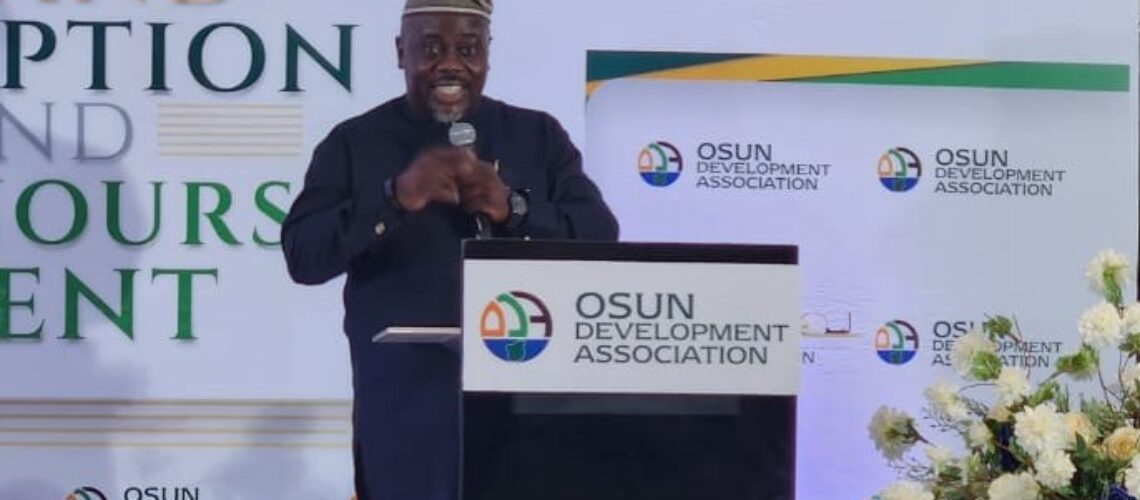
Being the paper delivered by Dr. Seye Oyeleye, FIAP, FIIHP, DG, DAWN Commission at the Grand Reception, Honours, and Induction event of the Osun Development Association (ODA) at the Radisson Blu Hotel, VI, Lagos on 2nd June, 2024.
PROTOCOL
It is a great honour and privilege to be here today at this grand reception and honours event. As we gather to celebrate and appreciate the founding members of this distinguished assembly, I am humbled to have been entrusted with the responsibility of delivering the keynote address.
It is really a tough job to do at an occasion honouring great personalities and I hope to do my best. If I succeed, then give me a pat on the back. But if I don’t, hold the organisers responsible, especially Dr. Olugbodi. I am still wondering the pounded yam induced dream they had before deciding that this small boy should stand to speak before Gen Akinrinade GCON, Nigeria’s first Chief of Defence Staff, before Engr Maduka MRF, Nigeria’s first female Fellow of COREN, before Prince Ponle MFR, whose MicCom cable became a colossus in an expatriate-dominated business, before Chief Aboaba, one of the first people to bring Igbajo to public reckoning, before Prof Aina OFR, the carpenter who became a professor and before the many dignitaries here today.
I am happy however that the honourees who have passed on are cheering me on and encouraging me because they have endorsed the message I have for this noble audience today. Again if you have any issue with what I have to say today, hold them responsible also.
On this note, Ladies and Gentlemen, may I crave your indulgence for a minute silence in honour of Late Chief Benjamin Adigun MFR, Late Prince Duro Oyinlola, and Late Professor Tunde Odetola.
May their souls continue to rest in peace and we pray God’s eternal blessing dwell with the people they left behind.
INTRODUCTION
Looking at the list of the honourees, it is easy to see that Osun State is blessed with a rich list of high achievers – people who rose to greatness on the launching pad of integrity, commitment, foresight and hard work. And this is where I want to start my short speech by challenging this group to make it a priority to nurture and mentor indigent indigenes of Osun State to become other high achievers like their esteemed members.
I came here to congratulate and celebrate with the honorees for this deserving recognition and I came here also to challenge ODA. This is why I have tweaked the topic given to me for this occasion slightly to, “Pioneering Progress: A Blueprint for Sustainable Development in Osun State.” It is a call to action – a challenge to chart a new course, to move beyond mere rhetoric, and to harness the immense potential that Osun State holds for growth and prosperity.
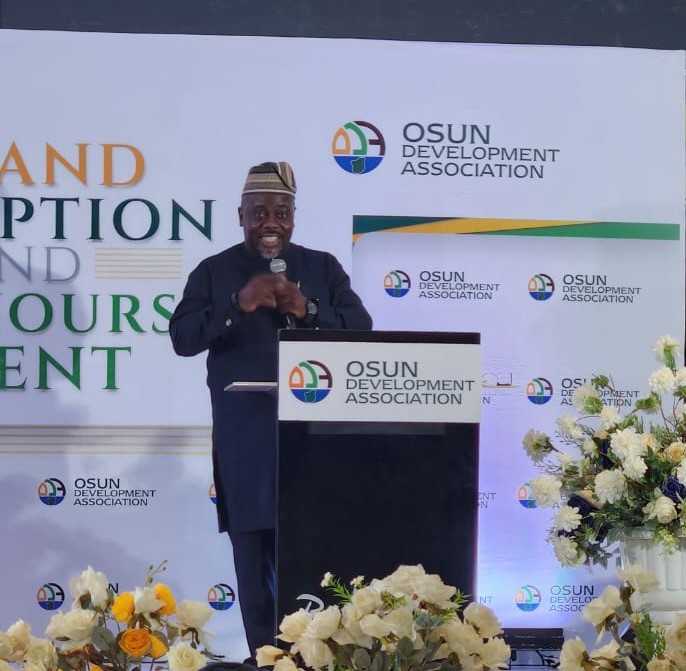
Development is something that resonates deeply with the aspirations and vision of this Association and its esteemed members who have demonstrated peak level achievements and performance in their endeavours. Nurturing young talents that could replicate or even surpass the achievements of our honourees should therefore be a top priority.
There is a Joana out there on the streets of Osogbo, a Alani combing the bush in Igbajo and setting traps for rodents, many Tundes in Ife, many Inaolaji in Ilesa. If these young people were to answer the surnames of our honourees, how proud would we be of them? I guess the answer is negative. We must therefore rise from this occasion and make it a deliberate course of action to make sure these young people become personalities worthy of the seal of respect that our honourees command in the society.
I know you have been doing this, providing opportunities for young people but what I am asking from you is a step deeper than provision. I am asking for a parent-child mentorship as a culture of this organisation – as a culture.
Why am I making this demand of you? Let me paint the picture of our dear state to you.
OSUN STATE AT A GLANCE
Today as we speak, the debt per capital of Osun State is ₦33,266. This is the amount each resident would have to pay to offset the debt of the state. Note that amount please.
The state’s Internally Generated Revenue (IGR) per capita stands at just ₦5,185. This means the government is able to raise an average of N 5,185 from each resident. This suggests that our government has limited ability to raise its own revenue and reduce dependence on federal allocations. The capital expenditure (capex) per capita is relatively low at ₦5,700, which implies that the state may be struggling to invest adequately in infrastructure and development projects.
What picture do we get from these data? It is simply that of a state that is incapable of investing in its own future, in critical infrastructure and development projects that are essential for long-term growth. It also means that that state’s capital expenditure is not yet directly improving the living standards of the people.
I list below the top five highest and bottom five lowest revenue of the Osun State government, gleaned from the state’s SFTAS report of Q1 2024.
High Revenue Sources (based on projected budget)
- Statutory Allocation: ₦29.5bn
- Share of VAT: ₦45.4bn
- Share of Other FAAC Revenues: ₦24.2bn
- Independent Revenue: ₦11.1bn
- Motor Vehicle Licences: ₦613m.
Low Revenue Sources (based on projected budget and/or performance)
- Capital Development Fund (CDF) Receipts: ₦12,367,008,240 – The report shows zero actual performance for this category.
- International Loans/Borrowings Receipt: ₦12,367,008,240 – Similarly, no actual revenue is recorded for this source.
- Rent on Government Buildings General: ₦367,530,000 – While the projected budget isn’t extremely low, the actual performance is only 1.4% of the budget.
- Earnings from Tourism, Culture, Arts Centers: ₦376,100,000 – The report shows no actual earnings from this potentially significant source.
- Earnings from Agricultural Produce: ₦7,965,000 – This projected revenue source also shows zero actual performance in the report.
From the data above, we could see that what brings money into the coffers of Osun State is not productive effort. A state that relies too heavily on external funding – in this case, federal allocation – is like a bird with clipped wings, unable to soar to new heights.
Little wonder we have our health and education statistics in a parlous state. Each time we lament about these below par data, I always say it is a case of Amukun, eru e wo. These stark realities paint a picture of Osun State that is both challenging and full of unrealized potential. It is a state that, despite its natural resources, human capital, and rich cultural heritage, continues to grapple with persistent development challenges. And it is our collective responsibility, as members of this esteemed Osun Development Association, to chart a new course – one that transforms these challenges into opportunities for lasting, sustainable progress.
Hopefully, you can now see why I asked that you, even in your old age and deserving retirement, to go beyond just donation and philanthropy and give yourself the job of replicating yourselves in the young people of Osun State. It is a daunting task that cannot be left to public governance alone. This should be your Big Hairy Audacious Goal, BHAG as it is known in business strategy circles.
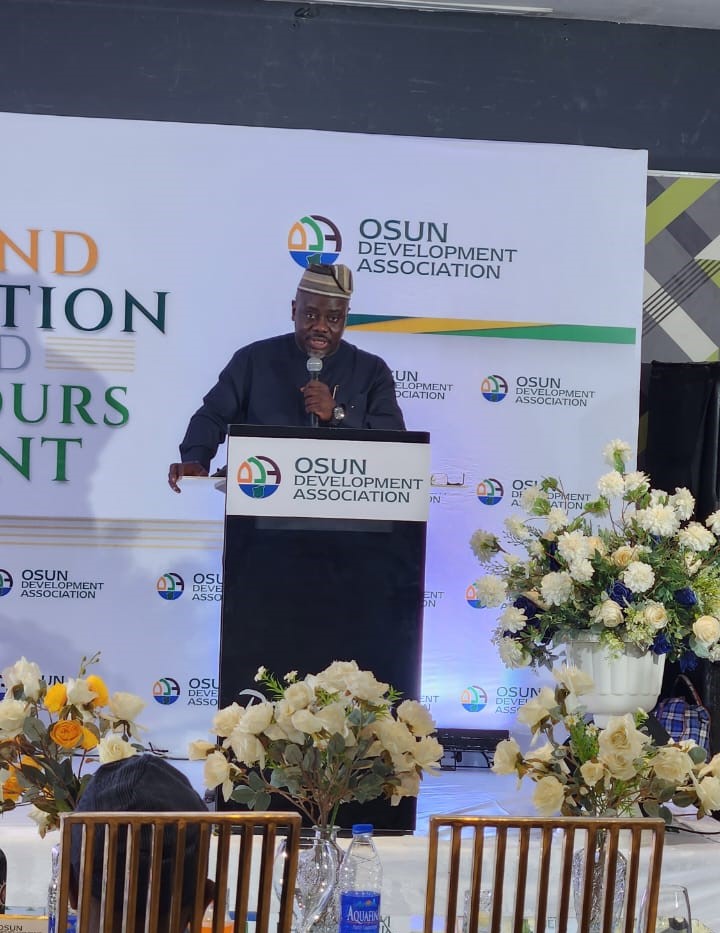
My dear elders of Osun State, we must ask ourselves: how can we, as a collective of non-partisan elders, thought leaders, technocrats, and top professionals, drive the transformative change that our beloved state so desperately needs? This is why I titled my speech “pioneering progress”. We must challenge ourselves to lay the foundation for the sustainable development of Osun State, irrespective of which political party is in power.
It is easy to play the blame game. Oh it is Aregbesola’s fault. Oh, Oyetola did nothing. Oh, Adeleke is not doing anything. We all have made the blame game a past time. It can even be therapeutic for some of us. We will fall sick if we don’t engage in it. This is very easy to do when we gather at our hangouts and relaxation centres. But the world of development is hard. Are we ready to change gear from the easy path of blame to the highway of development where the rubber meets the road?
From the picture I painted above, I am bold to say that the job of the governor of a state like Osun is one of the toughest. What the government therefore needs is everybody’s support and I hope ODA can lend itself as a pillar of support to the state government in ways that I will highlight here today.
A Blueprint for Osun’s Future
Why do we need a development blueprint model? It is very simple. So that we can be able to measure the impact of our interventions and know exactly what and where to improve. As it is often said in management circles, what you cannot measure, you cannot manage.
In my private chats with many well-meaning elders, there is always a sense of frustration. The more resources they pour into their philanthropic interventions, the more it seems things are getting worse and the ideal society they envisage remains elusive.
I know that ODA, as a group, shares this frustration.
But at the heart of this is a lack of a model upon which such interventions were based, making it difficult to know exactly what parameters to monitor and improve upon.
Iwo Road as a Metaphor of Development Model
Whether we like it or not, development models are actively shaping our realities in Nigeria, even though we like to think none exists, except the imported ones, as our people in the socialist circle love to say, from the IMF and World Bank.
But take a journey from Lagos to Ibadan. At Iwo Road, you are confronted with a choice – to continue up-north or veer inward the region. If you are to make a decision based on how good the roads are, many of us will choose to go up-north.
I like to think that our roads are a metaphor for Nigeria’s development model. Take any decade and consider the road development projects within it, you are likely to come to the conclusion that over the years, the north-south roads fared better while the roads connecting within the regions keep getting worse.
That tells us that we have not significantly moved away from the economic model that the colonialists established for moving goods from North to the South. If we open up the socio political and economic impacts of this model, I am sure we will arrive at the state of development we have found ourselves in NIgeria. Along that road lies a bus stop known for atomisation of regions into states, in a manner that makes them dependent on the “benevolence” of the federal government. I am sure you are already thinking of other bus stops that lead to Nigeria’s present state of affairs. They all started from that north-south model of organising the geographical space called Nigeria.
This is why I am an advocate of the Lagos-Calabar road project because it is the first major infrastructure that moved us away from this colonial economic model.
So going back to Iwo Road, what development model should ODA adopt?
Permit me to show my bias at this juncture as I have no other product to sell other than regional integration.
So, for instance, if you are planning to organise a secondary school debate that allows students of Osun State to compete against one another, let them compete with their peers in the region.
If ODA adopts regional integration as the underpinning philosophy for its interventions, the result may come in slower but it will be more sustainable.
Away from my bias, there is a compelling reason for Osun State to champion regional integration. It is the only state in the region that shares a border with four states. The only SW state it does not share a border with is Lagos. I will speak more about this in the course of this speech.
How to Harness the Potentials of Osun State
There is a consensus that Osun State has potential for commercial agriculture, agro-allied industries, tourism and mining. Where there is a big lacuna is how to begin to harness these resources and use them to chart a path to prosperity for the state and its people. For this, I am going to recommend a business strategy known as the Resource-Based theory.
The Resource-Based Theory (RBT) is a strategic management tool that focuses on the internal resources of an organisation as the key determinants of its competitive advantage and performance. The core idea of RBT is that organisations can achieve and sustain competitive advantage by developing and deploying valuable, rare, inimitable, and non-substitutable (VRIN) resources and capabilities.
RBT emphasises that a firm’s internal resources and capabilities, rather than its external market position, are the primary determinants of its performance and competitiveness. By identifying, developing, and effectively utilising these strategic resources, firms can create value, achieve competitive advantage, and sustain it over time.
How can RBT help ODA to achieve its aspirations? ODA must start by identifying and understanding Osun State’s valuable, rare, inimitable, and non-substitutable (VRIN) resources and capabilities. I have already identified one of these VRIN, which is the centrality of the state to the region and its borders with four states. I will mention some others as we progress.
But I want to draw your attention to the “capabilities” component of RBT. You can have the best resources in the world, if you do not have capabilities to use them, you will end up miserable.
So, in addition to identifying and understanding Osun’s VRIN resources, ODA must also understand how to help the state develop the capabilities. And I will focus more on this because it is even more important than the resources.
The word capabilities is a summary for two concepts, as the late Clayton Christenson explained in his book, “How will you measure your life?”. These concepts are processes and priorities. Developing the right processes and priorities are what you need to make the best use of your resources.
I go back to that fictional debate project. How should ODA leverage this tool to develop the human capacity of the students? Let us agree for example that ODA values competitiveness as a process and priority, it then becomes clear that the debate should have Osun State students competing with their peers in the region instead of against one another.
Hopefully, it is becoming clearer how the combination of regional integration model and the resource-based theory can help ODA achieve its aspirations. By employing this approach, you will be able to measure the impact of your interventions and will know what to improve and when to do so. This I believe is the best approach to getting value for your money.
Let me summarise all I have sad so far:
- ODA should set a BHAG of replicating themselves in young Osun State indigenes.
- ODA should adopt the regional integration model and resource-based theory in approaching this BHAG.
- ODA should identify Osun State’s VRIN resources
- ODA should agree among themselves the processes and priorities they will employ to develop the state’s resources.
At this point, my elders, leaders and colleagues, I want to give myself a pat on the back believing I have done a good job in helping ODA to approach the topic given to me.
However, knowing General Akinrinade for his very high standards, he may not be convinced I have done a good job yet, so I crave your indulgence for me to discuss my views about what should be considered Osun State’s resources and what processes and priorities should ODA employ.
Our Resources
When you ask around in the policy development circles about the resources of Osun, you are likely to hear mining, agriculture, tourism, human capital and the likes. These are not wrong but they do not speak of these resources in a manner that positions them as valuable, rare, inimitable, and non-substitutable.
If I say that Osun has agricultural potential. Well Osun is not the only state that has that potential. It is possible therefore for the state to get lost in the midst of states with agricultural potential. We must do the hard work of thinking and defining our resources not at the general overview but at a deeper level that connects instantly.

For instance, rather than say we have abundant human resources, it would be better to say we have experienced artisans and versed traders. You can see the difference. I can even go deeper by saying we have the best mining artisans in the country and the highest number of expert Toyota mechanics. Defining our resources in accordance with the dictates of VRIN can begin to expose our strengths, weaknesses, opportunities and threats. Thereby we will know what we need to take advantage of and what we need to quickly deal with.
For everything that we consider a resource, we need to list what is valuable, rare, inimitable, and non-substitutable about it.
You can now see that the business of development is not easy. But that is what we must do to lay the foundation for sustainable development. That is what ODA must do. Well, ODA can choose to outsource it to the DAWN Commission.
Processes
After identifying our VRIN resources, we now need to start developing the right capabilities. For this, there are no hard and fast rules. Each person, group or society will have to decide what it is. But for ODA, I want to make a case for a few.
The first is our code of conduct as Yoruba people. I am speaking of Omoluabi virtues. We make the mistake of calling for value re-orientation as a solution to the rise of social vices in our society. We however need to start seeing Omoluabi values as a business tool. As an investor, if I know that people of Osun are well behaved, trustworthy, honest, and hardworking, and there is another location where there is a deficit of character, where will I take my business to?
Omoluabi is beyond just values. We have to locate it as one of the secrets of our prosperity in Yorubaland. We must therefore place a premium on it by rewarding it in our society. We should organise events that reward Omoluabi values in young people, better than the way we organise beauty pageants. Is it not confounding that our societal processes make it easier for a young boy to enter a betting shop than to go to the farm.
I also want to recommend a few development tools that ODA should add to its arsenal. The first of these is called Community Driven Development, that empowers local communities to identify, prioritise, and manage their own development initiatives. The World-Bank funded Kecamatan Development Program in Indonesia offers a compelling example of how non-governmental organisations like ODA can facilitate this grassroots-level engagement and empower communities to take charge of their own progress.
Another strategic tool that can help us develop proven developmental processes is Sustainable Livelihoods Approach (SLA), which focuses on understanding and strengthening the diverse assets – human, social, financial, physical, and natural – that enable individuals and communities to pursue sustainable livelihoods. The Sustainable Livelihoods Programme in the United Kingdom demonstrates how non-profit organisations can collaborate with local stakeholders to develop tailored strategies for improving economic well-being.
Furthermore, the Integrated Rural Development (IRD) model, as exemplified by the Integrated Rural Development Programme in India, underscores the importance of a holistic, multi-sectoral approach to rural development. In this case, non-governmental organisations played a crucial role in bridging the implementation gap, providing technical assistance, and advocating for policy changes that benefited rural communities.
It is said in business circles that culture will eat strategy for breakfast. If ODA raises N10bn today and pour everything into its strategic agenda, based on the prevailing social culture in our state, no matter how logical or beautiful the strategy is and I don’t care if that strategy is developed by the best consulting firm in the world, it will fail.
We must take the difficult way of introducing new social processes into our culture and the four tools I mentioned above can guide us. This is not what money only can do and it is the reason I made a demand of us earlier in this speech for mentorship.
Let me summarise all I have sad so far:
- ODA should set a BHAG of replicating themselves in young Osun State indigenes.
- ODA should adopt the regional integration model and resource-based theory in approaching this BHAG.
- ODA should identify Osun State’s VRIN resources
- ODA should create new culture and social capacities by adopting Omoluabi, Community Driven Development, Sustainable Livelihood Approach and Integrated Rural Development as the processes for carrying out its interventions.
Priorities
I am on the last lap of my speech, which is setting the right priorities.
Any organisation may have the best resources and processes but can still fail if it gets its priorities wrong. The infamous press conference to announce Microsoft’s acquisition of Nokia drives this home. Nokia’s CEO, Stephen Elop, was quoted to have said “we didn’t do anything wrong, but somehow, we lost”.
A critical analysis of the events that led to Nokia’s acquisition will reveal that the company got its priorities wrong.
It is therefore important for ODA to set the priorities and I offer again a few suggestions, in no particular order of importance.
- How do we attract private investments to Osun? The first step will be to ensure the state has a PPP law. Osun is one of the two states in SW without a PPP law.
- Social entrepreneurship. I think Osun will be better off starting with social entrepreneurship, especially those that focus on the attainment of SDGs.
- Cooperatives and Chambers of Commerce. We should prioritise the establishment of these business development tools as part of our business culture in Osun State.
- Digital infrastructure, particularly the internet. This is an indispensable tool for developing modern human capital and Elon Musk has brought this to our rural communities now.
Rather than go all out for an ambitious industrialisation project, we should begin to build our industrial capacity by following these three recommended steps. Our state is renowned as a civil service state and if we jump straight into industrialisation, I fear we are not treading a sustainable development pathway.
Again, Let me summarise all I have sad so far:
- ODA should set a BHAG of replicating themselves in young Osun State indigenes.
- ODA should adopt the regional integration model and resource-based theory in approaching this BHAG.
- ODA should identify Osun State’s VRIN resources
- ODA should create new culture and social capacities by adopting Omoluabi, Community Driven Development, Sustainable Livelihood Approach and Integrated Rural Development as the processes for carrying out its interventions.
- ODA should prioritise enactment of PPP law, investments in digital infrastructure and social entrepreneurship, and establishment of cooperatives, business advisory centre and Chambers of Commerces
A Call to Action: Realising Osun’s Prosperous Future
Distinguished members, as we stand here today, united in our commitment to the advancement of Osun State, we are faced with a pivotal moment – a crossroads where the path to progress and the path to stagnation diverge.
The blueprint for sustainable development that we have outlined today is not merely a collection of lofty ideas, but a concrete, actionable plan that harnesses the collective wisdom and expertise of this esteemed assembly. It is a roadmap that, if embraced and executed with unwavering dedication, can propel Osun State towards a future of prosperity, equity, and social harmony.
But this is not a task that can be achieved by the Osun Development Association alone. It will require the concerted efforts of all stakeholders – the government, the private sector, civil society organisations, and, most importantly, the citizens of Osun State. Together, we must forge a shared vision, align our priorities, and pool our resources to bring this blueprint to life.
To our esteemed guests and newly inducted members, I invite you to join us in this transformative journey. Bring your unique perspectives, your innovative ideas, and your boundless energy to the table. Together, let us chart a course that will inspire generations to come, leaving an indelible mark on the history of Osun State.
To our founding members and the newly inaugurated council of elders, I commend you for your unwavering commitment to this cause. Your wisdom and experience will be the guiding light that illuminates our path forward. Embrace this moment, for it is yours to shape – to leave a lasting legacy that will echo through the halls of time.
And to the government of Osun State, we extend a hand of collaboration, for it is only through a spirit of partnership and mutual understanding that we can truly unlock the full potential of our beloved state.Partisan politics and development must be mutually exclusive, the only language development understands is bi-partisanship, an environment where we are all contributing our little bit in collaboration and not competition; Let us work in lockstep, aligning our efforts, and ensuring that the fruits of our labour are justly distributed among all our citizens.
The time for action is now. Let us leave the rhetoric behind and embrace the pioneering spirit that has long defined the people of Osun. Let us roll up our sleeves, sharpen our minds, and pour our hearts into the realisation of this bold blueprint for sustainable development.
For in doing so, we will not only transform the physical landscape of Osun State, but we will also forge a future where every citizen is empowered to reach their full potential, where opportunities abound, and where the promise of a better tomorrow is not merely a dream, but a tangible reality.
I stand before you today, filled with unwavering optimism and a steadfast belief in the indomitable spirit of Osun. Let us, together, embark on this journey of Pioneering Progress, and write a new chapter in the annals of our state’s history – one that will inspire generations to come. DAWN Commission stands ready to be your strategic partner on this journey.
About 70 years ago, some people sat in a room somewhere in western Nigeria and envisioned a building we all call cocoa house today, construction took like 7 years and in 1965, the building was commissioned for use, 60 years later, that building still stands strong as a testament to the heights both figuratively and literally we once reached as Yoruba; the power of vision gave birth to such an enduring legacy and apart from the federal government, no subnational or state government has given us anything close to that. It is that vision, not thinking of the now that i will implore us at ODA, to deploy as we envision and dream of a new Osun. It is doable, it is possible, indeed it has become a necessary imperative if we want to have a place we can be proud of in the near future that we call home.
Thank you, and may Osun State’s future shine brighter than ever before.