PROTOCOL:
His Excellency, Mr Governor
Distinguished Secretaries to State Governments of our Southwest region,
Honorable Commissioners,
Senior Government Officials,
Distinguished Ladies and Gentlemen
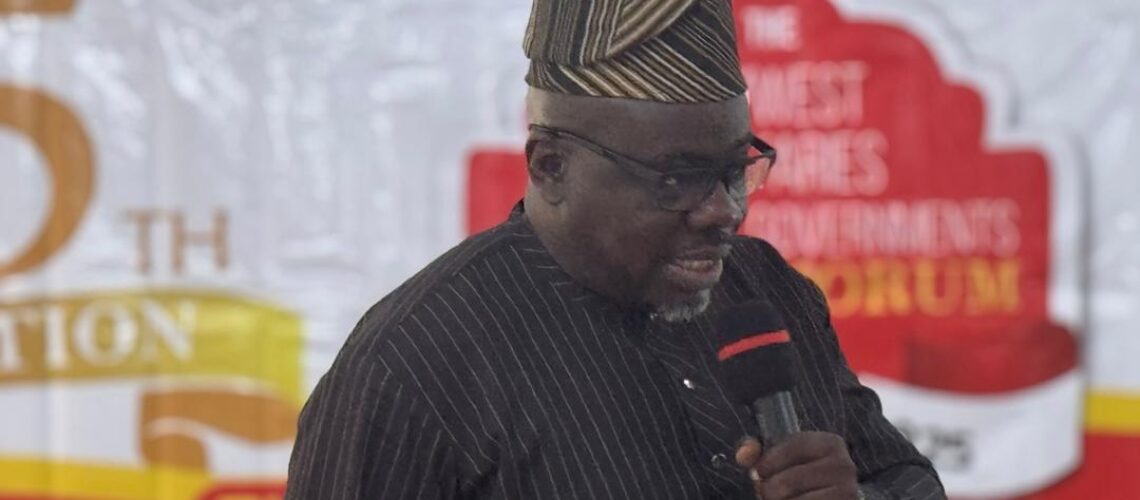
It is with great pleasure that I welcome you all yet again to the 5th edition of the Southwest Secretaries to the State Governments (SSGs) Forum on behalf of my team at DAWN Commission, the regional technocratic institution established in 2013 by the Governments of the six Southwest States to foster sustainable development across our region.
The SSGs Forum, as we all know, is one of DAWN’s Communities of Practice (CoP) instituted for learning and experience sharing among key government officials, facilitating the replication of good practices throughout the Region. This aligns with our strategy of an inclusive development process that involves convening conversations among diverse governance stakeholders—including political officeholders from both the executive and legislative branches, civil and public servants, citizens; groups, academia, media representatives, and development partners/donor agencies—all working toward realizing the Commission’s vision of making the Southwest Region the preferred place for people to visit, live, work, and invest.
I extend special appreciation to our gracious host, Professor Habibat Adubiaro, the Secretary to the State Government of Ekiti, for her exemplary hospitality in welcoming us to this beautiful state for our deliberations.
At our last meeting in Osogbo last December, we collectively resolved to strategically position the Southwest region for accelerated development by engaging the Federal Government through the Office of the Secretary to the Government of the Federation. The enthusiasm and The commitment demonstrated at that gathering has propelled us to this crucial next step.
In line with the resolutions reached at the meeting, the DAWN Commission was tasked with the responsibility of crafting a roadmap for the realization of our collective aspirations.
To this end, we immediately embarked on the preparation of comprehensive concept notes and position papers focused on the three critical sectors identified as key to driving our regional transformation: regional rail infrastructure, livestock agriculture, and artificial intelligence. This work has been guided by a commitment to excellence and the ambition to position the Southwest as a leader in these strategic areas. To ensure the highest level of expertise and innovation, we have engaged some of the most accomplished professionals and thought
leaders in these fields.
Today, they will share with us their insights and well-researched
strategies through detailed presentations that promise to provide actionable frameworks for development. We selected regional rail infrastructure, livestock agriculture, and artificial intelligence as
priority sectors through careful deliberation, not arbitrary choice. The Southwest possesses significant comparative advantages in these areas, which also present unique opportunities for cross-state collaboration yielding benefits exceeding what states could achieve independently.
In the Regional Rail Infrastructure presentation, we will explore the transformative potential of an integrated rail network connecting our six states. This connectivity will revolutionize interstate commerce by reducing transportation barriers that currently impede the flow of goods and services.
Our Livestock Agriculture presentation responds to both economic opportunities and social challenges. We will introduce sustainable livestock management models tailored to Southwest conditions, designed to increase productivity through modern techniques. These approaches will enhance food security while generating employment in rural areas where jobs are most needed.
The Artificial Intelligence presentation outlines our vision for technological leadership. Our experts will present concrete steps for positioning the Southwest as Nigeria”s premier AI hub through strategic investments and policy coordination. This plan leverages our exceptional educational institutions and established tech ecosystem in Lagos, Ibadan, and emerging centers.
Breaking Down the Silos
But before we dive into the meat of today’s discussions, permit me some minutes to muse and indeed reflect. I stand before you with both concern and hope. Concern, because despite our shared history, culture, and challenges, we continue to witness a troubling pattern of isolation, imposed by Nigeria’s governance structure, in our approach to governance and development. Hope, because I believe firmly in our capacity to change course.
The time has come for us to jettison completely the idea of working in isolation or silos. Our challenges—whether in security, infrastructure, economic development, or social welfare—do not recognize state boundaries. They are regional in nature and demand regional solutions.
When Ekiti faces food security challenges, it inevitably affects Ondo. When Lagos experiences urban congestion, it reverberates across Ogun. When educational standards decline in Osun, the impact extends to Oyo. We are interconnected by geography, history, and destiny. Why then should we persist in seeking isolated solutions to shared problems?
Small Wins, Great Impact
Distinguished SSGs, permit me to say that regional cooperation need not begin with grand projects alone, yes we must do Rail because that has become a necessary imperative for our development and we are already 3 decades behind in my opinion; but it can start with small, practical steps that demonstrate the power of unity.
Let me share a vision that exemplifies this small steps approach: regional transportation.
Imagine if each of our six states committed to purchasing just 20 modern buses each—120 buses in total—to establish a Southwest Regional Transport Company. This modest investment would immediately signpost the desirable model of transportation in our region, replacing the rickety, unsafe vehicles currently dominating our roads.
This initiative would not merely improve transportation. It would enhance interstate commerce, boost tourism, improve safety on our roads, and most importantly, stand as a visible symbol of regional cooperation. Citizens traveling from Akure to Ibadan would experience firsthand the benefits of states working together rather than in isolation, just like we have in the case of Amotekun—a shining example of our “Strategic Partnership for Regional Development” in action.
The cost to each state would be manageable, but the collective impact would be transformative. This is just one example of how small, coordinated actions can yield significant regional benefits.
Embracing an Ambitious Mindset
Distinguished SSGs, we are heirs to a proud legacy of regional ambition and achievement. We are the descendants of the visionaries who gave us the Cocoa House—once the tallest building in tropical Africa. We inherit the tradition of those who pioneered free primary education in Africa, decades before it became a global development goal.
These achievements were not the product of timid thinking or fragmented efforts. They stemmed from an ambitious mindset that saw possibilities where others saw problems, that envisioned a prosperous future and worked collaboratively to achieve it.
Today, that ambitious mindset must be rekindled. The challenges we face—rapid urbanization (SW Rail), youth unemployment, climate change, insecurity, technological disruption(AI)—are formidable. But so were the challenges our predecessors faced. The difference was in their approach—bold, united, and forward-looking.
Preparing for the Southwest Development Commission
Distinguished SSGs, I must also draw your attention to the imminent establishment of the Southwest Development Commission. This presents both an opportunity and a challenge for our region. The opportunity lies in the additional resources and federal support that will become available for our development initiatives. The challenge lies in how we engage with this new institution.
It is imperative that we approach the Southwest Development Commission as a unified bloc, with the DAWN Commission serving as our coordinating mechanism. If each state engages the Commission individually, we risk fragmenting our development agenda and diluting the impact of available resources. This would lead to atomized projects with limited regional significance rather than transformative initiatives with region-wide impact.
The newly established SEDC (South East Development Commission) in their maiden meeting with governors of the region, stated clearly that only region-wide projects will be prioritized, rail connectivity, road infrastructure that interconnects them and power sufficiency..this is what we hope to see when SWDC takes off. Imagine the Commission working with Ekiti/Ondo states to construct a super highway that connects from the northernmost part of Ekiti, through Ondo state and hitting the Lagos-Calabar road on the coast, think of a Commission, working with the 6 states to take over the Ikerre gorge dam in oyo state and develop the power generating and irrigation potentials.
By presenting a unified regional development plan through DAWN Commission, we can ensure that SWDC’s resources are deployed strategically to address our most pressing shared challenges and capitalize on our greatest collective opportunities. This approach would maximize the impact of the Commission and accelerate our progress as a region.
Moving Forward Together
As we deliberate, I urge us to approach every challenge with this question: How can we address this as a region rather than as individual states? How can we pool our resources, align our policies, and coordinate our actions to achieve what none of us could accomplish alone?
The DAWN Commission stands ready to serve as the coordinating mechanism for this regional approach. But we need your commitment, your creativity, and your courage to make it work.
The future of the Southwest region depends not on what Lagos can achieve alone, or what Ekiti can accomplish in isolation. It depends on what we can achieve together—as a unified, coordinated region with shared aspirations and common purpose.
The DAWN Commission remains steadfast in facilitating integrated development across the Southwest region. Today, we capitalize on the rare opportunity presented by the SGF’s willingness to partner with proactive states. By synchronizing our approach across our six states and presenting well-articulated proposals in rail infrastructure, livestock agriculture, and artificial intelligence, we position ourselves to attract substantial resources for accelerated development.
Let this meeting mark another milestone of regional cooperation—one small step at a time, but guided by the bold, ambitious vision that has always been the hallmark of our region.
I thank you for your attention and look forward to fruitful deliberations.